Every antique furniture piece carries hidden clues about who made it, when it was built, and what it's worth — if you know where to look. Maker's marks, stamps, paper labels, and tool marks form a fingerprint trail that connects a piece to its origin. But unlike silver hallmarks or pottery backstamps, furniture marks are rarely obvious. They hide underneath seats, inside drawer cavities, and behind back panels, often faded or partially worn after a century or more of use.
This guide walks you through a systematic identification process used by professional appraisers and auction-house specialists. By the end, you'll know exactly where to look, what tools to use, and how to distinguish genuine period marks from modern reproductions. The market impact is real: in 2025, Heritage Auctions and Sotheby's reported strong results across Early 20th Century Design furniture, with documented maker attribution driving premiums of 30% to several hundred percent over unmarked comparable pieces.
Antique Furniture Marks: Labels, Stamps and Maker Clues: appraisal basics
Antique furniture marks should be read with construction evidence: wood, secondary materials, joinery, hardware, finish, wear, repairs, and where the mark appears. A label alone can be transferred, replaced, or misleading.
Where Maker's Marks Hide on Furniture
Furniture makers — from individual cabinetmakers to established firms — almost never stamped the visible face of a piece. The mark was functional, not promotional. Here are the highest-yield locations to check, in order of likelihood:
- Underside of seats and tabletops. Turn the piece over. Carved initials, stamped names, or chalk/pencil marks are frequently found on the bottom of chair seats, the underside of tabletops, and the bottom boards of cabinets.
- Inside drawers and on drawer bottoms. Remove every drawer and look at the interior back wall, the bottom surface, and the sides. Many 19th-century manufacturers applied paper labels here.
- Back panels of case pieces. The backboard of chests, bookcases, and hutches often carries ink stamps, brand tags, or written provenance notes from previous owners.
- Behind doors and inside cabinet cavities. Open every door and check the interior surfaces. Some makers placed small brass plaques or printed labels inside.
- Bottom edges and feet. On larger pieces, marks sometimes appear on the bottom edge of the frame or on the foot blocks.

Types of Antique Furniture Marks
Not all marks are created equal. Understanding the form a mark takes tells you about the era, the maker's scale of operation, and how much confidence to place in the attribution.
Hand-Carved Initials and Monograms
The oldest form of maker identification, hand-carved marks appear on furniture from the 17th through mid-19th century. Individual cabinetmakers signed their work with initials, a surname fragment, or a simple symbol. These marks are shallow, slightly irregular, and show tool marks consistent with a gouge or V-tool rather than a modern router. The carving depth is usually no more than 1–2 mm, and oxidation inside the groove should match the surrounding surface age.
Stamped or Branded Marks
As workshops scaled into small factories during the late 18th and 19th centuries, metal stamps and hot brands replaced hand carving. These marks are more uniform and often include the maker's full name, city, and sometimes a date or patent number. Stamped marks on brass or bronze furniture mounts (handles, escutcheons, decorative elements) are particularly reliable because they were incorporated into the casting process.

Paper Labels and Printed Tags
From the mid-19th century onward, furniture manufacturers applied printed paper labels. These are the gold standard for identification because they typically include the company name, location, product line, and sometimes award medals or patent dates. The downside: paper labels are fragile. Many have been lost to moisture, pests, or previous refinishing. A surviving paper label in good condition significantly boosts both identification confidence and market value.

Brass Plaques and Metal Tags
Higher-end manufacturers, particularly in the Arts & Crafts and Art Deco periods, affixed small brass or copper plaques with engraved or stamped information. These are durable and often survive even when paper labels have perished. Check for screw holes or adhesive residue on the piece even if the plaque itself is missing.
Inspection Techniques That Reveal Hidden Marks
Finding a mark isn't just about knowing where to look — it's about knowing how to look. Professional appraisers use several techniques to surface marks that casual inspection misses.
The Raking Light Test
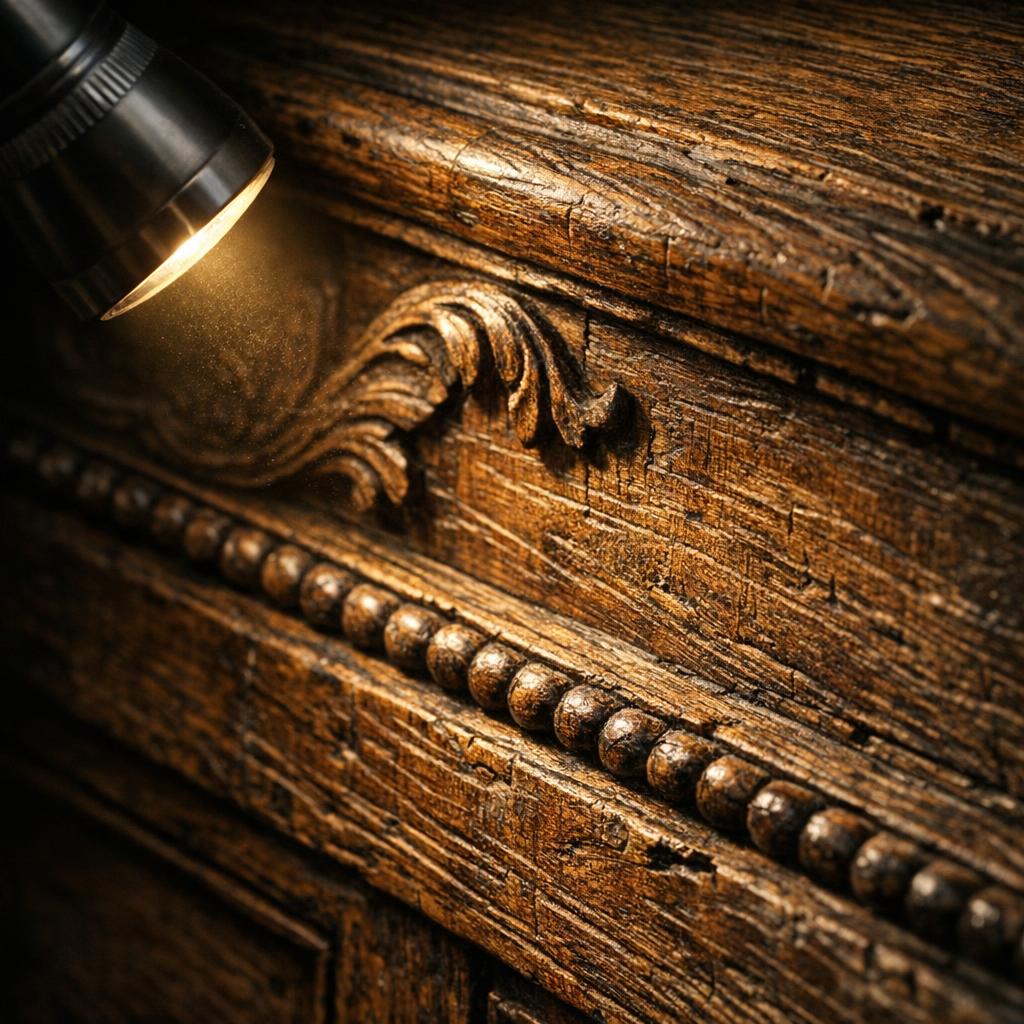
Hold a bright flashlight or your phone's LED at a very low angle (nearly parallel) to the wood surface and sweep it across. Raking light casts shadows in even the shallowest carving, stamping, or tool marks. This technique is indispensable for revealing hand-planing ridges, shallow carved initials, and saw marks that indicate the piece's age. Pre-1860 surfaces show irregular ridges from hand planes; post-1860 surfaces are typically smoother from early sanding machines.
Magnification
A 10× loupe or a smartphone macro lens attachment lets you examine the interior of carved or stamped marks. Look for:
- Tool marks inside the carving that match the period (gouge facets vs. rotary tool marks)
- Oxidation and dirt accumulation inside the mark — genuine old marks are darker inside than the surrounding surface
- Sharp, clean edges that suggest a modern laser engraving (a red flag on a supposedly antique piece)

Construction Clues That Support or Undermine a Mark
A mark alone is never enough. The piece's construction methods must be consistent with the era the mark claims. Here are the two most reliable construction indicators.
Dovetail Joints
Open a drawer and examine the corner joints. Hand-cut dovetails (pre-1860) show irregular pin sizes, slight angles between pins, and occasional miscuts. Machine-cut dovetails — a product of the industrial revolution — are uniform, symmetrical, and often quite small. A piece claiming to be from 1780 with perfectly uniform, machine-cut dovetails is almost certainly a reproduction.

Secondary Wood
Quality furniture makers used cheaper, locally available woods for interior parts that wouldn't be visible — drawer sides, backboards, and dust panels. An English Georgian chest might have oak exteriors with pine or poplar drawer interiors. An American Federal piece could feature mahogany faces with yellow pine secondary wood. If the interior wood is modern plywood, MDF, or a species that wasn't available in the claimed region and era, the piece is not period-correct regardless of the mark.
Patina vs. Refinishing: Reading the Surface
The surface finish of a piece tells its own story. Genuine patina develops over decades or centuries through handling, oxidation, light exposure, and gentle cleaning. It deepens unevenly, concentrating on edges, armrests, and other high-contact areas. The color shifts gradually — amber on oak, rich burgundy on mahogany, honey-gold on pine.
Modern refinishing — even high-quality restaining — produces a more uniform appearance. Polyurethane and modern varnishes sit on top of the wood rather than penetrating it. Under magnification, a refinished surface shows sanding marks that cut across the original tool marks, and the "patina" doesn't concentrate naturally in wear zones.
Why this matters for identification: an original surface with an intact maker's mark is far more reliable than a refinished piece where the mark may have been added during restoration. Appraisers estimate that original finish adds 30% to 50% to a piece's auction value — and the same logic applies to identification confidence.

Comparable Sales: What Marked Furniture Sells For
Real auction results illustrate the identification challenge — and the reward. Pieces with clear maker attribution consistently outperform unmarked comparables. The Chippendale desk and Pilgrim chest below both carry documented maker attribution through marks and provenance — commanding premiums of 5–10x over similar unmarked forms. See the detailed comps table further down for recent lot-level results.
Free instant estimate
Not sure if your item is worth appraising? Let us take a look.
Upload a photo, tell us what you know, and get a free first read. If a full appraisal makes sense, we will say so.
Free. No card needed. Takes about two minutes.
Quick-Reference Identification Checklist
Use this checklist the next time you examine a piece. Follow each step in order — skipping steps is the most common mistake collectors make when trying to identify furniture marks on their own.

Red Flags: When a Mark Is Likely Fake
Not every mark on an "antique" piece is genuine. The reproduction market is sophisticated, and added marks are a common way to inflate prices. Here are warning signs that should trigger skepticism:
- Too-perfect lettering. Laser-engraved marks with perfectly uniform stroke width and depth are almost certainly modern. Pre-20th-century marks show hand-tool irregularity.
- Mark sits on top of patina. If the carving or stamping is cleaner and brighter than the surrounding aged surface, it may have been added recently. Genuine marks have oxidation and grime inside the groove.
- Modern tool marks underneath. If raking light reveals circular-saw marks or router tracks beneath a supposedly hand-carved mark, the piece is later than the mark claims.
- Wrong mark type for the era. A printed paper label on a piece supposedly from 1720 is anachronistic. Paper labels didn't become common until the mid-1800s.
- Mark matches a famous maker but construction doesn't. A "Chippendale" mark on a piece with machine-cut dovetails and plywood backing is a reproduction — no matter how convincing the stamp looks.

Why Identification Matters: The 2025–2026 Market
The furniture auction market has shown renewed strength. Sotheby's reported $98 million in total sales across Furniture and Decorative Arts in 2025, and Roseberys achieved £17.7 million in consolidated hammer price — their strongest result in years. Country Living's expert panel highlighted antiques that will "skyrocket in value in 2026," with maker-attributed pieces leading the appreciation curve.
The common thread across every high-value lot: documented attribution through marks, labels, or provenance papers. A Chippendale-form desk with no maker attribution might sell for $15,000–$25,000. The same form, attributed to a documented craftsman like Calvin Willey through its marks and construction evidence, sold at Sotheby's for $576,000. Identification isn't an academic exercise — it's the single biggest value driver in the furniture market.
Active 2026 auction calendars from Denhams, Hughes, and other houses continue to show strong demand for documented pieces. If you have furniture with marks you can't identify, the opportunity cost of not investigating is real.
Note: We couldn’t find enough auction records that directly match Antique Furniture Marks: Labels, Stamps and Maker Clues to publish a defensible price table. If you are valuing a specific item, include its maker, model, material, photos, and condition so the search can be narrowed.
What similar items actually sold for
The current auction search does not contain at least three clean, directly matched sales for Antique Furniture Marks: Labels, Stamps and Maker Clues yet. If you’re valuing a specific item, use the free estimate flow so the search can be narrowed by maker, material, photos, and condition.
Disclosure: prices are shown as reported by auction houses and are provided for appraisal context. Learn more in our editorial policy.
Questions collectors often search for
These are common variations readers use when researching furniture marks:
- Where are maker's marks located on antique furniture? Usually on the underside, inside drawers, or on back panels.
- How to tell if a furniture mark is hand-carved or machine-made? Hand-carved marks show tool irregularity; machine marks are uniform.
- What does a maker's mark add to furniture value? Documented attribution can increase auction prices by 30% to several hundred percent.
- How to identify antique furniture without a mark? Study construction methods, wood species, and stylistic details as secondary evidence.
- Where to look up old furniture maker marks online? Kovels' Dictionary, Furniture History Society, and museum collection databases.
- Can furniture marks be faked or added later? Yes — check for tool mark consistency, patina age, and construction alignment.
- How to photograph furniture marks for expert review? Use raking light, include a scale reference, and shoot from multiple angles.
- What's the difference between a maker's mark and an owner's mark? Maker's marks identify the craftsman; owner's marks (often initials) were added by buyers.
Each question above is covered in the identification guide above — bookmark this page for your next piece examination.
Market context drawn from Sotheby's, Heritage Auctions, and Roseberys published results. For our full methodology, see our Editorial Policy.
Last updated: April 6, 2026 · Next review: Q3 2026