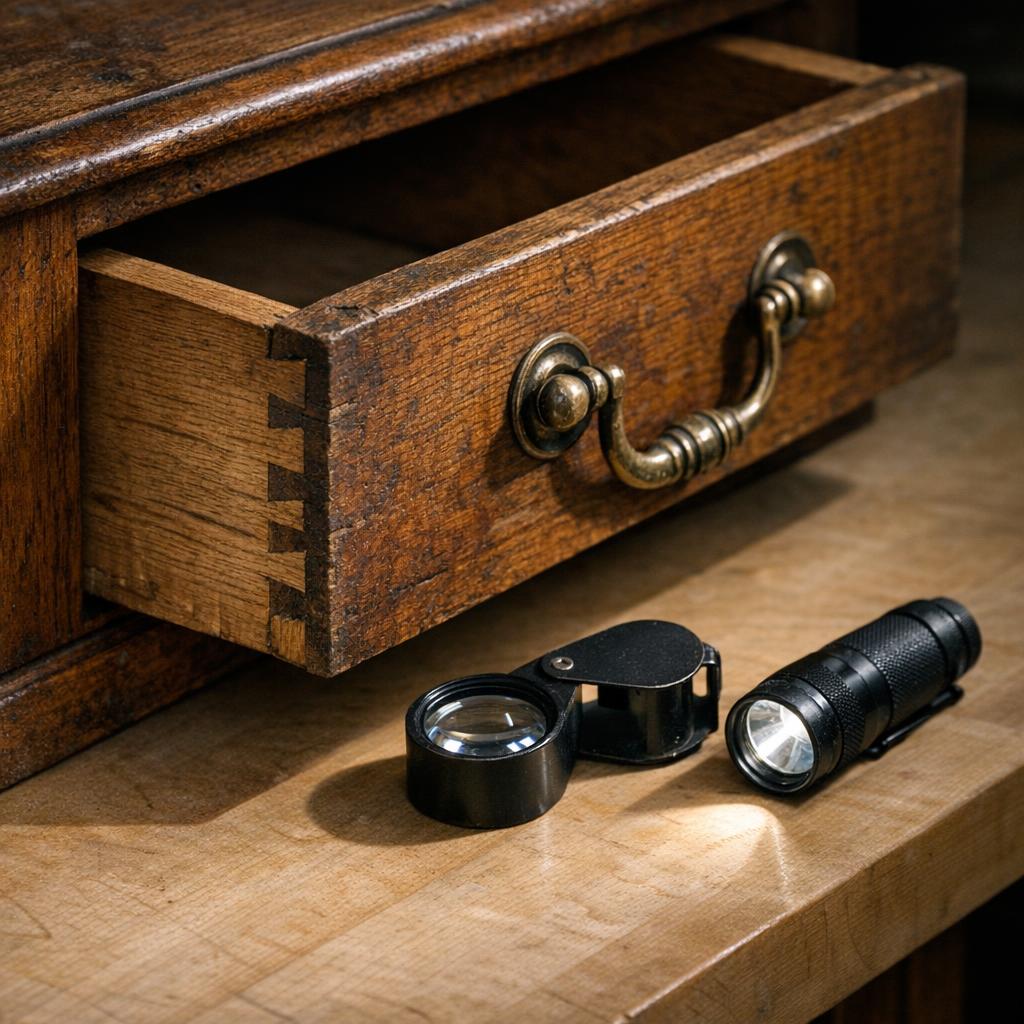
Quick answer: let the clues agree before you call it antique
Antique furniture is rarely identified by a single dramatic clue. The strongest read usually comes when the form, joinery, marks, materials, and wear pattern all point in the same direction.
That is why a hand-cut dovetail, an old retailer label, and a darkened pine back board matter more together than any one clue does on its own. If one detail looks newer than the rest, treat it as a signal to slow down and inspect the piece from the back, the bottom, and inside every drawer.
Comparable sales (examples)
These auction results show why antique furniture identification is about more than age. Original surface, honest repairs, form, and completeness all affect how the market responds.
The spread above tells the real story: a paint-decorated chest can land at $260, a better-surviving decorated chest can climb toward $775, and a complete Federal secretary bookcase can push past $1,000 when form, scale, and originality line up.
Two-step intake
Share your antique furniture details with an expert
If the marks, materials, and age clues still feel ambiguous, send photos and a few notes. We’ll route the intake into the right appraisal flow.
Secure intake. Routed to the right specialist. Checkout only if you decide to proceed.
10-minute checklist: start with raking light, then move inside
The quickest field workflow is simple. Step back, photograph the front, then check the back, underside, drawer bottoms, and the inside of any doors or drawers. The goal is to find whether the same age story appears in each place.
- Look at the form first. Does the silhouette match the period you expect, or does one leg, skirt, or cornice feel “off” for the rest of the piece?
- Use raking light. Side light highlights honest wear, later polish, sanding haze, and uneven repairs much better than overhead light.
- Open every door and drawer. Inside surfaces often preserve original tools marks, wood choice, and old labels even when the exterior has been cleaned.
- Photograph the joins. Hand-cut dovetails, pegged mortise-and-tenon joints, slip-matched veneer, and old glue lines are all useful age clues.
- Check the hardware logic. Do the screws, hinges, pulls, and escutcheons belong to the style and period—or were they swapped later?
- Record the smell of the finish, not just the look. Fresh lacquer, modern varnish, and stripped wood often betray recent work even when the design seems old.
That checklist works because antique furniture rarely gets everything replaced at once. The front may be refinished, but the back still carries old nails; the pulls may be later, but the drawer construction remains period-correct. That kind of mismatch is the clue to study, not the exception to ignore.
What marks really tell you: labels, stamps, chalk, and numbers
Marks are useful, but they are not magic. A retailer label, maker’s stamp, or pencil number tells you something specific about a piece, not everything about it.
Old paper labels can survive inside drawer sides or on the back of a case. Stamped brands or burn marks may identify a maker or retailer. Chalk numbers and penciled inventory marks are often assembly, shop, or sale marks, so they should be read with caution. A patent date or trade label can help you bracket the earliest possible age, but it does not automatically prove the whole piece was made at that date.
- Paper labels: Great for attribution when they match the wood, glue, and wear around them.
- Brands and stamps: Often found on drawer sides, backs, or underside rails.
- Pencil numbers: Useful for shop records, but easy to misread as a date.
- Retail tags: Helpful for provenance when they’re clearly old and in the right place.
If the mark looks much newer than the surrounding wood, treat it carefully. A label can be authentic while the rest of the piece is later, and a later replacement label can be aged to look convincing. The safest approach is to let the mark support the structural evidence, not replace it.
Materials and construction: wood, joints, backs, bottoms, and hardware
Once you know where to look, the construction almost always gives the game away. Wood species, board thickness, secondary woods, and joinery habits often line up with a region or period more reliably than style alone.
What to inspect
- Joinery: Hand-cut dovetails are irregular; machine-cut dovetails are usually more uniform and repetitive.
- Secondary wood: Drawer sides, bottoms, and backs may use cheaper local woods that help narrow date and place.
- Back boards: Old backs can show saw marks, shrinkage gaps, and hand-planing that modern replacements usually lack.
- Fasteners: Slotted screws, square nails, and hand-forged hardware can be period clues, but many have been replaced.
- Veneer and inlay: Thin, old veneer and worn glue lines are useful; thick modern veneer or new edge banding is not.
Antique furniture identification gets easier when you compare the visible construction with the hidden construction. A chair may look 18th century from the front, but a plywood seat, uniform dowels, or bright zinc screws in the hidden joints tell a different story. That’s why the back and underside matter so much.
Original hardware can also be persuasive, especially when the screw slots, oxidation, and wear all match the surrounding wood. But hardware is frequently moved between pieces, so treat it as corroborating evidence rather than proof on its own.
Age clues: wear, finish, saw marks, shrinkage, and honest repairs
Real age shows up in patterns. Wear develops where hands touch, drawers slide, doors swing, and knees or toes brush past edges. Old finishes darken unevenly and thin at the corners first. Boards shrink and move over time, leaving gaps that make sense only when the piece has been around for decades.
Machine saw marks tend to look different from hand-planed or pit-sawn surfaces. The key is to compare the back, inside, and hidden areas rather than judging only the face. A newly sanded top can erase evidence that would have helped you date the piece, which is why over-cleaning is such a common mistake.
Honest repairs are normal. Replaced glue blocks, an old patch, or a sympathetically repaired leg do not automatically kill value. The trouble begins when repairs are made to look original, or when later work is so extensive that the surviving antique is mostly just a shell.
Common mistakes that lead to bad identifications
Most misidentifications happen when someone leans too hard on style or one shiny detail. Here are the traps we see over and over.
- Assuming style equals age. A Chippendale shape can be 20th-century revival work.
- Trusting a label alone. Old labels can be moved, replaced, or copied.
- Confusing patina with grime. Dirt is not the same thing as original surface.
- Ignoring the back and underside. That’s where the honest evidence usually survives.
- Overvaluing repairs. A structurally sound repair is better than a total loss, but it still matters.
- Cleaning too aggressively. A fast refinish can destroy the age clues you needed most.
One of the easiest mistakes is to see a familiar period style and fill in the blanks from memory. If a piece has a Chippendale drawer front but modern screws, later boards, and a sprayed finish, the style is only telling you that someone liked the old look—not that the piece was made in the 18th century.
Visual reference gallery
These generated details show the kinds of clues you should train your eye to spot before you make a call.
When to get a pro appraisal or send photos
If the piece is valuable, unusual, or still unclear after a careful inspection, the best next step is to pause and get a second set of eyes. The right specialist can sort period work from later revival furniture, separate honest restoration from over-restoration, and help you understand whether the marks actually matter.
That is especially important when the item may need insurance, sale, donation, or estate documentation. A quick written opinion is cheaper than a bad cleanup, a wrong listing, or a missed maker attribution.
FAQ
What is the fastest way to identify antique furniture?
Start with the underside, drawer interiors, and back panels under raking light. If the construction, marks, and wear all agree, you’re usually close.
Are labels enough to prove a piece is antique?
No. Labels help, but they should match the joinery, wood, fasteners, and finish. A label without structural support is just one clue.
How do I tell a reproduction from a true antique?
Look for uniform machine work, modern screws, plywood or MDF, and over-even wear. Reproductions often mimic style better than construction.
Should I clean antique furniture before an appraisal?
Not aggressively. Light dusting is fine, but avoid refinishing or polishing until you know whether the surface is original and valuable.
What photos should I send if I’m still unsure?
Send the front, back, underside, drawer bottoms, hardware close-ups, labels, and any damaged or repaired areas. The hidden surfaces usually settle the question.
Long-tail search variations
These are the kinds of questions people ask after they’ve checked the obvious clues. Use them as a quick recap of the advice above.
- How do I tell if antique furniture is really old?
- What marks should I look for inside antique drawers?
- How can dovetails help date antique furniture?
- Does original paint lower the value of antique furniture?
- What screws or nails prove an antique is original?
- How do I tell a reproduction from a true antique?
- Should I clean antique furniture before appraisal?
- When is a repaired antique still valuable?
References
- Appraisily internal auction results database, used for the comparable sales examples above.
- Appraisily editorial policy for sourcing and update standards.
- Metropolitan Museum of Art and Victoria and Albert Museum furniture collections for general period-reference study.