Need A Local Appraiser Near You?
Compare in-person appraiser directories in high-demand cities, or browse all locations if you want nearby options.
Searching for "antique appraiser near me" usually means you have a real-world deadline: insurance paperwork, estate inventory, a potential sale, or a family heirloom you don't want to guess on.
This guide helps you choose the right kind of appraiser (local vs. remote), understand what drives fees, and prepare the photos and details that make an appraisal defensible—not just a quick opinion.
If you only do five things:
- Pick the goal: insurance replacement, fair market value, or liquidation.
- Photograph the whole piece and the evidence (marks, joinery, repairs, damage).
- Measure accurately (overall size; for art, image size vs. framed size).
- Write down the backstory you do have (where it came from, any receipts, family notes).
- Choose a specialist by category (furniture vs. silver vs. paintings vs. watches).
Free instant estimate
Not sure if your item is worth appraising? Let us take a look.
Upload a photo, tell us what you know, and get a free first read. If a full appraisal makes sense, we will say so.
Free. No card needed. Takes about two minutes.
What an antique appraiser actually does
A qualified antique appraiser doesn't just "name a price." They identify what you have, document condition and originality, and then support the conclusion with market evidence. If you need the result for an insurer, attorney, or tax file, the writing and the definitions matter as much as the dollar figure.
- Identification: material, era, maker marks, construction details, and known patterns.
- Condition assessment: repairs, replacements, restoration, and stability issues that impact value.
- Market research: comparable auction results and (when appropriate) retail listings.
- Written reporting: scope of work, value definition, effective date, and supporting notes.
Know your value type (it changes the number)
Two appraisers can be equally competent and still produce different values because they are answering different questions. Always confirm the standard of value before you book.
- Insurance replacement: what it costs to replace with a comparable item at retail (often higher than auction).
- Fair market value (FMV): commonly used for taxes/donations and some estate contexts.
- Liquidation / auction estimate: what you might net via a fast sale path.
How to find a reputable antique appraiser near you
- Start with specialty, not distance. Search by category (furniture, silver, watches, Asian ceramics), then narrow to your city.
- Verify training and ethics. Ask if they are USPAP-aware/compliant when required, and whether they belong to ASA/ISA/AAA.
- Confirm conflicts of interest. Dealers can appraise, but you want disclosure and a written scope if they also want to buy.
- Ask for a report outline. You want value definition, effective date, photos, and a comparison narrative.
- Match the service to the job. Estates and collections often need inventory and grouping, not one number.
Questions to ask before you book
- What value definition will the report use (insurance replacement vs FMV vs liquidation)?
- Do you specialize in my category (furniture, silver, paintings, watches, etc.)?
- What evidence will you cite (comparable-sale records, retail listings, catalogs)?
- How do you handle restorations or altered parts in the value narrative?
- How do you charge (hourly, per item, or project fee) and do you avoid share-of-value pricing?
- Will I receive a written report that I can use for insurance/estate/taxes?
How much does an antique appraisal cost?
Fees vary by region and complexity. Most professional work is priced hourly, per item, or as a flat project fee for estates. Be cautious of pricing that is a share of value (many ethics codes discourage it).
The practical way to compare quotes is not just price, but what you receive: is it a written report, a verbal opinion, a brief memo, or a photo-based estimate? If your use-case is insurance or legal, the deliverable matters.
- Single item (remote, photo-based): often lower cost when documentation is strong and condition is clear.
- In-home inspection: travel time and detailed condition checks can increase fees.
- Estate inventory: typically a project quote (time on-site + research + reporting).
Local vs. remote: when in-person matters
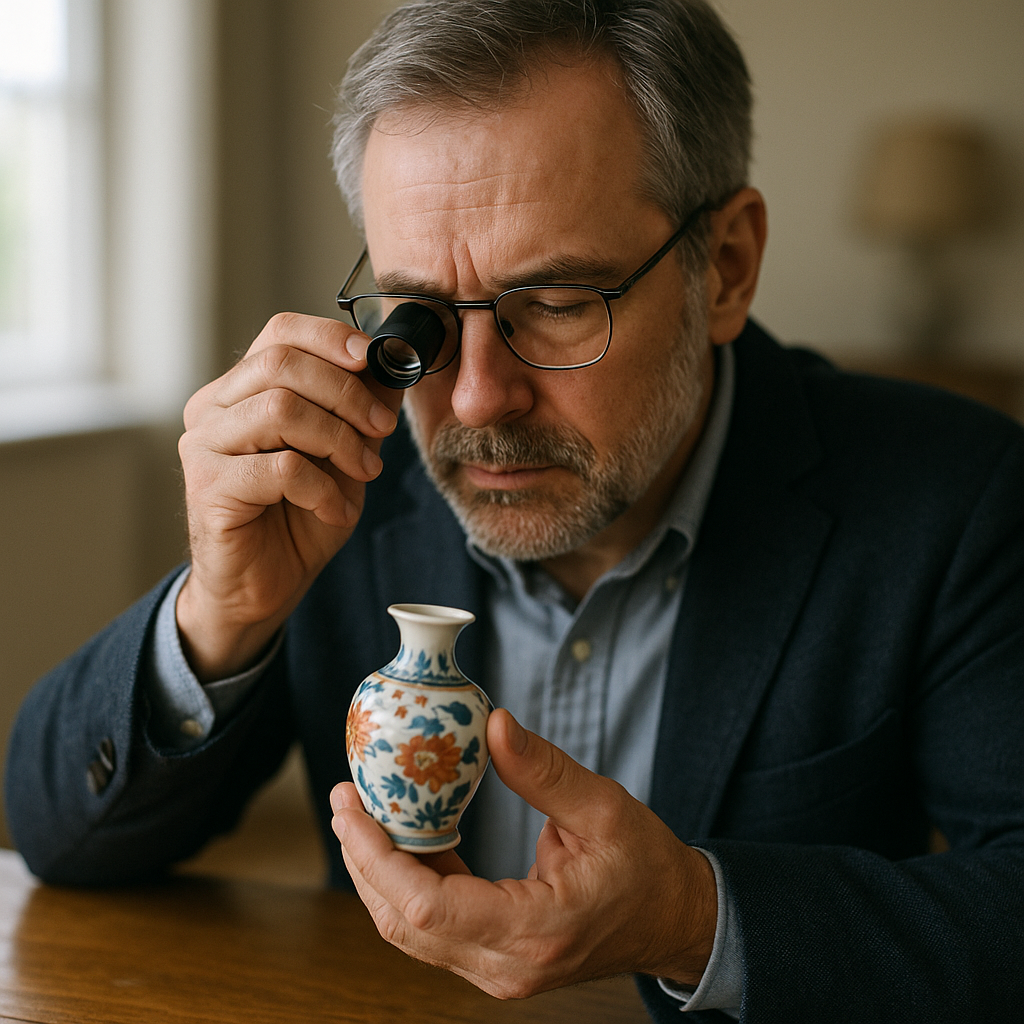
Remote appraisals can be excellent for many items if photos are strong. In-person inspection matters most when material and condition are the primary value drivers: unstable furniture, heavy restoration, repaired ceramics, or high-value pieces where a microscope-level look at marks and surfaces changes the conclusion.
- In-person recommended: fragile media, disputed originality, complex repairs, unclear maker marks.
- Remote often fine: well-photographed mid-tier pieces, many prints/multiples, clearly marked silver.
Prep checklist (so the appraiser can work fast)
- Photograph: full views + closeups of marks, joinery, repairs, and damage.
- Measure: overall dimensions (and for art: image size vs framed size).
- Document: how you acquired it, any receipts, family notes, or prior appraisals.
- Don't clean aggressively: patina and original finishes matter; ask before any restoration.
Photo guide: detail shots that change value
Appraisers price specific objects. The fastest way to get a reliable result is to send evidence photos that support material, age, and condition. Use this gallery as a checklist for what to capture.
Search variations collectors ask
Readers often Google:
- how to find a certified antique appraiser near me
- antique appraiser near me for estate inventory
- in-home antique appraisal cost near me
- what to ask an antique appraiser before hiring
- antique furniture appraiser near me reputable
- silver appraiser near me for hallmarks and value
- insurance replacement value vs fair market value antiques
- online antique appraisal vs in-person inspection
- how to document antiques for insurance schedule
Each question is answered in the guide above.
Key takeaways
- Choose a specialist by category first, then narrow by geography.
- Confirm the value definition and effective date in writing before work begins.
- Strong photos (marks, joinery, condition) are often the difference between a guess and a defensible appraisal.
- Market evidence only work when the item is identified precisely and condition is documented.
References & data sources
- Appraisal Foundation (USPAP overview): https://appraisalfoundation.org/uspap
- American Society of Appraisers (ASA): find an appraiser: https://www.appraisers.org/find-an-appraiser
- International Society of Appraisers (ISA): find an appraiser: https://www.isa-appraisers.org/find-an-appraiser
- Appraisers Association of America (AAA): directory: https://www.appraisersassociation.org/
- IRS Publication 561 (fair market value guidance for donations): https://www.irs.gov/publications/p561
- Auction datasets cited in-text: Neal Auction Company (Lot 106, 2018-07-14), Freeman's | Hindman (Lot 25, 2024-09-13), Swann Auction Galleries (Lot 707, 2021-11-03).