An American Empire Style Furniture Set Composed of Rocking Chair and Parlor Sofa Circa Early Mid 20th Century: appraisal and value basics
An American Empire Style Furniture Set Composed of Rocking Chair and Parlor Sofa Circa Early Mid 20th Century research should start with identification, condition, provenance, and item-specific market evidence. Use this guide to compare the signals that matter before paying for a formal appraisal or deciding whether to sell.
If your family has an “Empire-style” parlor sofa paired with a rocking chair (often upholstered, carved, and heavy), you’ll usually run into a common valuation problem: the style name is older than the furniture. Most examples like this are Empire Revival (late 19th to mid 20th century) rather than true early-1800s American Empire.
This guide shows you how to confirm whether your set is an early–mid 20th century revival, what details move the value up or down, and how to choose a selling channel that matches furniture of this size (local pickup vs. shipping).
Quick ID checklist: what “American Empire style” looks like
Empire style is a French-inspired Neoclassical look that became popular in the U.S. in the early 1800s. Revival pieces usually borrow the same motifs, but with later construction methods.
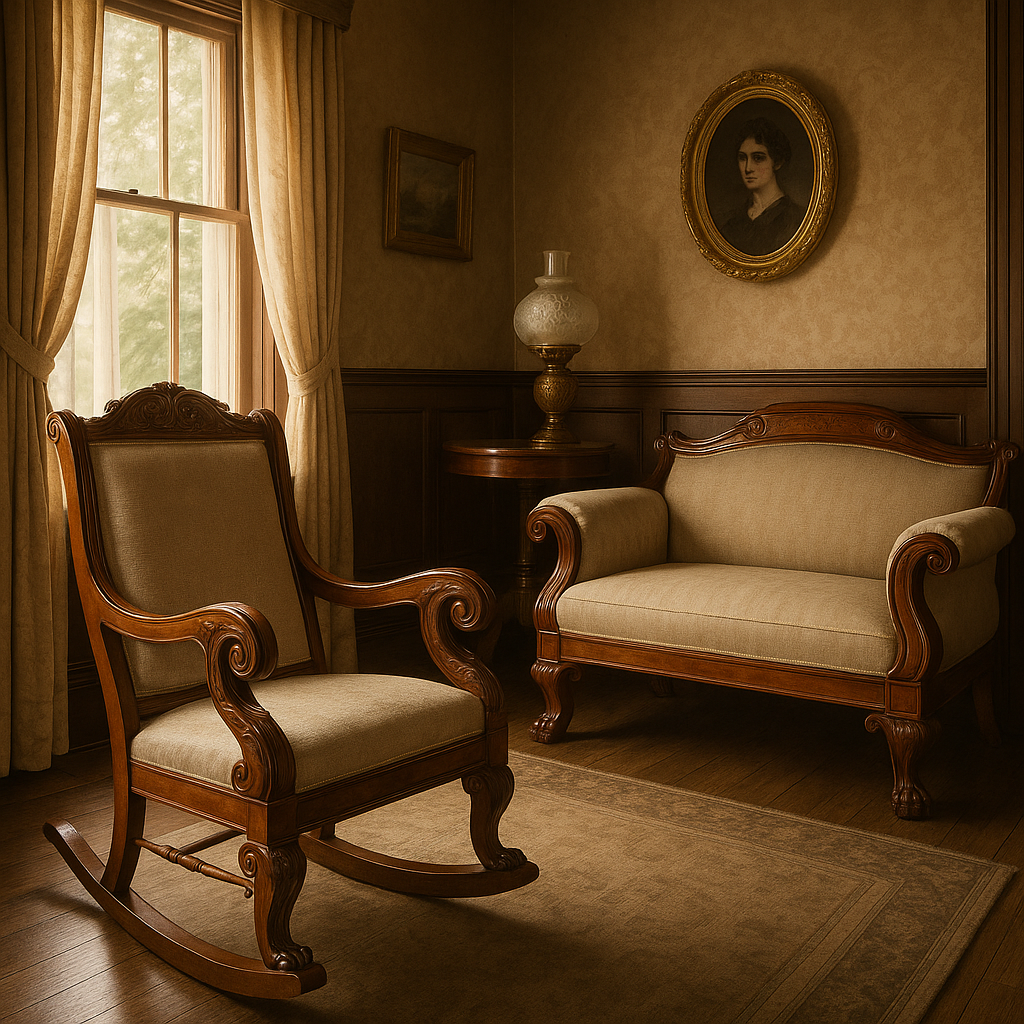
- Classical symmetry: balanced arms/legs and a “monumental” silhouette rather than delicate curves.
- Scroll or rolled arms: sometimes in a tight spiral with applied rosettes.
- Paw feet: animal-paw terminals (sometimes with claw detail) or heavy scroll feet.
- Column-like legs: turned or reeded supports meant to read as classical columns.
- Anthemion/rosette carving: leaf motifs, star bursts, and other neoclassical ornament.
- Gilded accents on some examples: painted highlights meant to mimic aged bronze (“vert antique” green/bronze effects can appear on higher-end work).
How to date a set to the early–mid 20th century (vs. early 1800s)
True American Empire furniture (circa 1815–1845) tends to show different construction habits than revival sets made for parlors in the 1900s–1950s. Here are the fastest “tell” photos to take:
- Underside framing: look for sawn lumber with more uniform milling (revival) vs. irregular early boards and older joinery habits (period pieces).
- Fasteners: later screws, staples, and newer upholstery tacks usually indicate reupholstery and/or later manufacturing.
- Upholstery foundation: early pieces often used webbing + hand-tied springs + natural stuffing; mid-century work often shows more standardized spring units or later padding replacements.
- Hardware marks: replacement casters, modern brackets, or later corner blocks are common on revived/used seating.
It’s normal for a genuine early 20th century suite to be “Empire style” rather than truly early Empire. The style label affects value mainly because collectors pay differently for period vs. revival work.
Materials: oak vs. mahogany (and why a “set” can mix woods)
Many owners notice what you’ve described: the parlor sofa looks like oak, while the rocking chair reads as mahogany. That can happen for a few reasons:
- Coordinated, not matched: some households built a “suite” by purchasing complementary pieces over time rather than a single factory set.
- Different core woods + stained finish: oak, birch, or poplar can be stained to resemble mahogany; a close-up of end grain helps confirm.
- Veneers and applied moldings: higher-end pieces may use veneer faces over a secondary wood frame.
For valuation, wood species matters most when the piece is either (a) truly period, (b) attributed to a known maker, or (c) exceptionally well carved. For most early–mid 20th century Empire Revival suites, condition and visual impact matter more than the exact species.
Condition checklist (the fastest value movers)
When two pieces are sold together, the set is usually valued to the weaker link. Check these items before setting a price:
- Frame stability: rocking chair runners tight and even; sofa joints not racked.
- Carving loss: chipped paws, broken rosettes, missing appliqués, or over-sanded details.
- Finish: heavy stripping/refinishing can reduce collector interest; light wear and patina can help.
- Upholstery: stains, odors, sun fading, or foam breakdown can force a buyer to budget reupholstery.
- Active wood issues: powdery frass, fresh holes, or soft spots that suggest infestation or rot.
A practical way to think about upholstery: if a buyer needs to spend a value that must be established from current, topic-matched sales on reupholstery, they will often want the frame cheap unless the carving or maker attribution is exceptional.
Value range: what to expect (and why it varies)
For an early–mid 20th century American Empire Revival rocking chair + parlor sofa suite, values typically fall into three different bands depending on selling channel and how ready-to-place the upholstery is:
- Quick sale / local pickup (as-is): often a value that must be established from current, topic-matched sales for the pair.
- Private sale with good photos + clean upholstery: often a value that must be established from current, topic-matched sales for the pair.
- Insurance / replacement framing: can be higher (commonly a value that must be established from current, topic-matched sales+) because it reflects retail sourcing and delivery.
As a reality check, a legacy professional appraisal for a similar Empire-style suite placed an as-is value around a value that must be established from current, topic-matched sales for both pieces together. That sits comfortably inside the typical “quick sale” band above.
How to sell an Empire Revival sofa + rocking chair set
The biggest constraint with seating is logistics. Your best channel depends on whether you can deliver locally and whether the upholstery is buyer-ready:
- Local marketplace pickup: best for fast sales; photograph the underside, joints, and any labels to reduce “is it sturdy?” messages.
- Consignment: useful when the pieces are visually strong and clean; ask about delivery fees and commission up front.
- Auction: can work if the suite is carved, unusual, or attributed; otherwise, bulky seating can underperform when buyer shipping is complex.
Before listing, measure width, height, and seat depth, and note whether the sofa can be moved safely (tight staircases can limit buyers).
Care tips that protect value
- Clean gently: dust carvings with a soft brush; avoid soaking old finishes.
- Stabilize before moving: don’t lift by arms; support the frame under the seat rails.
- Keep out of direct sun: UV damages finish and upholstery faster than most owners expect.
- Document repairs: if you tighten joints or refinish, keep photos and receipts for transparency.
FAQ
Is “Empire Revival” less valuable than true American Empire?
Usually, yes—period furniture has different collector demand and scarcity. Revival pieces can still be valuable, but they are typically priced more as decorative furniture unless made by a recognized maker.
Does reupholstery ruin the value?
Not necessarily. Many buyers prefer clean, neutral upholstery. Value drops when reupholstery changes the profile (overstuffing) or when it hides structural problems.
Do mixed woods (oak sofa + mahogany rocker) mean it’s not a real set?
It may still be a coordinated suite from the same period, but it’s common for families to assemble matching-by-style pieces over time. Mixed woods can also be the result of stain/finish differences.
What photos are most helpful for an appraisal?
Front, side, and back views; closeups of feet and arms; underside construction; any labels/stamps; and upholstery foundation (springs/webbing) if accessible.
Search variations collectors ask
Readers often Google:
- American Empire Revival parlor sofa value
- how to identify Empire style rocking chair paw feet
- oak parlor sofa with carved scroll arms appraisal
- mahogany Empire style rocker early 20th century value
- Empire Revival furniture set worth selling or donating
- how to date Empire style upholstered sofa by underside
- insurance replacement value for parlor sofa and rocker
- best way to sell heavy antique sofa local pickup
Each question is answered in the valuation guide above.
Key takeaways
- Most “Empire style” parlor sets are early–mid 20th century Empire Revival, not early-1800s American Empire.
- Condition and upholstery readiness usually move value more than the exact wood species.
- Expect lower auction outcomes for bulky seating; private sale and insurance values can run higher.
- Photograph underside construction, feet, and carving to match your pieces to the right market evidence.
References
- Empire style overview and common motifs (columns, rosettes, anthemion/leaf ornament) drawn from standard decorative arts history references.
- comparable-sale evidence dataset entries cited in-text (Brunk Auctions; Pook & Pook Inc.; Bonhams; Crow’s Auction Gallery Ltd).