
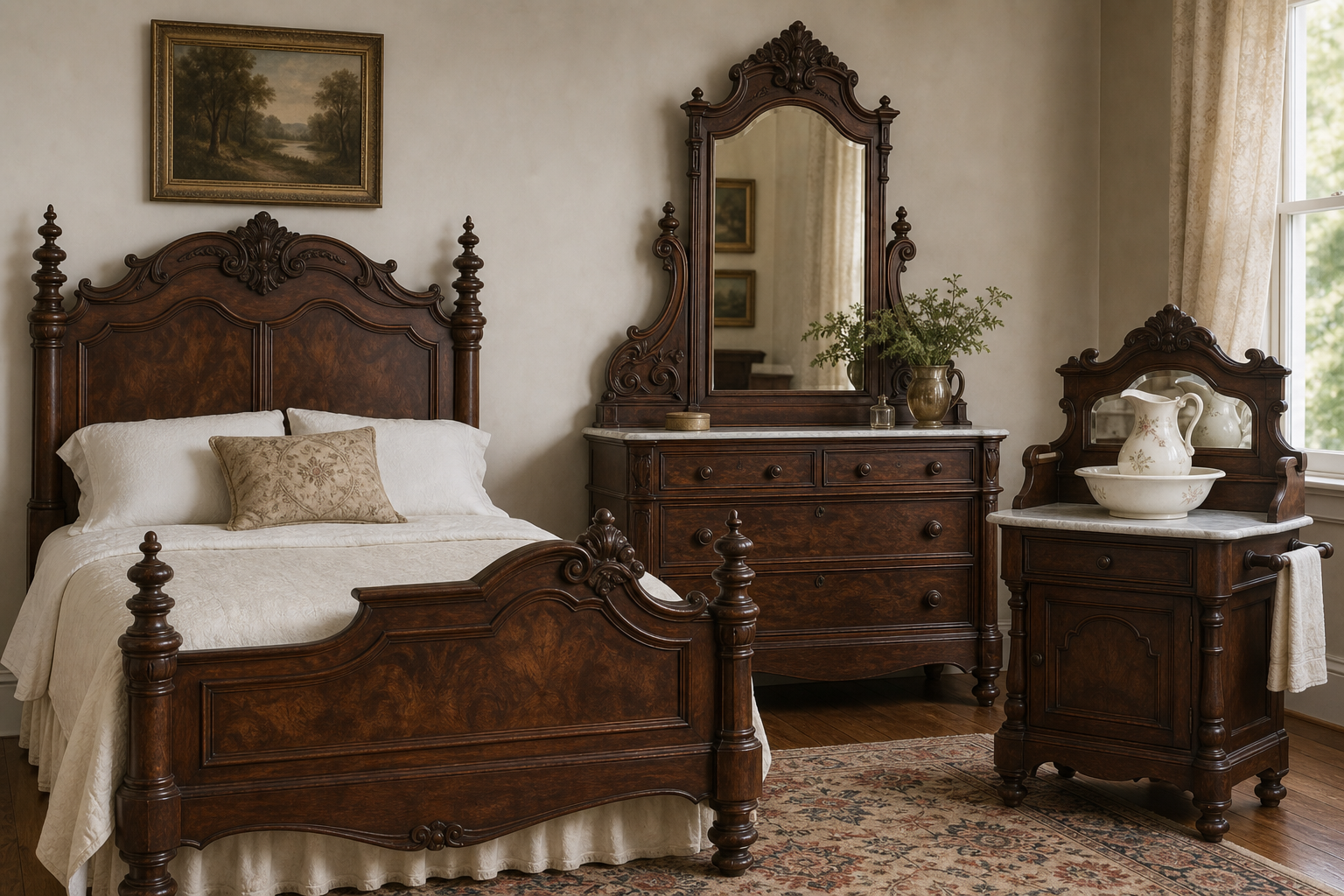


Antique Walnut Bedroom Set From Circa 1885 Victorian Era: appraisal and value basics
Antique Walnut Bedroom Set From Circa 1885 Victorian Era research should start with identification, condition, provenance, and recent comparable sales. Use this guide to compare the signals that matter before paying for a formal appraisal or deciding whether to sell.
1885 Victorian Walnut Bedroom Set Value Guide: Style and Condition
Antique walnut bedroom suites from around 1885 occupy a sweet spot in Victorian furniture: richly detailed yet increasingly geometric and restrained, well-made but often produced in sophisticated factories, and still widely available enough to study closely. For appraisers, dealers, and advanced collectors, this period offers clear stylistic and construction markers that make identification, authentication, and valuation both practical and precise. This guide distills the key features to look for and how those features affect market value today.
What Defines a Circa-1885 Walnut Bedroom Set
By the mid-1880s, American and British makers were transitioning from the more curvaceous Renaissance Revival forms of the 1860s–1870s to the angular, incised, and geometric Eastlake and Aesthetic Movement vocabulary. A typical walnut bedroom “suite” of this era commonly includes:
- A bedstead (usually full-size or three-quarter)
- A dresser/bureau with a tilting mirror (often marble-top)
- A washstand/commode (frequently marble-top, with a towel bar)
Higher-end suites may add a shaving stand, wardrobe/armoire, or a second dresser. “Walnut” refers most often to American black walnut (Juglans nigra) employed as solid framing and veneer; burl walnut veneers appear on drawer fronts, headboards, and mirror frames. Secondary woods are typically poplar, white pine, or other local softwoods.
Expect:
- Applied cresting on the headboard and mirror
- Incised linear ornament, chamfers, modest chip carving, and ebonized accents (Eastlake influence)
- Geometric brass hardware with sunburst or stylized floral motifs
- Shellac finishes, sometimes French-polished on show surfaces
- Porcelain or brass casters
Color typically reads as medium to dark brown today, often darkened by oxidized shellac and accumulated patina rather than stain alone.
Construction Details and Dating Clues
Construction details are the strongest indicators for authenticating and dating circa-1885 furniture. Focus on the following:
- Drawer joinery: The “Knapp joint” (also called pin-and-cove or scallop-and-dowel) is a hallmark dating tool. Patented in 1867 and common from the 1870s into the 1890s, it appears as semicircular pins interlocked with coved sockets. If you see clean machine-cut dovetails instead, dating can still be 1880s, but the Knapp joint is a particularly persuasive 1870–1900 indicator. Hand-cut dovetails would more likely suggest earlier, or a high-end shop deliberately using traditional joinery.
- Secondary woods: Poplar or white pine is typical for drawer sides and backs; species identification supports region. Walnut veneer over a poplar carcase is normal.
- Saw and tool marks: Circular saw marks dominate by the 1880s. Hand-plane chatter on interior surfaces is less common than earlier decades. Machine uniformity becomes standard.
- Screws and nails: Machine-made screws with gimlet points are expected in this period. Cut nails might appear in backboards or drawer bottoms, but wholesale use of hand-forged screws would be anachronistic.
- Bed rails and fasteners: Look for bolt-through bed rails with iron or brass nuts, or iron hook-and-pin hardware mortised into the rail ends. Both are consistent with the era.
- Backboards and bottoms: Dresser backs use vertical boards or large panels; drawer bottoms slide into grooves, often running front-to-back.
- Glue: Hot animal (hide) glue is standard. Evidence of modern PVA glue squeeze-out indicates later repairs.
- Finish: Shellac is nearly universal. Alligatoring, crazing, or a warm amber underlayer is a good sign. Varnish appears more often on later replacements or overcoats.
Labels and marks can be decisive. Look for stenciled numbers, paper labels, or stamped plates on the back of mirrors or drawer cases. American firms to watch include Mitchell & Rammelsberg (Cincinnati), Berkey & Gay (Grand Rapids), Paine’s (Boston), and other regional shops. Hardware might be stamped by Eagle Lock Co. Part numbers chalked or penciled on concealed surfaces often match case elements to a suite, supporting originality.
Stylistic Markers: Eastlake to Aesthetic
The period around 1885 sits solidly within the Eastlake-influenced phase of Victorian design, with some Aesthetic Movement crosscurrents. Diagnostic stylistic cues include:
- Incised lines and shallow, geometric carving rather than deeply sculpted foliate forms
- Chamfered corners and rectilinear framing
- Ebonized stringing or accents on edges and panels
- Square, faceted elements and turned pulls with flats
- Brass pulls with rectangular or square backplates, often engraved or stamped with rosettes, fans, or sunbursts
- Cresting that is crisp and pierced, but generally more geometric than rococo
- Veneer panels that are bookmatched burl walnut, sometimes framed with inlaid lines (boxwood/maple)
Earlier Renaissance Revival suites display heavier scrollwork and bombe curves; later Colonial Revival moves toward mahogany and simpler classical lines. If your set is walnut with restrained geometric ornament, a medium-high headboard with a pierced but angular crest, and incised lines on drawer fronts, 1880–1890 is likely.
Components and Typical Dimensions
While dimensions vary by maker and region, the following ranges are common for circa-1885 walnut suites:
Bedstead:
- Size: Three-quarter (approx. 48–50 in wide) or full/double (approx. 53–54 in wide). Queen-size is rare in original form; conversions are common.
- Headboard height: 60–78 in, with cresting.
- Rail-to-rail length: around 74–76 in inside length for original slat systems.
- Rails: 5–7 in high with mortised hardware; wooden slats and center support are typical.
Dresser/Bureau:
- Width: 38–52 in
- Depth: 18–22 in
- Height to top: 30–35 in, plus mirror frame and crest
- Mirror: Tilting between “harp” uprights; marble top is common, typically white Carrara or Tennessee brown marble, 3/4–1 in thick with an ogee or bevel edge.
Washstand/Commode:
- Width: 28–36 in
- Height: 27–33 in
- Features: One or two short drawers above a cupboard, often with an interior shelf; towel bar(s) at back or sides; marble splashback sometimes present.
Casters:
- White porcelain, brown stoneware, brass, or nickel-plated casters fitted into sockets. Missing or mismatched casters are a frequent condition issue.
Hardware:
- Drawer pulls in stamped brass with geometric motifs are most typical; wood pulls less common by the mid-1880s. Key escutcheons in brass or ebonized wood. Many drawers were originally lockable; check for working locks and the presence (or absence) of keys.
Condition, Restoration, and Conservation
Condition drives value in Victorian furniture more than almost any other factor, especially for suites that derive part of their value from completeness and matched veneer figure.
Common condition issues:
- Veneer losses and patches, especially on burl panels and drawer fronts.
- Detached or reglued cresting; missing finials.
- Replaced marble tops (thickness, edge profile, and under-staining help determine originality).
- Over-stripped or heavily stained finishes that obscure grain; silicone contamination from spray polishes.
- Bed conversions that cut or widen original rails; added metal brackets.
- Replaced hardware with period-incorrect pulls.
Conservation-minded approaches:
- Clean first: Use mineral spirits or naphtha to remove wax and grime; stop if you see color lifting. Avoid water-based cleaners.
- Preserve shellac where present: Shellac can often be re-amalgamated with alcohol and padded out (a French-polish technique) to level crazing without stripping.
- Veneer repairs: Use hot hide glue for reversibility; match grain and figure carefully. Clamp with cauls; avoid excessive heat on burl.
- Marble care: Test dye/stain in an inconspicuous area. Poultice for stains; avoid aggressive grinding. Loose marble sits on a wood sub-top—rebed with appropriate blocks and pins if needed.
- Hardware: Maintain original patina; clean gently. If replacement is necessary, choose high-quality period-style hardware and retain originals in a labeled bag.
- Beds: For conversions, use adapter rails or bolt-on extenders that are mechanically reversible and do not cut original components. Keep all original slats and hardware with the piece.
Re-finishing:
- Full strip-and-refinish reduces value unless the existing finish is unsalvageable. If refinishing is unavoidable, use shellac and wax rather than polyurethane; aim for a period-correct luster.
Market Value, Rarity, and Buying/Selling Tips
Market dynamics for “brown furniture” have been soft for years, but quality and completeness still command interest. Values vary by region, condition, and design quality.
Indicative retail ranges (2025):
- Typical 3-piece walnut Eastlake suite (bed, dresser, washstand) in very good original condition: $1,800–$4,500
- Exceptional matched sets with superior burl, crisp incising, original marble, and documented maker: $4,500–$8,500+
- Mixed or incomplete sets, minor issues: $900–$1,800
- Single pieces: bed $300–$900; dresser $600–$1,800; washstand $250–$700
Factors increasing value:
- Documented maker/retailer label or stencil; Grand Rapids and Cincinnati makers are sought after.
- Strong veneer patterns, especially bookmatched burl panels.
- Original marble tops with period edge profiles and uniform aging.
- Retained finish with attractive patina, minimal over-cleaning.
- Full suite with consistent hardware and matching chalk/stencil numbers.
Factors reducing value:
- Non-reversible bed conversions; cut rails.
- Over-stripped, stained, or polyurethane-coated surfaces.
- Replaced hardware and marble that is obviously modern.
- Missing cresting, extensive veneer loss, heavy water damage.
- Mismatched components assembled into a “marriage.”
Logistics note: Shipping large suites is costly; local markets often dictate price ceilings. Professional disassembly and careful packing of marble are essential. When selling, clear photographs of joinery, backs, labels, and underside details help realize stronger prices by proving authenticity and originality.
Field Checklist for Appraisers and Collectors
- Identify style: Look for Eastlake incised lines, geometric pulls, ebonized accents, pierced but angular cresting.
- Inspect joinery: Check drawers for Knapp joints or machine-cut dovetails; note consistency across the suite.
- Confirm woods: Walnut primary; poplar/pine secondary. Note burl veneer placement and figure.
- Hardware audit: Are pulls, escutcheons, and casters consistent and period-appropriate? Retain any replaced originals.
- Finish assessment: Shellac present? Alligatoring/patina vs. heavy re-stain. Avoid silicone-laden shine.
- Marble verification: Thickness, edge profile, underside patina, and fit to sub-top. Do pieces match across the suite?
- Structural integrity: Bed rail hardware intact; slats original; mirror supports tight with functional pivots.
- Evidence of alteration: Bed conversions, cut rails, modern screws, filled holes indicating hardware changes.
- Labels and marks: Paper labels, stencils, pencil/chalk assembly numbers, lock maker stamps.
- Measurements: Bed inside width/length, dresser and washstand dimensions. Note three-quarter vs. full width.
- Provenance: Family history, shipping tags, photos, invoices—anything that ties the suite together over time.
FAQ
Q: Is an Eastlake walnut bedroom set considered “Victorian”? A: Yes. Eastlake and Aesthetic styles are late-Victorian subsets. A circa-1885 walnut suite with incised, geometric detailing sits firmly within the Victorian era, specifically its later phase.
Q: How can I date my drawers—are Knapp joints a sure sign of the 1880s? A: The Knapp or pin-and-cove joint is a strong indicator for roughly 1870–1900, peaking in the 1880s–1890s. It’s not exclusive to the 1880s but is excellent corroboration when combined with Eastlake styling and machine-made hardware.
Q: Will refinishing destroy value? A: Over-stripping and modern glossy finishes typically lower value. If the original shellac can be conserved or re-amalgamated, that’s preferable. Necessary refinishing should use shellac and wax, preserve color, and avoid sanding through veneer.
Q: Can I convert a three-quarter bed to a queen without hurting value? A: Use reversible adapter rails or a bed frame that hooks into existing hardware, preserving original rails and slats. Avoid cutting or widening original components. Keep all original parts with the bed; document any alterations for future owners.
Q: How much does a replaced marble top affect value? A: A well-matched period marble replacement with appropriate thickness and edge profile has a modest impact; obviously modern stone, mismatched color, or poor fit reduces value more significantly. Original marble across the suite remains a premium feature.
With a measured eye on joinery, secondary woods, hardware, finish, and stylistic vocabulary, most walnut bedroom suites from around 1885 can be authenticated and appraised confidently. The best outcomes, for both preservation and value, come from reversible conservation, careful documentation, and respect for the original materials and design.