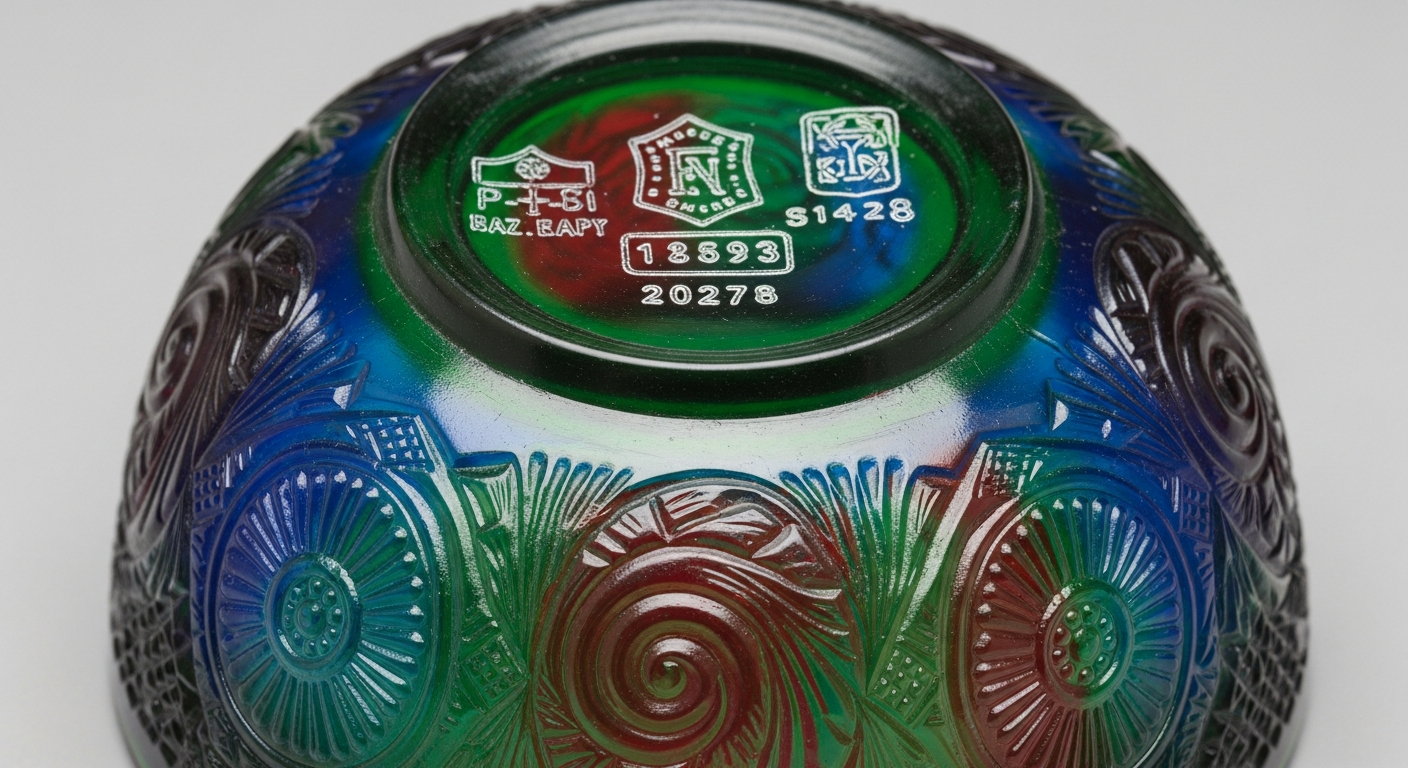
To identify an antique glass bowl, start with the base and the way it was made. A pontil mark, rough or polished, means hand-blown glass, common before about 1860. Visible mold seams point to machine-made glass from 1860 to 1920, and thin pink, green or amber glass to the Depression era, 1920 to 1940. Under a blacklight, Vaseline (uranium) glass glows bright green. Then match the pattern in a reference book and look for a maker’s mark. Glass over 100 years old is antique; at least 40 years, vintage. In the sales below, the 77 in US dollars ran $1 to $4,750, median $75.
Table of Contents
- Age Definition: Antique vs. Vintage
- Dating Methods and Techniques
- Attribution review and Valuation
- Caring for Your Antique Glass Bowls
- Common Questions
- External Resources
Age Definition: Antique vs. Vintage
In the world of collectibles, specific terms have concrete meanings that help categorize items by age. According to experts and collectors, glassware that is more than 100 years old is considered antique, while pieces that are at least 40 years old are classified as vintage. This distinction is not merely semantic but carries implications for value, collectibility, and historical significance.
Blacklight (UV) test for old glass
Ultraviolet light (blacklight) testing is a valuable tool for identifying certain types of antique glass:
- Vaseline/Uranium Glass: Glows bright green under UV light due to uranium content
- Manganese Glass: Produces a subtle green glow from manganese additives (common in glass from 1880-1915)
- Selenium Glass: Pink or amber glass with selenium may fluoresce orange-red
- Modern Glass: Typically shows little to no reaction under UV light
This non-destructive testing method can quickly help document certain types of antique glass bowls and narrow down their production period.
Dating Methods and Techniques
Clues from how the bowl was made
The evolution of glass manufacturing techniques provides valuable dating clues:
- Pre-1860: Hand-blown glass with pontil marks and frequent bubbles or imperfections
- 1860-1920: Early machine manufacturing with visible mold seams and less precise patterns
- 1920-1940: Depression era mass-production with thinner glass and more consistent coloring
- Post-1940: Modern production methods with fewer imperfections and more uniform characteristics
Pattern Research
Pattern identification is one of the most reliable methods for dating antique glass bowls:
- Reference books like “Collector’s Encyclopedia of Depression Glass” by Gene Florence
- Online glass pattern databases with historical production dates
- Museum collections with documented examples and historical context
- Collector forums where experts can help identify rare or unusual patterns
Historical Context
Understanding the cultural trends and technological capabilities of different eras helps with dating:
- Art Nouveau (1890-1910): Flowing, natural designs with organic motifs
- Art Deco (1920-1940): Geometric patterns and bold colors
- Mid-Century Modern (1945-1965): Simple forms, often with distinctive colors
Scientific Testing
For high-value pieces, professional attribution review might include:
- X-ray fluorescence (XRF) analysis: Non-destructive testing that reveals glass composition
- UV aging analysis: Examination of how ultraviolet reaction has changed over time
- Microscopic examination: Professional assessment of wear patterns and manufacturing marks
Attribution review and Valuation
What makes a glass bowl valuable
The value of antique glass bowls depends on several key factors:
- Rarity: Uncommon colors, patterns, or limited production runs command higher prices
- Condition: Mint condition pieces without chips, cracks, or repairs are most valuable
- Provenance: Documented history of ownership, especially if connected to notable individuals
- Maker: Pieces from prestigious manufacturers like Tiffany, Steuben, or Lalique are more valuable
- Age: Generally, older pieces (especially pre-1900) command higher prices
- Desirability: Current collector interest and market trends influence value
- Size and Form: Unusual sizes or distinctive forms may increase collectibility
Where to research a glass bowl
When seeking to document antique glass bowls, consider these resources:
- Reference Books: “Kovels’ Antiques and Collectibles Price Guide,” “Warman’s Glass,” and manufacturer-specific guides
- Online Databases: The Glass Encyclopaedia (20thcenturyglass.com) offers extensive reference materials
- Collector Groups: Organizations like the National Depression Glass Association provide expertise
- Professional Appraisers: Appraisers specializing in glass can provide formal valuations
- Auction Records: Past sales at reputable auction houses establish market precedents
Signs a bowl is a reproduction
Be aware of these warning signs that might indicate a reproduction:
- Too Perfect: Lack of period-appropriate wear or aging
- Wrong Weight: Modern reproductions are often lighter than their antique counterparts
- Color Inconsistencies: Reproductions may use modern coloring techniques that differ from period methods
- Pattern Details: Subtle differences in pattern depth or detail often distinguish reproductions
- Wrong Manufacturing Marks: Incorrect or inconsistent mold marks, seams, or pontil treatments
If you’re considering a significant purchase, it’s always wise to consult with an expert or professional appraiser to verify production consistency. If you still can’t place your bowl, you can upload photos of the bowl and its base for a free check.
Caring for Your Antique Glass Bowls
Handling Recommendations
- Always hold antique glass bowls with both hands, supporting the base
- Avoid temperature extremes that can cause cracking or crazing
- Handle with clean hands to prevent transferring oils and dirt
- Never stack antique glass bowls inside one another
- Place felt or soft cloth between the bowl and hard surfaces
Cleaning Methods
- Wash by hand using mild soap and lukewarm (not hot) water
- Avoid dishwashers and harsh cleaning chemicals
- Use soft microfiber cloths rather than paper towels
- For stubborn residue, soak in a solution of mild soap and water
- Dry thoroughly with a soft, lint-free cloth
Display and Storage
- Display away from direct sunlight to prevent fading or discoloration
- Use plate stands or special display cases to showcase pieces safely
- For storage, wrap in acid-free tissue paper and place in padded containers
- Maintain consistent temperature and humidity levels
- Consider museum putty for securing pieces in earthquake-prone areas
Insurance and Documentation
- Photograph your collection from multiple angles
- Keep records of purchases, provenance, and appraisals
- Consider specialized insurance for valuable collections
- Have significant pieces professionally appraised every 5-10 years as market values change
Common Questions About Antique Glass Bowl Identification
How can I tell if my glass bowl is genuinely antique?
- Look for pontil marks on the base - a rough circular area where the glassblower’s rod was attached
- Check for tiny bubbles or inclusions in the glass - common in handmade antique pieces
- Examine the bowl for uneven thickness and slight asymmetry, indicating hand production
- Research any maker’s marks or patterns to establish manufacturing dates
- Consider the weight - antique glass is often heavier than modern reproductions
- Look for signs of appropriate wear consistent with age, such as minor scratches on the base
What are pontil marks and why are they important for identification?
These marks are critically important for identification because:
- They indicate the piece was hand-blown rather than machine-made
- Different types of pontil marks can help date the piece (rough pontil marks vs. polished pontils)
- They were common in glass production before approximately 1860
- The absence of a pontil mark on an allegedly very old piece may suggest it’s a reproduction
How do I identify Depression Glass bowls?
- Distinctive colors including pink, green, amber, blue, and clear
- Machine-made with visible mold seams and pattern numbers
- Thin, lightweight glass compared to cut crystal
- Mass-produced patterns that were widely distributed
- Often contain small bubbles or manufacturing flaws
What is Carnival Glass and how can I identify it?
- Look for the distinctive metallic, rainbow-like sheen on the surface
- Check the base color - marigold (orange-gold) is most common, but blue, green, red, and purple exist
- Examine the pattern - usually pressed into the glass with intricate designs
- Note that most Carnival Glass was produced between 1905-1925
- Common manufacturers include Fenton, Northwood, Imperial, and Millersburg
How does the color of glass help with identification and dating?
- Certain colors were only produced during specific time periods
- Some colors required particular chemical compounds that date the manufacturing era
- Color execution techniques evolved over time
Key examples include:
- Vaseline glass (greenish-yellow, containing uranium) was popular from the 1840s through the 1930s and glows under UV light
- Cobalt blue saw peaks of popularity in the 1840s-1860s and again in the 1880s-1900s
- Milk glass (opaque white) was produced since the 16th century but was especially popular during the Victorian era and again in the 1950s
- Depression glass colors (pink, green, amber, etc.) were characteristic of the 1920s-1930s
- Black amethyst (appears black until held to light) was popular in the Art Deco period
What's the best way to determine the value of my antique glass bowl?
-
Proper Identification: First identify the manufacturer, pattern, age, and type of glass
-
Condition Assessment: Carefully examine for any chips, cracks, or repairs which significantly impact value
-
Research Recent Sales:
- Check completed listings on auction sites like eBay
- Review specialized glass auction results
- Consult current price guides and collecting books
-
Consider Rarity Factors:
- Unusual colors typically command higher prices
- Limited production pieces are more valuable
- Pieces with maker’s marks or original labels have increased value
-
Seek Expert Opinion:
- Consult with antique glass dealers or appraisers
- Join collector groups for community knowledge
- Consider professional appraisal for valuable pieces
How can I tell the difference between cut glass and pressed glass bowls?
Cut Glass:
- Created by cutting patterns into glass with a wheel after the piece is formed
- Shows sharp, precise patterns with crisp edges
- Pattern has depth with highly reflective, prismatic surfaces
- Produces a clear, resonant ring when gently tapped
- Pattern may be uneven as it was cut by hand
- Typically heavier due to thicker glass needed for cutting
Pressed Glass:
- Pattern is molded directly during manufacturing
- Displays smoother, less defined pattern edges
- Pattern has a more uniform appearance
- Produces a duller sound when tapped
- Often shows mold seams where pattern parts join
- Generally lighter weight than cut glass
Are there apps or online tools that can help identify antique glass patterns?
Mobile Apps:
- Google Lens - Use photo recognition to match patterns
- Collector’s Assistant - Database of collectibles including glass
- What’s It Worth - Community-based identification and valuation
Online Resources:
- The Glass Encyclopedia (20thcenturyglass.com) - Comprehensive reference database
- Replacements, Ltd. - Extensive pattern database with images
- EAPG (Early American Pattern Glass) Pattern Index - Searchable database
- Ruby Lane - Reference materials for various glass types
Community Resources:
- Facebook groups like "Vintage Glass Identification" connect you with knowledgeable collectors
- Reddit’s r/Antiques community offers identification assistance
- Pattern-specific collector forums provide specialized expertise
External Resources for Glass Bowl Identification
Explore these trusted sources for more detailed information on antique glass identification
Glass Encyclopedia
A comprehensive glass identification guide featuring many types of antique and vintage glassware, with detailed galleries and information on manufacturers, patterns, and glass types.
Identifying Antique Glassware Guide
Detailed guide explaining the four main identifiable markings for antique glassware: embossed markings, maker's marks, pontil marks, and mold lines.
Westland London Antique Glass Guide
Expert advice on determining whether glass is antique by studying patina, color, markings, patterns, bubbles, and pontil marks.
National Depression Glass Association
Official organization dedicated to the education, preservation, and research of Depression Era glassware, with pattern guides and identification resources.
Hemswell Antiques Glass Guide
Comprehensive guide on features of antique glass, including how to identify imperfections, pontil marks, and other characteristics that help document vintage pieces.
Decorative Collective's Vintage Glassware Guide
Beginner-friendly resource explaining how to identify vintage glass through mould marks, pontil marks, and other identifying characteristics.
Elle Decor: How to Identify Antique Glass
Expert advice from professional decorators and collectors on identifying antique and vintage glass by examining colors, seams, and distinctive features.
Veranda: Antique Glassware Guide
Luxury magazine's guide to distinguishing between antique (over 100 years) and vintage (at least 40 years) glassware with expert advice on identification.
Conclusion
Identifying antique glass bowls requires careful observation, research, and sometimes expert consultation. By examining the physical characteristics, manufacturing marks, patterns, colors, and other distinctive features outlined in this guide, you’ll be better equipped to determine the age, origin, and potential value of your glass treasures. Remember that condition significantly impacts value, and proper attribution review may require professional expertise for rare or valuable pieces.
For particularly rare or valuable pieces, consider consulting with professional appraisers or glass specialists who can provide definitive attributions and valuations. As your knowledge grows, you’ll find that identifying antique glass bowls becomes both a rewarding intellectual pursuit and a practical skill for building a meaningful collection.
What similar items actually sold for
Real auction sales of items like your glass bowl. Open a sale to see the original listing.
Shown USD range: USD 1-USD 4,750. Median of these 77 USD examples: USD 75.


How these auction records were verified
These sales are market context, not an object estimate.
Each row retains its exact source URL, lot identity, retrieval time, access result, and immutable record hash. Live source access was blocked; the exact record matched Appraisily's immutable pipeline provenance. Inspect the public comparable provenance record.
Free photo check
Not sure if your item is worth appraising? Let us take a look.
Upload a photo, tell us what you know, and get a free photo check. If a full appraisal makes sense, we will say so.
Free. No card needed. Takes about two minutes.
Get antique glass appraised
Upload glass photos, pattern and maker details, pontil or mold marks, measurements, condition notes, set counts, and the report purpose.
- Signed report with photos and market context
- Delivered within 24 hours of receiving your photos
- Fixed, upfront pricing
No obligation. Secure upload.
Find a local antique or art appraiser
Ready for pricing guidance?
Start a secure online appraisal
Upload images and details. Delivered within 24 hours of receiving your photos.
Upload photos for a free first look View signed report sample