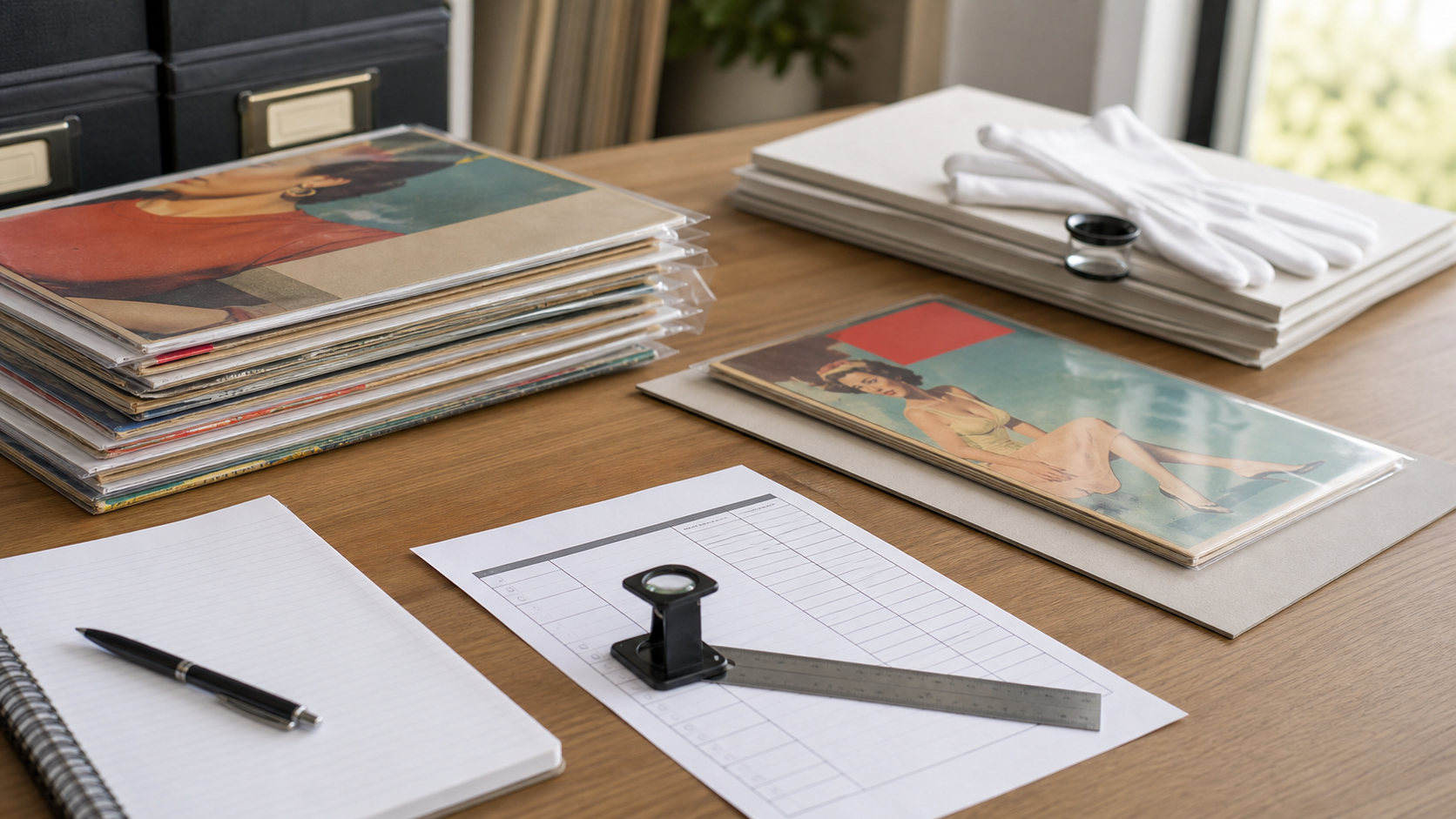
What old Playboy magazines are worth
Most Playboy issues from the 1970s onward were printed in large numbers and are worth modest sums, and whole lots often go cheaply. The 8 auction lots in the table below range from $10 to $200, with a median of $19; six 1977 issues sit at the bottom and a lot of 33 issues from 1983 to 1985 at the top. Early issues from the 1950s and early 1960s, landmark interviews and select celebrity covers sell for more, above all Vol. 1, No. 1 from December 1953 with Marilyn Monroe. Condition and completeness decide the rest: an attached centerfold, every insert, a newsstand copy with no mailing label, a tight spine and clean pages.
What similar items actually sold for
Real auction sales of items like your playboy magazines. Open a sale to see the original listing.
Shown USD range: USD 10-USD 200. Median of these 8 USD examples: USD 19.
| Comparable | What sold | Auction house | Date | Lot | Source-reported amount |
|---|---|---|---|---|---|
 |
16 PLAYBOY Magazines | R & R Auction INC | 2025-09-14 | 2220 | USD 20 |
 |
33 PLAYBOY MAGAZINES FROM 1983 TO 1985 | Converse Auctions | 2023-08-25 | 349 | USD 200 |
 |
A collection of 7 vintage men's magazines inc. Playboy, Gallery, etc | Lawsons | 2025-08-14 | 2225 | AUD 40 |
 |
Misc. Playboy Magazines | Pace & Hong Auctions, LLC | 2019-02-25 | 245 | USD 50 |
 |
Vintage Playboy Magazines | Apple Tree Auction Center | 2025-08-27 | 5329 | USD 17 |
 |
Playboy Magazines 1977 Lot Of Six | Lettieri Auction & Appraisal | 2022-06-08 | 800 | USD 10 |
 |
PLAYBOY MAGAZINES 1973, 1974, 1975 | Converse Auctions | 2023-08-25 | 354 | USD 60 |
 |
1970s and 1980s Playboy Magazines | R & R Auction INC | 2025-08-31 | 2117 | USD 10 |
 |
Box of Vintage Playboy Magazines | Apple Tree Auction Center | 2025-08-27 | 5332 | USD 18 |
How these auction records were verified
These sales are market context, not an object estimate.
Each row retains its exact source URL, lot identity, retrieval time, access result, and immutable record hash. Live source access was blocked; the exact record matched Appraisily's immutable pipeline provenance. Inspect the public comparable provenance record.
Have a magazine stack to sort?
Screen key issues before pricing the collection
Upload cover, spine, centerfold, label, and condition photos. The free screener helps identify whether grading, authentication, or a full appraisal is worthwhile.
Start free screenerThe five things that set the price
For many collectors, old Playboy magazines sit at the intersection of mid-century design, celebrity culture, and American social history. They’re also a classic example of how printed ephemera values are set: issue significance, condition, scarcity, and shifting tastes all matter.
Before diving in, a reality check: most Playboy issues from the 1970s onward were printed in large numbers and survive in quantity. They are typically modest in value unless in exceptional condition or featuring especially sought-after content. By contrast, early issues (1950s–early 1960s), landmark interviews, and select celebrity covers can command strong prices, especially when complete and high grade.
1) Which issues are worth more: firsts, covers and interviews
Not all issues are created equal. The single biggest driver of value is what’s in (and on) the magazine.
- Firsts and landmarks: Vol. 1, No. 1 (December 1953) featuring Marilyn Monroe is the archetypal “key” issue. Early volumes from the 1950s and early 1960s often carry premiums simply due to lower print runs and cultural cachet.
- Celebrity covers and pictorials: Issues tied to major celebrities, breakthrough models, or pop culture events tend to be more sought after. Demand usually tracks household-name recognition.
- The Playboy Interview: The magazine’s long-form interviews with significant figures—politicians, artists, and athletes—give certain issues cross-collectibility. When an interview becomes historically notable, collectors outside the pin-up niche pay attention.
- Art and design: Work by notable illustrators and photographers (e.g., Alberto Vargas, LeRoy Neiman, Helmut Newton), as well as distinctive typography and mid-century layout, add appeal to art and design collectors.
- Special numbers: Anniversary issues, Playmate of the Year issues, and thematic editions can be favored. That said, many were promoted heavily and printed in large quantities—content desirability must be weighed against supply.
Tip for appraisers: Start by identifying the cover subject, signature features (centerfold model, interviewee, standout artists), and whether the issue marks a “first” (first appearance, debut of a recurring feature, notable redesign). A precise identification is the foundation for any valuation. If you can’t tell which issue you have or whether it is a reprint, you can upload photos of the cover, spine and centerfold for a free check.
2) Condition, centerfold and mailing labels
Condition is the great multiplier. Two copies of the same issue can differ in value severalfold based on condition and whether all original elements are present.
Focus on these condition checkpoints:
- Cover: Look for gloss retention, color vibrancy, and absence of creases, tears, or abrasions. Subscription mailing labels or residue grade down significantly; newsstand copies without labels are preferred.
- Spine: Tightness, minimal stress lines, no splitting at the head or tail, and clean staples (no rust bleed-through). Detached or heavily rolled spines depress value.
- Corners and edges: Sharp corners and clean edges suggest careful storage. Blunting, chipping, or edge tears indicate lower grade.
- Paper quality: Even, off-white to white pages are ideal. Tanning, brittleness, foxing, and water rippling reduce desirability and risk future deterioration.
- Odor and staining: Musty odors, mildew, or smoke smell are red flags; so are water stains and tide marks.
- Completeness: The centerfold must be present and attached to be considered “complete” by most collectors. Verify all inserts (posters, calendars, special supplements) and that no pages have been cut out. Reply cards and order forms are often removed; intact examples are preferred.
Grading notes:
- Use consistent, conservative magazine grading terminology (e.g., Poor to Near Mint). Overgrading is the most common credibility killer in listings.
- Professional encapsulation by recognized third-party graders can help at the high end (especially for key issues) by standardizing the grade and protecting the book. For autographed copies, reputable signature authentication is similarly important.
- Do not clean, press, or “repair” a magazine unless you know the best practices. Tape, lamination, pressing with heat, or stain removal attempts often do irreversible harm.
Storage and handling:
- Store upright in magazine-sized, archival polypropylene or mylar sleeves with acid-free backer boards.
- Keep in a cool, dry, dark environment. Avoid PVC plastics, attic heat, and basement humidity.
- Handle with clean, dry hands; avoid sliding the cover on rough surfaces.
3) Rarity by year: print runs and newsstand copies
Scarcity isn’t only about how many were printed; it’s about how many survived in collectible condition.
- Early print volumes: The 1950s issues typically had modest print runs compared to the multi-million circulations of the 1970s and 1980s. Many early copies were read, shared, and discarded, making high-grade survivors genuinely scarce.
- Newsstand vs. subscription: Newsstand copies without mailing labels are preferable. Subscription copies with labels (or label removal damage) trade at discounts relative to comparable condition newsstand examples.
- Regional and international editions: U.S. domestic editions generally attract the widest demand among U.S.-based collectors. International editions can be fascinating but often have narrower collector bases. Exceptions exist where content differs or an edition had a very small run.
- Variants and errors: Price box differences, cover text variations, and occasional production anomalies can generate interest, but authentication is crucial. Most “error” claims add no value unless documented and recognized by collectors.
- Survivability effects: Items prone to centerfold detachment, staple rust, or tanning are rarer in top grade. As a result, even relatively common later issues can command premiums if they’re truly Near Mint with pristine gloss and no label.
Key takeaway: A “common” issue in exceptional, unmailed condition can outperform an average copy of a more interesting issue. For pricing, adjust your expectations by both absolute scarcity and condition scarcity.
4) Who buys old Playboys, and when
Values move with attention, nostalgia, and demographics.
- Cross-collector demand: Issues with crossover appeal—to fans of a particular celebrity, political history buffs, design nerds, or photography collectors—tend to perform best. The broader the audience, the more resilient the price.
- Generational nostalgia: Collectors often seek issues from their formative years (late teens to early adulthood). That means increased interest in 1960s–1990s material cycles as generations age into peak collecting years.
- News cycles: Anniversaries, biographies, and obituaries can spark short-term demand spikes. These are often temporary; avoid chasing peaks unless you’re selling into them.
- Venue and seasonality: Specialist auctions, paper ephemera shows, and well-described online listings attract more serious buyers. Late-year gift seasons can lift prices for presentable, slabbed, or “giftable” copies. Estate cleanouts in spring can flood supply.
- Set-building: Some buyers prefer runs by year, complete decades, or every cover appearance by a specific model or photographer. Individual pricing may be lower, but the aggregate value of a matched, consistent-condition set can be attractive; see recorded Playboy collection sales.
Actionable tip: Track recent, comparable sales for the same issue and grade before pricing. Playboy collecting is mature enough that comps exist for most key issues—what changes is condition, completeness, and timing. See recorded single-issue Playboy sales.
5) Signatures and ownership history
Who owned the magazine—and who signed it—can matter.
- Autographs: A cover signed by the featured model, photographer, or interview subject can carry a premium, but only with trustworthy authentication. Signatures personalized to a specific individual can either raise or lower value depending on the buyer.
- Association copies: Magazines mailed to, or inscribed for, notable figures (artists, celebrities, industry insiders) can be collectible, especially if provenance is clear. Labels or internal notations showing a famous original recipient might add interest.
- Collection integrity: “One-owner” runs stored carefully often grade better and sell more easily. A consistent look (clean spines, no labels, similar page quality) reduces buyer friction and supports better prices.
- Documentation: Save original invoices, event photos of signings, or provenance letters. Good paper trails create confidence.
Quick checklist before you price an issue
- Identify the issue: Month, year, volume/number, and cover subject.
- Confirm completeness: Centerfold present and attached; all inserts intact.
- Check the cover: Any mailing label or residue? Creases, tears, color loss?
- Inspect the spine and staples: No splits; minimal stress lines; no rust bleed.
- Evaluate paper: Even color, no brittleness, no water damage or odors.
- Note edition specifics: U.S. vs. international, subscription vs. newsstand.
- Look for value drivers: Celebrity features, landmark interviews, special art.
- Decide on next steps: Consider third-party grading/authentication for key issues in high grade; otherwise, protect and list with clear, honest photos and descriptions.
FAQ
Q: Are old Playboy magazines legal to sell? A: In many jurisdictions, yes, provided buyers are adults and listings comply with platform and local regulations. Some online marketplaces restrict adult content or require specific listing practices. Always review the rules of your selling venue and applicable laws before listing.
Q: How can I tell if my December 1953 (Vol. 1, No. 1) is an original or a later reprint? A: Look for period-correct details: no barcode, a 50¢ price on the cover, and 1950s paper age characteristics. Many commemorative reprints have modern copyright lines, different ad content, and other subtle tells. Because counterfeits and reprints are common, compare to verified references or consult a specialist before assigning a high value.
Q: Do mailing labels really hurt value? A: Yes. Collectors typically prefer clean, label-free covers. A subscription label (or evidence of removal) usually reduces value versus an otherwise comparable newsstand copy. The impact varies by issue and grade but is notable on high-end examples.
Q: Is it worth getting issues graded or slabbed? A: For key, early, or celebrity-significant issues in strong condition, third-party grading can increase buyer confidence and sometimes net higher prices, especially at auction. For common 1970s–1990s issues in average shape, the grading fee often exceeds the potential value increase.
Q: What’s the best way to store and display them without hurting value? A: Use archival sleeves and acid-free boards, store upright in a cool, dry, dark place, and avoid PVC plastics, extreme heat, and direct sun. Do not laminate, tape repairs, or flatten with heat. For display, consider copies in protective sleeves or professionally graded holders to limit handling and UV exposure.