19th Century Antique Scottish Mahogany Longcase Clock: appraisal and value basics
19th Century Antique Scottish Mahogany Longcase Clock research should start with identification, condition, provenance, and recent comparable sales. Use this guide to compare the signals that matter before paying for a formal appraisal or deciding whether to sell.
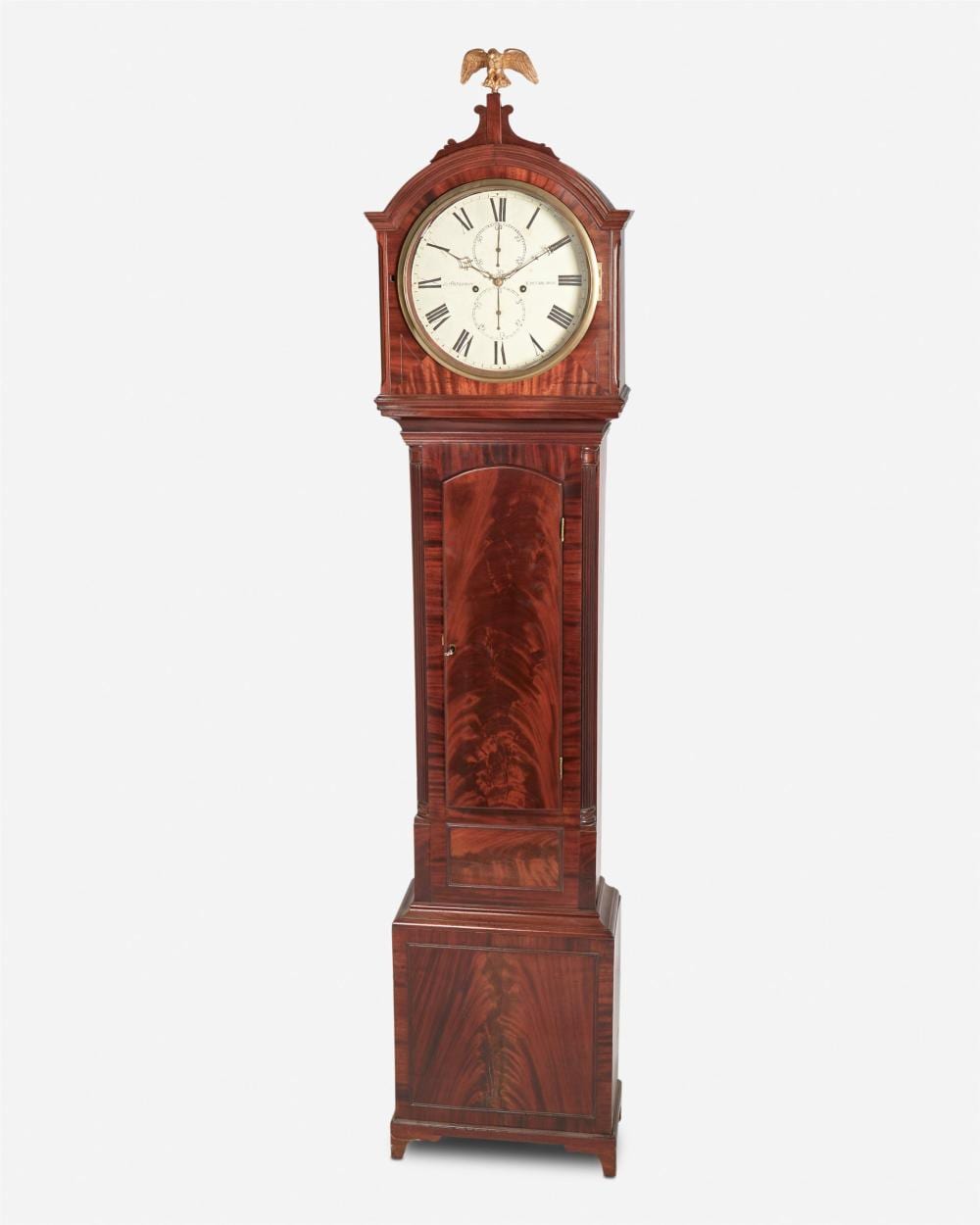
19th Century Antique Scottish Mahogany Longcase Clock
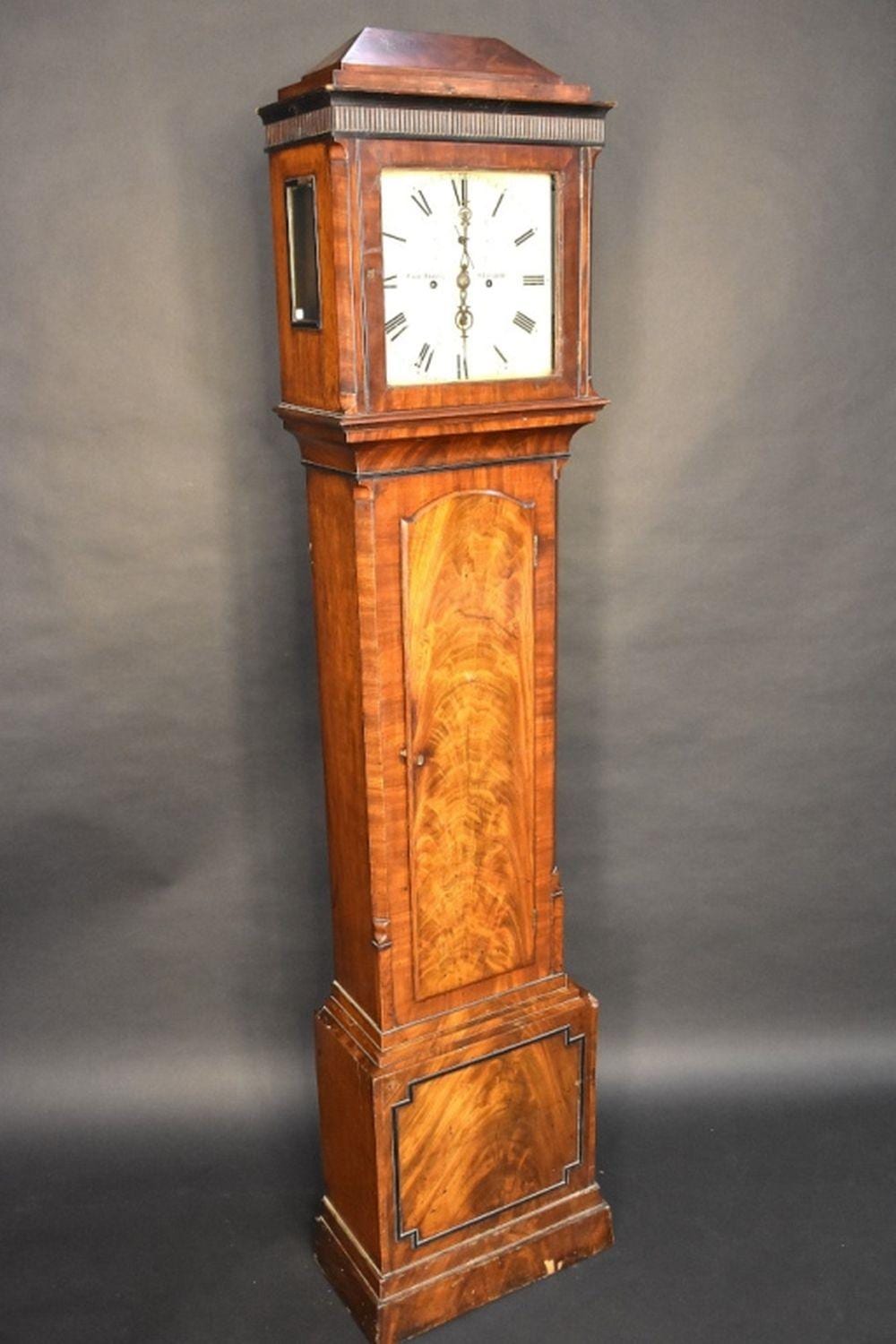
For collectors and appraisers, a 19th-century Scottish mahogany longcase clock is a rewarding study in regional cabinetmaking, evolving dial art, and robust horology. While often called “grandfather clocks,” these tall timekeepers reflect distinct Scottish tastes, trade routes, and workshop practices. This guide outlines what to look for, how to place an example within its period, and the factors that most influence condition and value.
What Defines a 19th-Century Scottish Mahogany Longcase Clock
- Period: Roughly 1800–1900, spanning late Georgian/Regency through Victorian eras.
- Regions: Edinburgh and Glasgow as principal centers; Aberdeen, Dundee, and northeastern towns also produced recognizably Scottish forms.
- Materials: Mahogany (solid and veneered), with secondary woods typically Scots pine or oak. Scottish cases often show high-quality veneers sourced through Glasgow’s port trade.
- Movement types: Predominantly 8-day (two weights, time and strike), with 30-hour movements (single weight) common in rural examples.
- Dials: Painted iron dials dominate the 19th century, often with an arched top and decorated corners; moon-phase and automata appear on higher-grade clocks.
- Aesthetic: Proportions tend toward slim, with refined veneers and restrained ornament, though regional variations include bolder “drumhead” hoods and distinct inlay patterns.
Terminology
- Longcase/tall case/grandfather clock: interchangeable terms; “longcase” is standard in British usage.
- Hood: The upper section housing the dial and movement, typically with a glazed door.
- Trunk: The central section with the long door over the pendulum and weights.
- Base: The plinth or footed bottom section.
Casework and Design Details to Recognize
Scottish cabinetmakers favored imported mahogany for its figure and stability, often deploying veneers to dramatic effect. Key features include:
- Mahogany veneers: Flame or crotch mahogany on the trunk door and base panel, sometimes framed by satinwood or ebony stringing. Crossbanded borders are common.
- Hood forms:
- Arched or swan-neck pediments in early 19th-century examples, with brass finials occasionally present.
- “Drumhead” hoods, especially in northeast Scotland, where a circular or nearly circular hood frames a round dial in a drum-like housing.
- Hood pillars: Free-standing or half-columns, often reeded or ring-turned; brass or wood capitals and bases.
- Trunk proportions: Tall, relatively narrow doors, sometimes with an oval, shield, or shell inlay near the top in late Georgian/Regency taste. Book-matched veneers frequently appear.
- Bases: Ogee or bracket feet early in the century; later Victorian examples may have plain plinth bases. Check for replaced feet or skirting—common areas of later alteration.
- Secondary woods: Scots pine is prevalent inside, on backboards, and as carcase wood. Consistency in secondary wood and patina supports originality.
- Glazing: Early glass may show light waviness or seed bubbles; later 19th-century replacements are more uniform. Side windows in the hood vary by workshop and can help with attribution.
- Sound frets: Pierced fretwork above the hood’s dial area can appear in earlier 19th-century pieces; later and plainer Victorian clocks may omit it.
- Joinery and wear: Dovetailed bases, hand-planed backboards, oxidation and natural shrinkage cracks in predictable places (backboards, along veneer seams). An absence of any age-related irregularity can signal extensive restoration.
Regional touches
- Edinburgh and Glasgow: Polished, refined cases, often with elegant veneer work and arched painted dials.
- Northeast (Moray, Aberdeen): Drumhead hoods, robust proportions, and occasionally simpler decorative programs.
- Inlay: Scottish cases may feature fan, shell, or thistle motifs, though thistle inlay is less common than folklore suggests.
Dials, Movements, and Complications
Most 19th-century Scottish longcase clocks feature painted iron dials—an innovation that largely replaced earlier brass dials after the 1770s. Birmingham dial makers supplied much of Britain, including Scottish workshops.
Painted dials
- Layout: Roman hour numerals with Arabic minute track; subsidiary seconds dial at 12 and date aperture at 6 are typical for 8-day clocks.
- Corners and arch: Floral sprays, birds, baskets, or patriotic motifs; some Scottish dials feature Highland landscapes or shipping scenes, especially when paired with a moon-phase.
- Moon-phase: A rotating disc in the arch showing the lunar cycle; Scottish scenes or maritime imagery are common. Some include automata like a rocking ship.
- Signatures: Most dials are signed with a maker’s name and town on the chapter ring or below the center. Verify that the signature aligns with known Scottish towns and active dates.
- Falseplate: A cast-iron plate behind the painted dial often bears the dial maker’s name (e.g., Wilson, Osborne, Walker & Hughes). This can assist with dating to a decade range.
Movements
- Power and duration:
- 8-day: Two weights and two winding holes on the dial; more desirable, often with seconds and calendar features.
- 30-hour: One weight and typically one winding hole; often uses a “countwheel” strike and can be wound daily. Common in rural production.
- Escapement: Anchor recoil is standard. Deadbeat escapements appear in higher-precision regulators, less common in domestic longcase clocks.
- Strike: Typically strikes the hour on a bell; some also chime the half-hours or quarters in rare cases.
- Plates and pillars: Brass plates with turned pillars; earlier plates and hand-filed components show irregular tool marks; later Victorian examples may be cleaner and more standardized.
- Weights and pendulum: Lead or iron weights; a brass-faced pendulum bob on a steel rod is typical. Check length and crutch alignment for originality.
Clues from dial art and hardware
- Early 1800s: Bold florals, naïve figures, Roman hours with minute numerals, and larger hand-cut screws.
- 1820–1840: Increasing use of transfer-printed motifs; cleaner, standardized artwork; narrower minute numerals.
- Mid- to late Victorian: Simpler arch painting, plainer cases, and sometimes less elaborate calendars.
Dating and Attribution: Reading the Evidence
Dating a Scottish longcase clock relies on cumulative evidence:
- Dial and falseplate:
- Compare the style of chapter ring, numerals, and corner art to known period patterns.
- Inspect the falseplate for a dial maker’s name; cross-check against known working dates.
- Signature and town:
- The signed maker (often the retailer/watchmaker) and town on the dial anchor the clock regionally. Note that movements and cases were frequently supplied by different specialists.
- Maker’s working dates help bracket the clock’s era; always allow for overlap as unsold dials or parts were used later.
- Movement characteristics:
- 8-day with calendar and seconds suggests a better-quality clock; wheel count, profile of pillars, and strike arrangement can point to a narrower date window.
- Case construction and veneer:
- Early 19th-century cases may show higher-relief cornices, fine crossbanding, and elaborate veneers; later Victorian cases trend plainer.
- Secondary wood choice, fasteners (hand-cut vs machine screws), and glass character all assist in dating and assessing originality.
- Proportions and regional style:
- Drumhead hoods and specific inlay patterns suggest northeastern origins; urbane veneers and symmetrical book-matching are more often Edinburgh/Glasgow.
Attribution cautions
- Retailer vs maker: The name on the dial is usually the retailer/watchmaker, not necessarily the movement or case maker.
- Married clocks: Movement, dial, and case may not have started life together. Mismatched screw holes, altered seatboards, or inconsistent patina are telltales.
Condition, Originality, and Value Drivers
Value hinges on aesthetics, originality, and mechanical health. Market preferences currently favor quality 8-day clocks with strong visual presence, moon-phase features, and known Scottish retailers.
Key drivers
- Case originality:
- Untouched or lightly restored veneers with good color and patina are prized.
- Replaced feet, re-veneered doors, or heavily stripped and re-polished surfaces reduce desirability.
- Dial condition:
- Original painted dials with minor wear and stable craquelure are preferred.
- Overpainting, poorly executed restorations, or repainted numerals diminish value. Conservator-led stabilization is better than repainting.
- Movement integrity:
- Clean, complete, and running movements that haven’t been over-polished or aggressively bushed are best.
- Replacement wheels, bent arbors, or incorrect pendulums lower value.
- Features:
- Moon-phase, automata, seconds, and calendar functions add appeal.
- Unique regional hood forms (e.g., drumhead) or particularly fine veneers can elevate price.
- Maker recognition:
- Edinburgh and Glasgow retailers with documented histories can increase value; precision or regulator-grade clocks by noted firms are exceptions that can command strong prices.
Indicative values
- 30-hour rural Scottish longcase: modest examples in fair condition may range in the low thousands or less, depending on market and location.
- 8-day mahogany with seconds and date: mid-range; attractive veneers and original dial can see higher results.
- Moon-phase or automata, exceptional veneers, and strong retailer provenance: generally higher tier within the category.
Note: Longcase clocks are currently undervalued relative to their craftsmanship; regional demand and moving costs can significantly influence results.
What similar items actually sold for
Real auction sales of items like your scottish longcase clock. Open a sale to see the original listing.
Shown GBP range: GBP 350-GBP 1,300. Median of these 3 GBP examples: GBP 360.
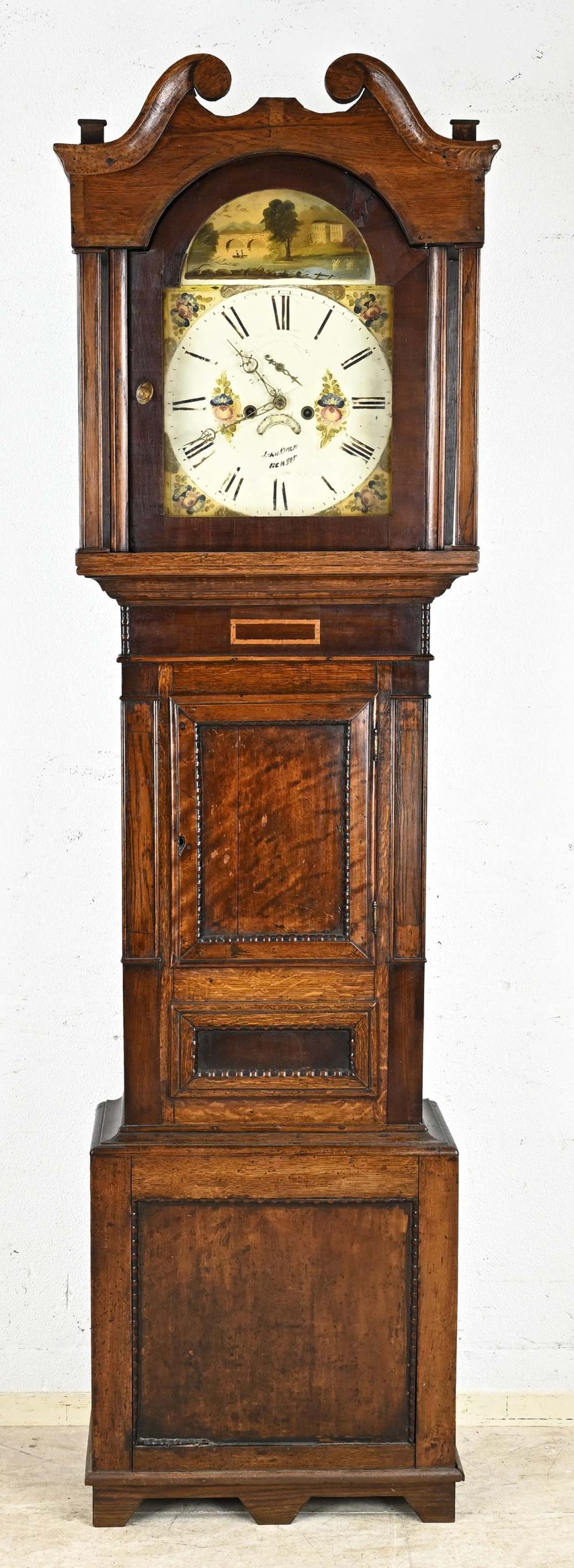
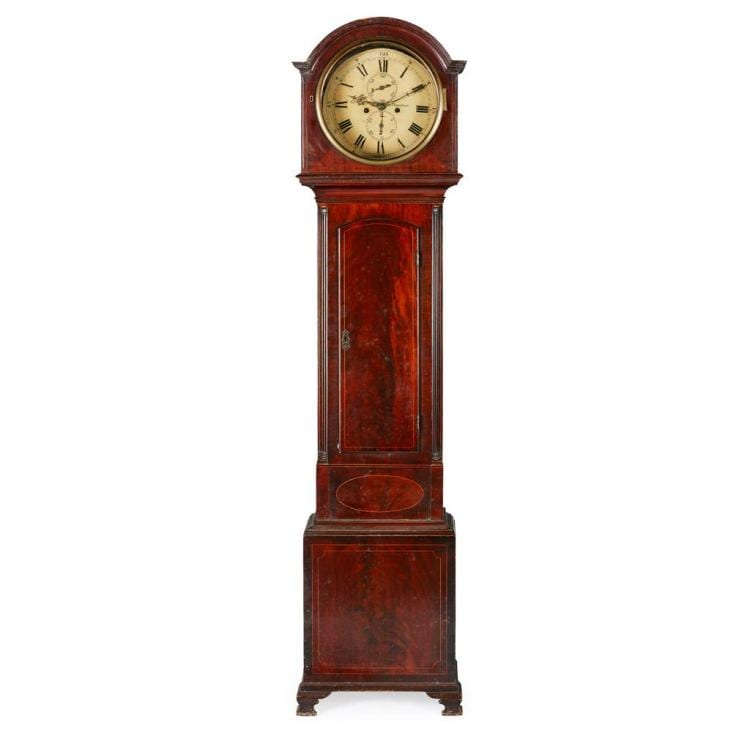
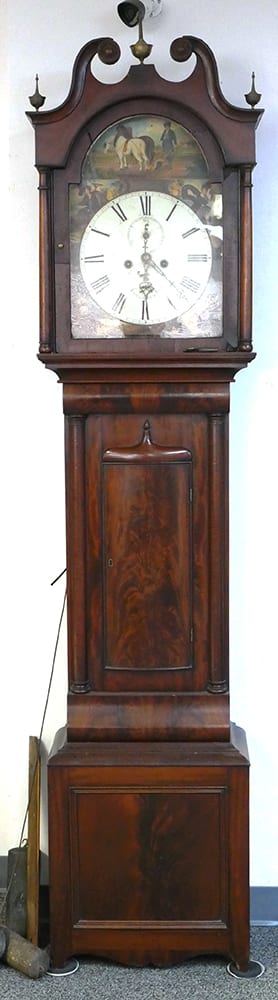
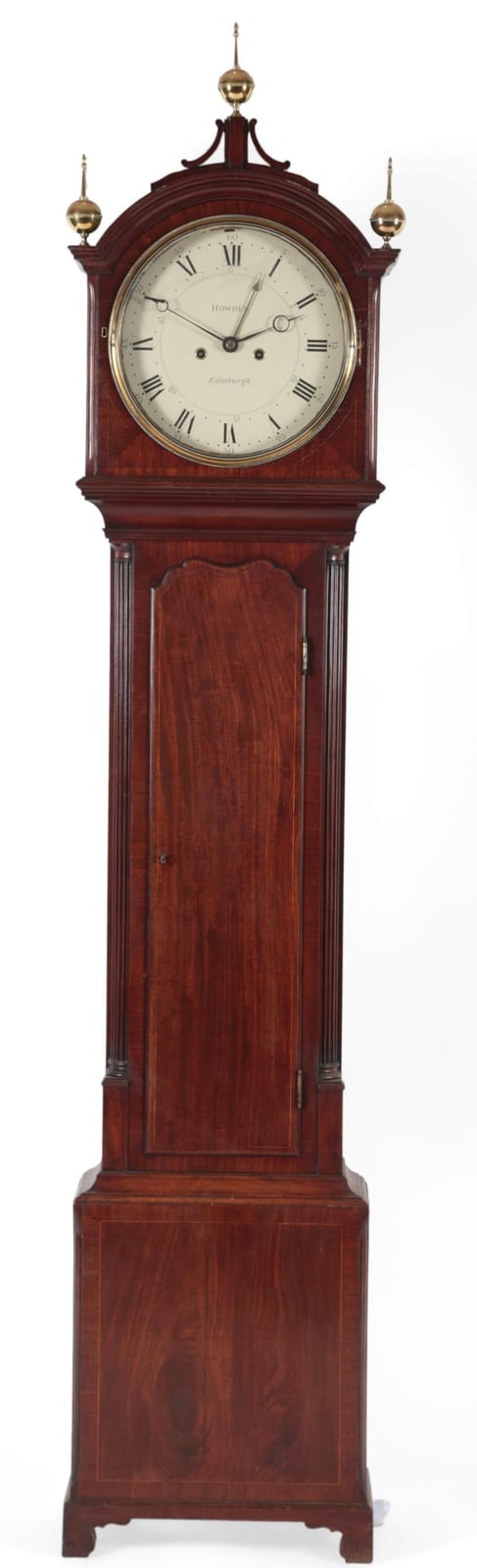
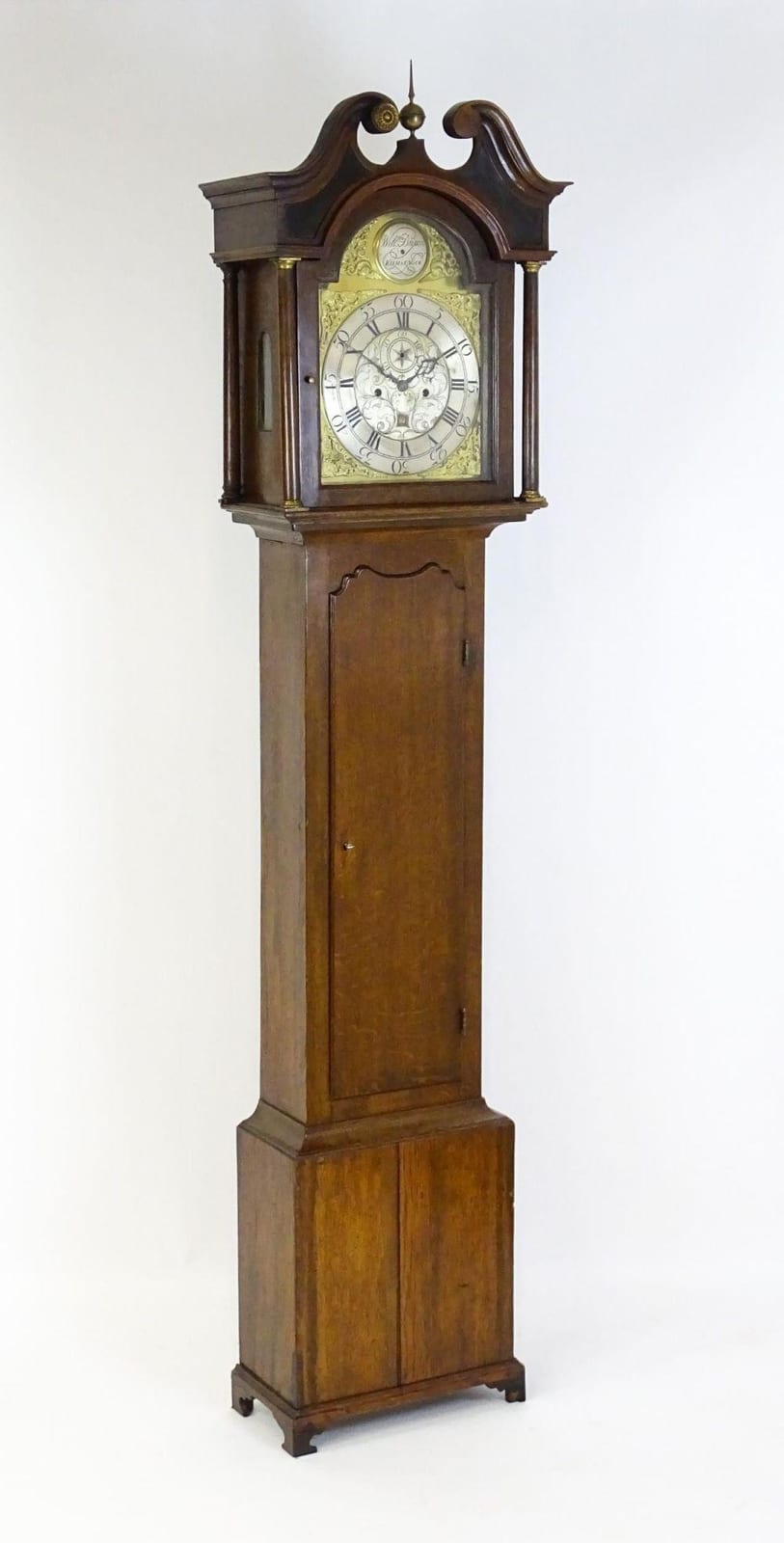
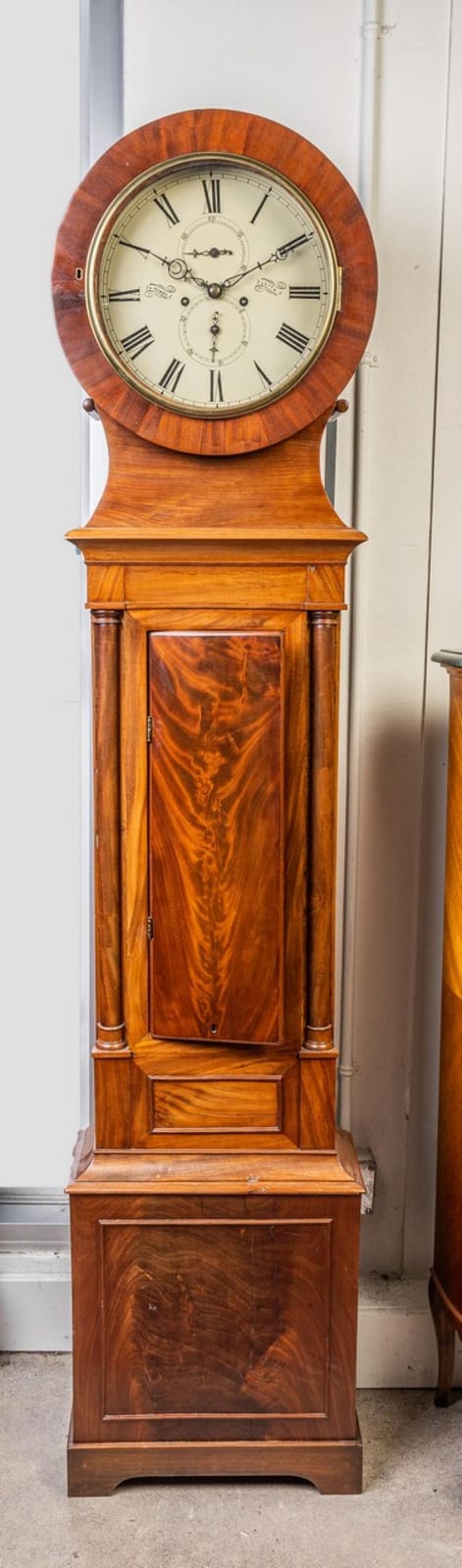
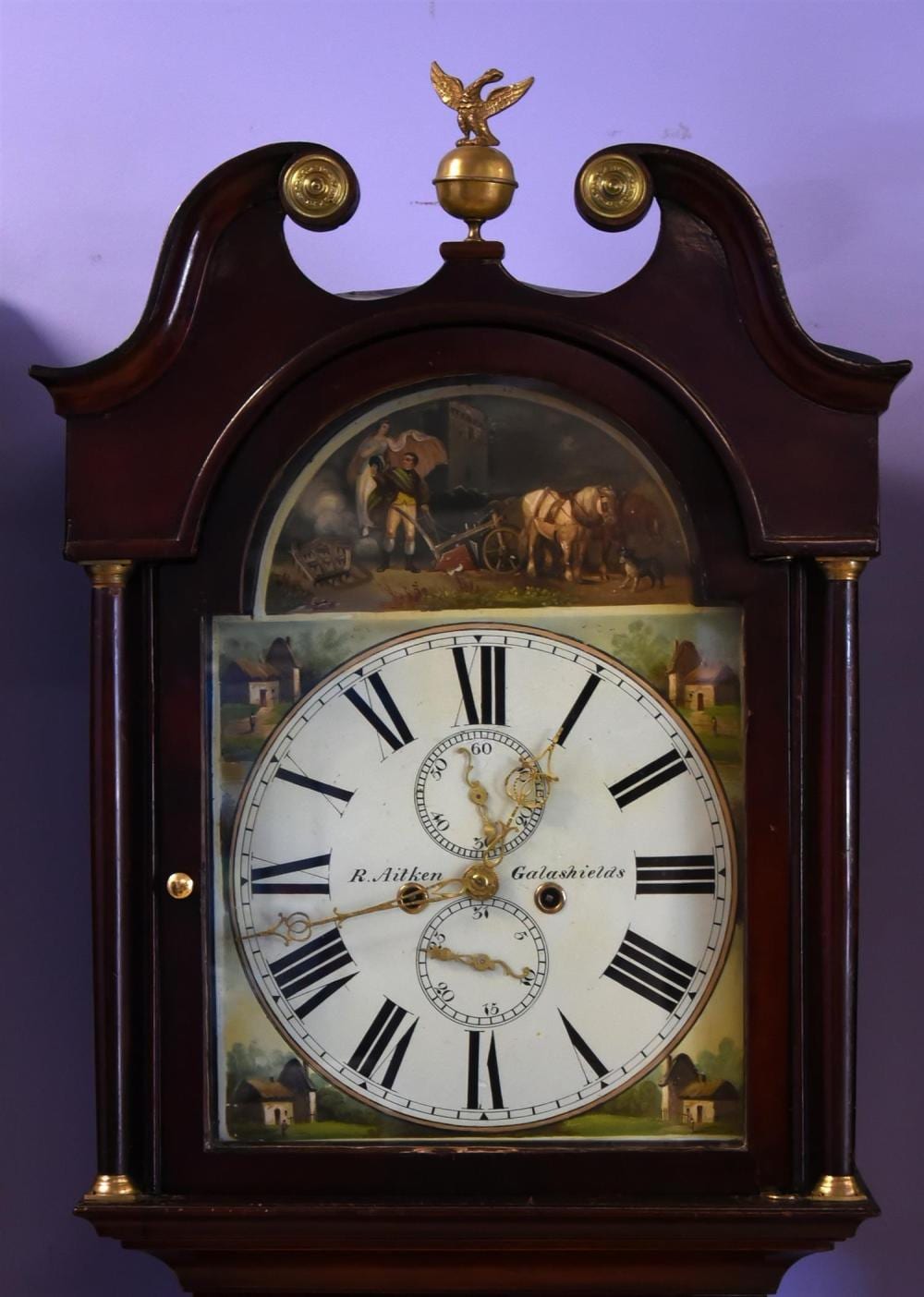
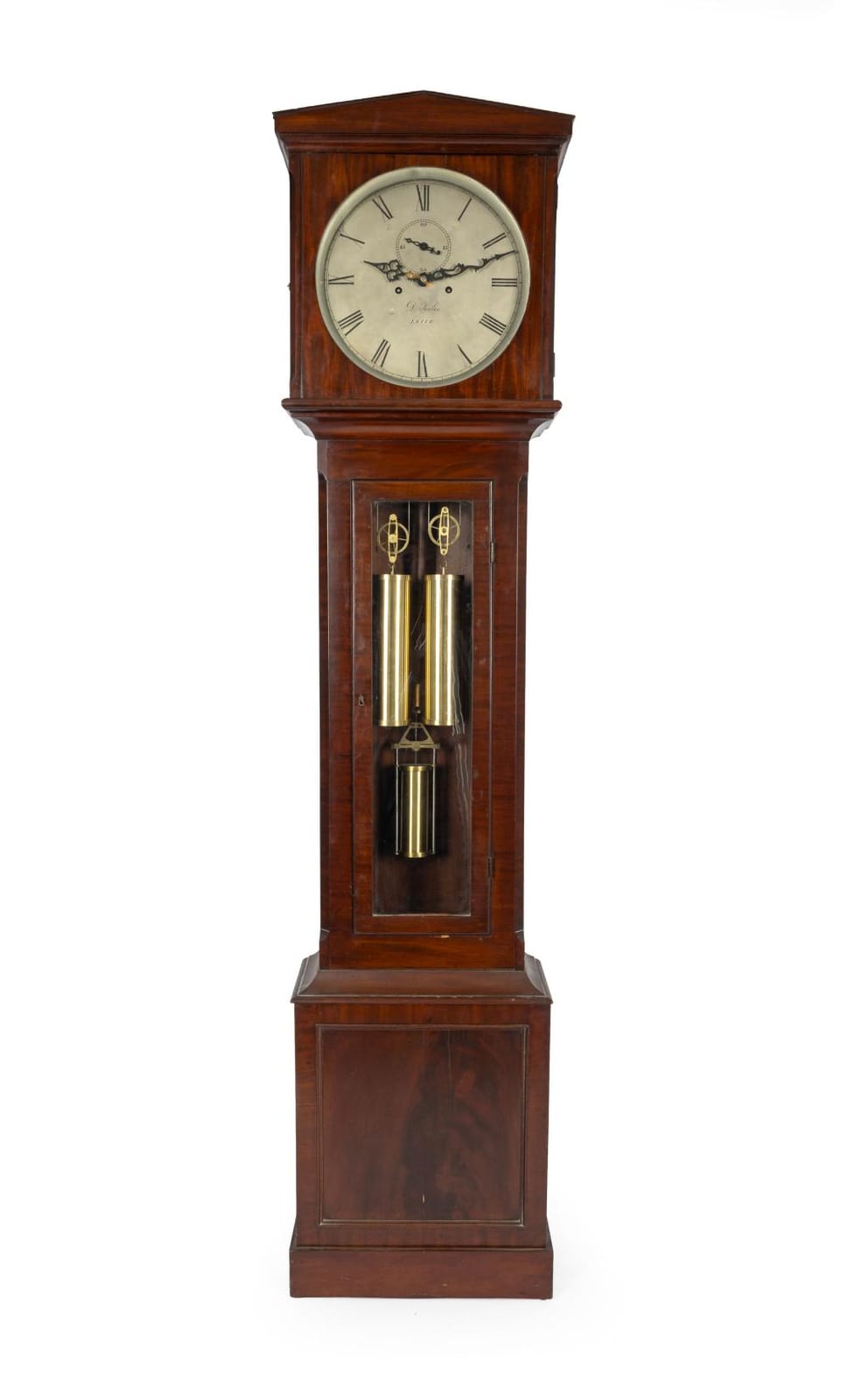
How these auction records were verified
These sales are market context, not an object estimate.
Each row is tied to its lot identity, retrieval time, access result, and immutable record hash. Live source access was blocked; the exact record matched Appraisily's immutable pipeline provenance. Inspect the public comparable provenance record.
Check whether your longcase clock is worth a report
Use the free screener to share maker signature, dial, hood, movement, seatboard, weights, pendulum, and condition photos before paying for a written appraisal.
Care, Conservation, and Practical Ownership
- Environment: Stable humidity (ideally 40–55%) and temperature; avoid radiators and direct sunlight which stress veneers and dial paint.
- Movement servicing: Every 5–10 years by a qualified horologist. Avoid spray lubricants. Document any work done.
- Case care:
- Dust with a soft cloth; use high-quality wax sparingly. Do not strip original finishes.
- Leave dial painting to conservators; avoid solvents or abrasives on painted iron.
- Setting up:
- Ensure the case stands plumb front-to-back and side-to-side; shim discreetly as needed.
- Hang the pendulum and weights correctly (heavier weight typically drives strike on 8-day clocks, though verify).
- Start the pendulum with a gentle push and listen for even tick-tock to verify beat; adjust the crutch as needed.
- Moving:
- Always remove hood, pendulum, weights, and secure the movement before transport. Protect the trunk door and glass.
Practical Checklist: Inspecting a Scottish Mahogany Longcase Clock
- Confirm period and region
- Look for a painted iron dial with Scottish retailer name and town.
- Assess hood style: arched, swan-neck, or drumhead common in Scotland.
- Verify materials and construction
- Mahogany veneers with Scots pine or oak secondary woods.
- Original joinery, backboards, and feet; check for replaced skirting.
- Examine the dial
- Original paint with stable craquelure; inspect numerals and corner art.
- Look for a dial falseplate name to help date.
- Confirm features: seconds, date, moon-phase, automata.
- Assess the movement
- 8-day (two winding holes) vs 30-hour (one hole).
- Complete, clean, and running; no excessive play or over-polishing.
- Check for correct pendulum length and matching hands.
- Check for marriages
- Consistent screw holes in the seatboard and dial feet; matching patina across case, dial, and movement.
- Note condition issues
- Veneer lifts, patches, or re-veneer; replaced glass; modern screws.
- Over-restored dials or movement parts.
- Evaluate value factors
- Desirable hood form, strong veneers, moon-phase, and named Scottish retailer.
- Documented provenance or service history.
FAQ
Q: How can I quickly tell if it’s an 8-day or a 30-hour clock? A: Look at the dial. Two winding holes usually indicate an 8-day movement that runs a week on two weights (time and strike). One winding hole generally indicates a 30-hour movement that needs daily winding and uses a countwheel strike.
Q: What makes a longcase clock specifically Scottish? A: Scottish examples often combine mahogany veneers with Scots pine secondary woods, feature distinctive hood forms (including the drumhead style in the northeast), and bear signatures of Scottish retailers or watchmakers on the painted dial, paired with towns such as Edinburgh, Glasgow, or Aberdeen.
Q: Are moon-phase longcase clocks more valuable? A: Typically yes. A functioning moon-phase, especially with appealing artwork or automata like a rocking ship, elevates both desirability and value, provided the dial remains largely original.
Q: How risky is a repainted dial? A: Heavy overpainting or full repaint reduces value; collectors prefer original surfaces with honest wear. Professional conservation that stabilizes flaking while preserving original paint is preferable to cosmetic overhauls.
Q: What’s the safest way to move one? A: Remove the hood, weights, and pendulum first; secure the movement; pad glass and doors; transport the case upright if possible. Re-level and re-establish the beat after setting up in its new location.