Unlocking the Worth of Vintage Seating the Ultimate Guide to Antique High Chair Value: appraisal and value basics
Unlocking the Worth of Vintage Seating the Ultimate Guide to Antique High Chair Value research should start with identification, condition, provenance, and item-specific market evidence. Use this guide to compare the signals that matter before paying for a formal appraisal or deciding whether to sell.
Antique high chair appraisal checklist
Antique and vintage high chairs sit at the intersection of furniture history, family nostalgia, and design collecting. They range from utilitarian nursery pieces to sculptural works of bentwood and wicker, and their values span modest to museum-worthy. This guide explains how to identify, date, and appraise antique high chairs; what affects price; how to approach restoration; and where and how to sell. Whether you’re cataloging a family heirloom or buying for a collection, you’ll find the tools to determine true market value.
What Makes an Antique High Chair Valuable
Several factors converge to set the value of an antique high chair. Understanding each will help you benchmark realistic prices and avoid costly mistakes.
- Age and originality: Early examples (19th century and earlier) with verifiable age command higher prices, especially when retaining original finish and hardware. Genuine period construction (hand tooling, pegged joinery) outvalues later reproductions.
- Maker and attribution: Labeled or well-attributed pieces — think Thonet bentwood, Heywood-Wakefield wicker, or a documented regional Windsor maker — tend to sell for more than anonymous shop-made chairs.
- Style and design quality: Desirable styles include bentwood (Continental/Jugendstil), American Windsor child chairs, Eastlake and pressed-back Victorian, Mission/Arts & Crafts, and sculptural wicker. Convertible “combination” high chairs that transform into a stroller, rocker, or play table also attract interest.
- Materials and craftsmanship: Solid oak, maple, walnut, and birch are common in the U.S.; bent beech for Thonet; woven cane, rattan, or reed for wicker examples. Mortise-and-tenon joints, pinned stretchers, hand-turned spindles, and tight caning elevate value.
- Condition and originality: Intact trays, footrests, arms, and locking mechanisms matter. Original finishes and paint can double or triple value over refinished surfaces. Replaced parts, cut-down legs, and structural breaks reduce value.
- Rarity and survival rate: Child-size furniture saw hard use; complete, unaltered survivors are relatively scarce, and that scarcity supports price.
- Aesthetic merit: Finely proportioned forms and crisp decoration (stenciling, japanning, gilt striping) stand out.
- Provenance: Documented family history, period photographs, or retailer labels provide context and often a premium.
Note: Antique high chairs are collectible furniture and generally not considered safe for modern child use without specialized conservation and safety review.
Identification and Dating: Features That Tell the Story
If you can read construction clues and stylistic cues, you can usually place a high chair within a few decades and sometimes closer.
- Joinery and tool marks:
- Hand-cut joinery and slightly irregular turnings suggest 19th century or earlier workshop production.
- Pegged mortise-and-tenon joints are period indicators; abundant staples or pocket screws signal later repairs.
- Slot-head screws predate Phillips-head, which becomes common from the mid-20th century onward.
- Hardware and mechanisms:
- Iron or brass locking bars, porcelain knobs, and cast-iron brackets often carry patent dates. Those dates indicate “no earlier than” production.
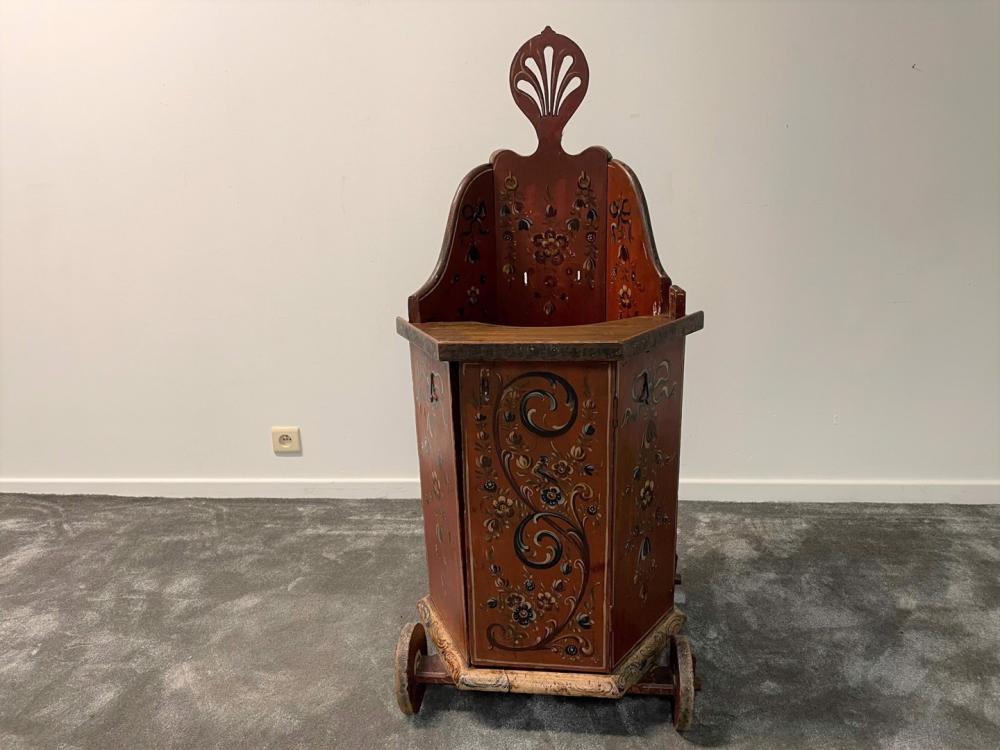
- Combination high chairs with swinging or folding bases may convert to a low wheeled stroller or rocker (“go-cart”/“roller”); examine the mechanism for originality.
- Woods and finishes:
- Golden oak and maple dominate late Victorian/Edwardian American examples; walnut saw earlier use.
- Bentwood child chairs (beech) with ring-stamped numbers or paper labels suggest Thonet or its contemporaries.
- Wicker and reed nursery chairs often trace to American makers such as Heywood Brothers & Wakefield Company; look for paper labels or impressed marks under the seat.
- Original shellac develops fine crazing; thick, glassy clear coats are usually modern polyurethane.
- Seats and supports:
- Caned seats and backs appear on both bentwood and wicker chairs; look for consistent oxidation and wear.
- Rush seats are less common but occur in rural or country pieces.
- Decoration:
- Pressed-back oak (raised floral/sunburst panels) is typically late 19th century.
- Eastlake details include incised linear carving and geometric motifs.
- Painted and stenciled child chairs in the Hitchcock manner, often in black with gilt designs, can be sought after when documented and well preserved.
- Labels and marks:
- Paper labels, decals, brands, and stenciled retailer marks are commonly placed under seats, on stretchers, or on rear rails. Even partial remnants can help date and attribute.
- Scale and form:
- Most antique high chairs stand notably taller than dining chairs and feature a fixed or removable tray, a safety bar, and often a footrest; combination chairs include wheels or curved rockers below.
Dating by era and style (general guide):
- Early to mid-19th century: Child-size Windsors, country chairs, early caned examples; hand-finished parts and simpler restraints.
- Late Victorian (circa 1870–1900): Pressed-back oak, Eastlake motifs, combination high chairs with cast-iron hardware; growing use of decals.
- Turn of the century/Edwardian: Wicker nursery furniture (American), refined bentwood (Continental); paper labels and patent info more common.
- Arts & Crafts/Mission (circa 1900–1920): Straight lines, quarter-sawn oak, visible joinery; less ornament.
- Interwar to mid-century: Chrome-tube and enamel finishes appear; collectible as vintage, typically lower values than earlier artisan work.
Market Values and Price Ranges You Can Expect
Prices fluctuate by region, season, and taste. The following ranges reflect typical observed retail and fair market outcomes for complete, original examples in good condition. Exceptional provenance, rare variations, or outstanding condition can exceed these numbers; heavy wear, missing parts, or aggressive refinishing may halve them or worse.
- Pressed-back oak high chairs (common Victorian): a value that must be established from current, topic-matched sales
- Eastlake-influenced oak/maple high chairs: a value that must be established from current, topic-matched sales
- Combination “go-cart”/rocker high chairs with functional mechanisms: a value that must be established from current, topic-matched sales
- Wicker nursery high chairs (attributed to Heywood-Wakefield and peers): a value that must be established from current, topic-matched sales
- Bentwood child high chairs (Thonet and similar): a value that must be established from current, topic-matched sales
- American Windsor child high chairs (documented regional work): a value that must be established from current, topic-matched sales
- Painted/stenciled child chairs in the Hitchcock tradition: a value that must be established from current, topic-matched sales
- Mission/Arts & Crafts child high chairs: a value that must be established from current, topic-matched sales
- Mid-century chrome-tube/steel high chairs (vintage): a value that must be established from current, topic-matched sales
- Shaker or exceptional folk-art child high chairs: a value that must be established from current, topic-matched sales+
Condition adjustments:
- Original surface/patina: often a category-dependent amount to a category-dependent amount versus refinished.
- Original tray and footrest present: a category-dependent amount to a category-dependent amount.
- Sensitive, documented restoration: neutral to modestly negative.
- Refinished to a bright polyurethane: a category-dependent amount to a category-dependent amount.
- Replaced tray, missing mechanism, cut-down legs, or cracked/broken elements: a category-dependent amount to a category-dependent amount.
- Structural instability or unsafe repairs: large discounts; often unsalable to most collectors.
Market context:
- Regional differences matter: bentwood and Continental pieces can be stronger in urban design markets; country Windsors fare well in regions with established Americana interest.
- Shipping costs curb demand for heavy bulk items; local sales may net higher net proceeds after fees.
- Trend cycles: nursery and toy auctions periodically refocus attention on combination high chairs and exceptional wicker.
Condition, Restoration, and Ethical Choices
Collectors prize integrity and reversibility. The best conservation preserves original material while stabilizing function.
- Cleaning: Start with dry dusting and a pH-neutral wood cleaner. Avoid saturated water or silicone polishes. A microcrystalline wax can refresh without altering the finish.
- Structural repairs: Use reversible adhesives (traditional hide glue) for loose joints. Avoid metal brackets or screws that weren’t present originally unless safety requires it; document any additions.
- Caning and wicker: Professional recaning/reweaving can be acceptable when matched in pattern and color. Partial tinting of fresh cane to blend is preferable to painting over.
- Finish: Retain original shellac/paint whenever possible. Inpainting minor losses may be appropriate; full stripping often erases value.
- Hardware: Source period-appropriate slot-head screws and hardware if replacements are unavoidable. Keep any removed originals in a labeled bag taped under the seat for provenance.
- Safety ethics: Even after restoration, antique high chairs typically should not be used as baby equipment. Treat them as historical furniture for display.
Documentation adds value: photograph “before and after,” keep invoices, and note materials used. Provenance plus repair transparency boosts buyer confidence.
How to Appraise, Price, and Sell
A structured approach yields defensible values whether for insurance, estate planning, or sale.
- Identify and describe
- Record materials, construction, dimensions, and distinctive features (tray mechanism, footrest, arm shape).
- Photograph all sides, the underside, labels/marks, tray hardware, and any damage. Natural, even light is ideal.
- Establish condition
- Note stability of joints, surface finish (original vs. refinished), integrity of caning/wicker, presence of all parts.
- Grade conservatively: excellent, very good, good, fair, or project.
- Research market evidence
- Look at recent sales of similar style, maker, materials, and condition. Focus on actual selling prices, not just asking prices.
- Align venue to venue: compare auction-to-auction and dealer-to-dealer for accuracy.
- Determine the value type
- Fair Market Value (FMV): the price between willing buyer and seller, typical for estates and donations.
- Retail Replacement Value (RRV): the cost to replace with a similar item at retail; typically higher, used for insurance.
- Price for your venue
- Auction: lower estimate to entice bidding; consign with a specialist if the chair is exceptional or maker-marked.
- Dealer/antique mall: price with room for negotiation (a condition-specific range).
- Online marketplace: set competitive pricing near the low end of dealer retail; provide thorough photos and disclosure.
- Prepare to sell
- Gentle cleaning; tighten loose joints if you can do so reversibly.
- Present clear measurements and shipping/collection terms.
- Time listings for peak interest periods (autumn design seasons or before holidays).
Where to sell
- Specialty toy and children’s furniture auctions for rare mechanisms and top-tier examples.
- Americana or design-focused auctions for Windsor, Shaker, bentwood, and wicker.
- Local antique shops and fairs for common pressed-back and Mission styles.
- Online marketplaces for broad exposure; factor in packing and transport.
Care, Storage, and Display
- Environment: Maintain moderate humidity and temperature; avoid direct sunlight to prevent fading or cane desiccation.
- Handling: Lift from the seat rails, not the tray or arms. Lock mechanisms before moving combination chairs.
- Padding: Use felt pads under feet to prevent floor scratches and protect fragile casters.
- Cane and wicker: Support seats in display; avoid heavy objects and seat pressure. Periodic gentle vacuuming with a soft brush removes dust from weave.
- Long-term storage: Wrap loosely in breathable material; never plastic wrap directly against finished surfaces.
Quick Practical Checklist
- Identify the style: pressed-back, Eastlake, Mission, wicker, bentwood, Windsor, or combination chair.
- Check for originality: tray, footrest, locking bar, casters/wheels, and hardware type.
- Inspect joinery: mortise-and-tenon, pegged joints, and hand tool marks vs. modern screws/staples.
- Look for labels or patent dates: underside of seat, stretchers, hardware brackets.
- Evaluate finish: original shellac/paint and honest wear vs. heavy refinishing.
- Assess condition: caning/wicker intact, joints tight, no cut-down legs or replaced parts.
- Photograph thoroughly: all angles, details, and defects; include measurements.
- Research market evidence: match style, maker, condition, and venue.
- Choose venue and price: auction, dealer, or online with realistic expectations.
- Document everything: provenance, repairs, and cleaning notes for the next steward.
Short FAQ
Q: Are antique high chairs safe for everyday child use? A: Generally no. They were built to period standards and may not meet modern safety requirements. Treat them as collectible furniture for display unless evaluated and modified by a qualified professional.
Q: How can I tell if my high chair has its original finish? A: Original finishes often show gentle, uneven wear, fine crazing, and oxidized edges. Modern polyurethane looks thick and glossy with little depth. If in doubt, consult a conservator rather than stripping.
Q: Does refinishing always reduce value? A: Usually. Collectors prefer original surfaces. Sensitive conservation that stabilizes the existing finish preserves more value than a full refinish, which can lower value by a condition-specific range or more.
Q: What if the tray or mechanism is missing? A: Missing functional parts significantly reduce value. Period-appropriate replacements can make the chair displayable, but disclose replacements and price accordingly.
Q: How do I insure a valuable example? A: Obtain a written appraisal specifying Retail Replacement Value, supported by market evidence and a detailed condition report. Update coverage if the market or condition changes.
With a careful eye for construction, a respect for original surfaces, and solid comparable research, you can unlock the true worth of vintage seating and confidently evaluate antique high chairs in any setting.