
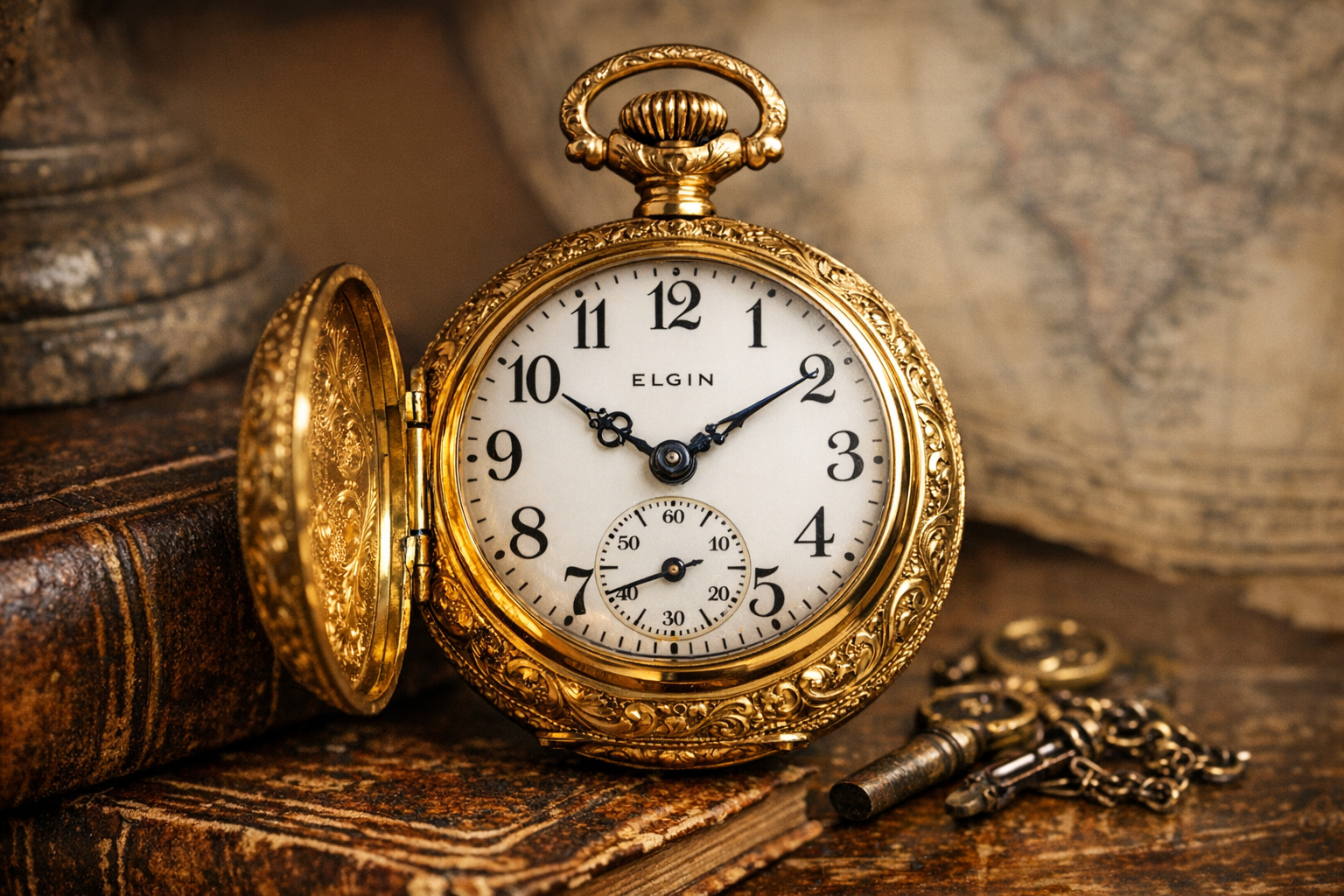
Unlocking the Secrets of Vintage Timepieces Discover the Value of Your Old Elgin Pocket Watch: appraisal and value basics
Unlocking the Secrets of Vintage Timepieces Discover the Value of Your Old Elgin Pocket Watch research should start with identification, condition, provenance, and item-specific market evidence. Use this guide to compare the signals that matter before paying for a formal appraisal or deciding whether to sell.
Old Elgin pocket watch value checklist
Elgin pocket watches are among the most approachable American timepieces for collectors and appraisers. They combine rich industrial history with a wide range of grades, sizes, and case materials—some purely utilitarian, others crafted to the highest railroad standards. If you’ve inherited, found, or collect an Elgin, understanding what you have is essential to assign meaningful value and decide whether to conserve, service, or sell.
This guide walks you through identification, dating, grading, and valuation, then finishes with a practical checklist and quick answers to common questions.
Why Elgin Matters: A Concise History And What It Means For Value
- Origins: Founded in 1864 as the National Watch Company and soon known as the Elgin National Watch Company, Elgin produced tens of millions of movements in Elgin, Illinois.
- Era overview: Production spans late 1860s through mid-20th century. Early 18-size models dominated the late 19th century; by the early 1900s, 16-size became the standard for precision and railroad use.
- Railroad legacy: Elgin’s high-grade lines—B.W. Raymond, Father Time, and Veritas—were built to rigorous standards: higher jewel counts, precise adjustments, lever setting, and robust regulators. These remain the most collectible mainstream Elgins.
- Postwar shift: Manufacturing evolved post-WWII; Elgin phased down U.S. movement production by the 1960s. Later watches with the Elgin name may be Swiss or import movements and are a different collecting category.
Value implications: Collectors often pay premiums for:
- Early, uncommon grades in excellent condition.
- True railroad-grade 16-size and 18-size movements with 21–23 jewels and multiple positional adjustments.
- Originality (unmolested dials, cases, and hands).
- Private-label dials and movements (made for specific jewelers or railroads).
- Presentation or documented provenance.
Identify What You Have: Size, Setting, Jewels, Adjustments, Case, Dial
Start with careful, non-invasive observation. Work over a padded surface with clean hands, and avoid over-winding or forcing stuck case backs.
Key attributes to note:
Size (movement diameter)
- Common Elgin sizes: 0-size and 6-size (smaller, often ladies’), 12-size (dress), 16-size (standard railroad era), 18-size (earlier pocket standard).
- 18-size: larger and thicker; 16-size: slightly smaller and typically later.
Setting mechanism
- Pendant-set: Pull the crown to set—typical of dress or general-use watches.
- Lever-set: A small lever under the bezel must be pulled out to set—preferred for railroad service because it prevents accidental time changes.
Jewels (friction-reducing bearings)
- Elgin movements commonly range from 7 to 23 jewels.
- 7–15 jewels: utilitarian; 17–19 jewels: mid-grade; 21–23 jewels: high-grade, often railroad-suitable.
- Jewel count is typically marked on the movement.
Adjustments (precision tuning)
- “Adjusted” may be followed by positions (e.g., 3, 5, or 6) and temperature/isocronism.
- More adjustments generally equate to better quality and desirability.
- Railroad-grade examples are often adjusted to 5 or more positions.
Case type and material
- Open-face (OF): stem at 12, seconds at 6. Common for railroad watches.
- Hunter-case (HC): hinged metal cover over the dial; stem at 3, seconds at 6.
- Materials: gold-filled (often marked “20 year,” “25 year”), nickel/silveroid, coin silver (.900), sterling (.925), and solid gold (10K, 14K, 18K).
- Many cases were made by separate case companies (e.g., Wadsworth, Keystone), so case serial numbers do not date the movement.
Dial and hands
- Enamel/porcelain dials: double-sunk or single-sunk; hairlines and chips affect value.
- Arabic numerals were common for late railroad era; Roman numerals more typical on earlier or dress dials.
- Montgomery minute tracks and bold Arabic numerals appear on some railroad dials.
- Hands: spade, whip, and other period styles—original style matching the era is better.
Movement finish and markings
- Look for damaskeening (decorative engine turning), grade names (e.g., B.W. Raymond, Veritas, Father Time), jewel count, and adjustments.
- Avoid relying on case engraving alone; value is driven primarily by the movement grade, condition, and originality.
Dating And Grading Your Movement: Serial Numbers, Grades, And Lines
Where to find the serial number
- Open the back carefully and look on the movement (the works), not the case.
- Elgin movement serial numbers are the primary key to estimating production year and grade.
- Caution: Case serials are independent and rarely useful for dating.
Dating considerations
- Elgin’s movement serial numbers underpin most date estimates, especially for watches produced through the early-to-mid 20th century.
- For late pieces, serial conventions changed; cross-reference to authoritative resources for precise dating.
Grades and lines to know
- Named lines with stronger collector interest: B.W. Raymond, Father Time, Veritas.
- Features suggesting a higher grade:
- 21–23 jewels.
- Steel escape wheel on some high grades.
- Gold train wheels on select models.
- Micrometric regulators (e.g., star wheel, swan neck styles).
- Multiple positional adjustments (5+).
- Lever setting; open-face configuration with bold, legible dial.
Private-label and retailer-marked watches
- Elgin often produced movements and dials signed for specific jewelers or railroads.
- Private-label signatures can increase appeal, especially if linked to a known city, railroad, or notable presentation.
Authenticity and originality checks
- “Marriages” (mismatched case and movement) are common. While not inherently bad, a period-correct pairing is preferable.
- Re-cased railroad movements in later cases or dress cases may reduce desirability.
- Refinished dials, luminous paint replacements, or incorrect hands can erode collector value.
What Drives The Market: Rarity, Condition, Originality, Metal, Demand
Market value for Elgin pocket watches spans a wide range. Typical drivers:
Condition and completeness
- Running is good; keeping time is better—but unsserviced, dry watches should not be run extensively.
- Clean enamel dials, original hands, unpolished cases, and crisp movement finishes attract higher bids.
- Cracks, hairlines, missing seconds hands, bent balance staffs, rust, or over-polishing reduce value.
Grade and specification
- Common 7–15 jewel movements in base-metal or gold-filled cases command modest prices.
- 21–23 jewel, lever-set, adjusted movements in open-face cases command premiums, especially in original railroad configurations.
Case metal and weight
- Solid gold cases add intrinsic metal value; gold-filled cases do not.
- For solid gold: calculate approximate melt by weighing the empty case (without crystal, springs, or movement), multiplying by fineness (e.g., 0.585 for 14K; 0.750 for 18K), then by current gold price per gram, less refiner fees.
- Collectors may pay above melt for scarce, desirable watches—don’t rush to scrap.
Provenance and rarity
- Documented railroad service, presentation engravings, or archival materials can enhance value.
- Scarcer grades or early production runs increase desirability.
Indicative retail ranges (heavily dependent on condition, originality, and current demand):
- Common 12-size or 18-size, 7–15 jewel, base-metal or gold-filled case: roughly a value that must be established from current, topic-matched sales.
- Better 16-size pendant-set with 17–19 jewels in nice condition: roughly a value that must be established from current, topic-matched sales.
- True railroad-grade 16- or 18-size with 21–23 jewels, lever-set, and multiple adjustments: roughly a value that must be established from current, topic-matched sales; exceptional, mint, boxed, or rare variants can bring a value that must be established from current, topic-matched sales+.
- Solid gold cases: intrinsic metal value can add several hundred dollars or more, depending on karat and weight; collector-grade examples can exceed melt by a wide margin.
These are broad, transparent ranges meant to orient you; confirm with recent, market evidence of like-for-like condition and specification.
Appraisal Workflow: From Bench To Estimate
Use a methodical approach:
- Document and photograph
- Photograph the dial, movement (with readable markings), case exterior, hinges, and any inscriptions.
- Note any damage: hairlines, chips, case dents, brassing, or corrosion.
- Identify and record specs
- Movement serial number, jewel count, adjustments, setting type (pendant/lever), size (0s/6s/12s/16s/18s), and named grade if present.
- Case material and maker marks (e.g., karat hallmarks, “gold-filled,” “20 year,” “sterling,” “coin silver”).
- Date and grade the movement
- Use a reliable serial number reference to estimate production period and verify grade.
- Confirm whether the configuration is correct (e.g., open-face lever-set for railroad).
- Assess originality
- Does the dial match the grade and period? Are the hands correct style? Is the case appropriate for the movement’s size and era?
- Look for evidence of re-casing: extra case screw marks, misaligned lever slots, or non-period case style.
- Evaluate condition and running status
- Do not force winding if resistance is rough; a stuck mainspring or dried oils can damage parts.
- Note balance motion and whether it runs through a full power reserve.
- Factor in a routine service cost if selling (commonly a value that must be established from current, topic-matched sales+ depending on region and complexity).
- Determine value
- Weigh case metal (if solid gold) for a melt baseline; don’t include the movement.
- Compare with recent sales of the same grade, jewel count, and condition.
- Add premiums for standout features: rare private labels, superior dials, exceptional originality.
- Decide on conservation vs restoration
- Light conservation (gentle cleaning, correct crystal replacement, sympathetic service) usually adds value.
- Avoid aggressive polishing, dial repainting, or swapping parts. Originality is king in the pocket watch market.
Care, Storage, And Sensible Restoration
- Service intervals: If you plan to run the watch, a full service every 5–10 years helps preserve it. Dry oils increase wear.
- Storage: Keep in a dry, stable environment away from magnets. Store dial up or crown up to avoid stress on the balance if running.
- Handling: Use a soft cloth; avoid over-winding. If a lever-set, gently pull the lever with a fingernail—don’t pry metal tools against the case.
- Crystals and cases: Period-correct glass crystals look right and protect the dial. Avoid polishing gold-filled cases to the point of brassing.
- Luminous material: Early luminous paints can contain radium. If present, avoid scraping or inhaling dust; consult a professional.
Quick Appraisal Checklist
- Photograph dial, movement, case, and any inscriptions.
- Record movement serial, jewel count, adjustments, setting type, and size.
- Note case material and maker; verify if solid gold, gold-filled, nickel/silver, coin, or sterling.
- Confirm configuration: open-face vs hunter; lever-set vs pendant-set.
- Check originality: dial, hands, case fit, lever slot alignment, extra case screw marks.
- Assess condition: hairlines, chips, dents, corrosion, brassing, movement cleanliness.
- Test gently: does it wind and run? Do not force; avoid running a dirty movement.
- Establish baseline value: solid gold melt (if applicable) + collector premium for grade, condition, and rarity.
- Compare to recent sales of like-for-like examples.
- Decide on light service or conservation before listing or insuring.
FAQ
Q: How do I find the serial number on an Elgin pocket watch? A: Open the back carefully and look on the movement itself, not the case. The movement serial number lets you estimate production date and grade. Case serials are from separate case makers and generally don’t date the watch.
Q: Is lever-set always better than pendant-set? A: Not always, but lever-set typically indicates a higher-grade, railroad-appropriate configuration, which is more sought after by many collectors. Pendant-set dress watches can still be desirable if condition and originality are strong.
Q: Does a gold-filled case have significant melt value? A: No. Gold-filled cases are layered and not worth significant melt. Solid gold cases will be marked 10K, 14K, or 18K (or with hallmarks). Verify gold content before assuming melt value.
Q: Should I service my Elgin before selling it? A: If the watch is a quality piece and hasn’t been serviced in years, a professional service may improve value and buyer confidence. For lower-value examples, disclose “running/untested” honestly and price accordingly—full service might exceed the sale price.
Q: What’s the difference between open-face and hunter-case, and does it affect value? A: Open-face has no lid and the crown at 12; hunter-case has a metal lid and the crown at 3. Many railroad-grade watches are open-face, which often helps demand. Hunter-cases can be very attractive and collectible, especially in solid gold, but desirability depends on the specific model, grade, and condition.
With a careful look at size, setting, jewels, adjustments, case metal, and originality—plus methodical documentation—you can unlock the history and value of your Elgin pocket watch. Whether you keep it, insure it, or sell it, a grounded, detail-driven appraisal will serve you well.


