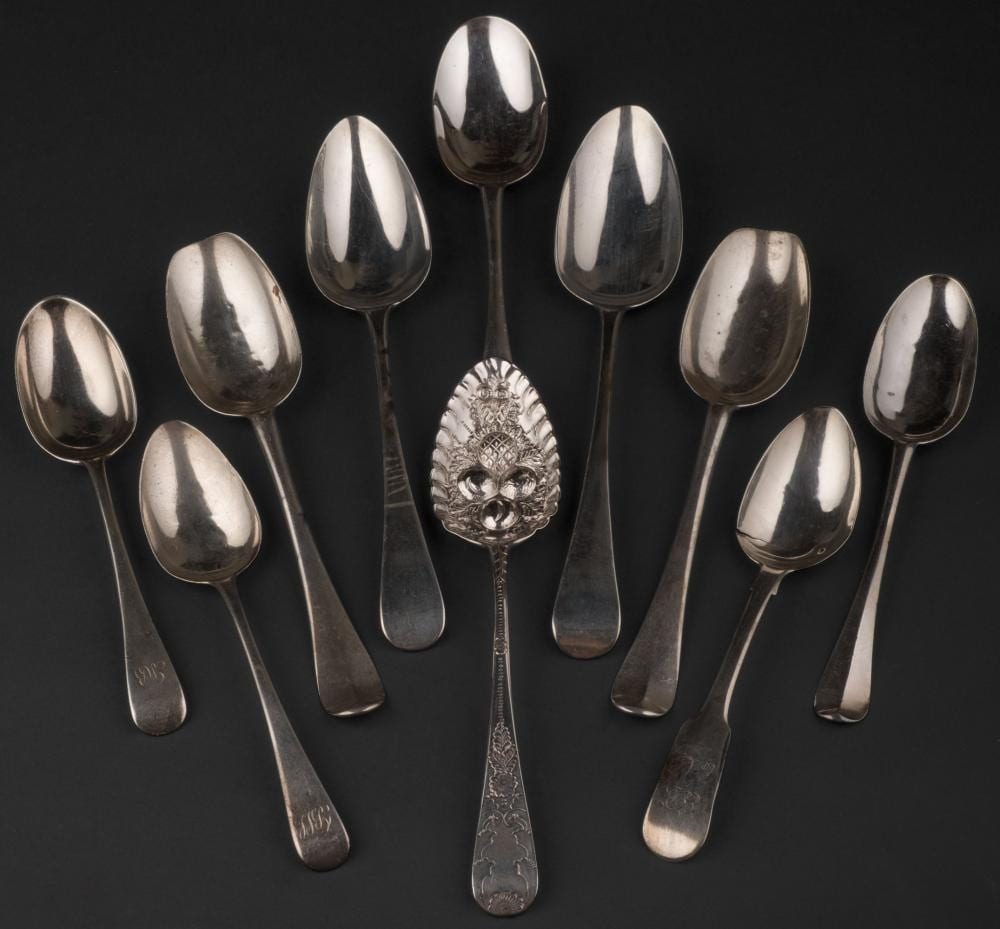
Unlock the Secrets of Antique Spoons a Collectors Guide to Determining Value and Rarity: appraisal and value basics
Unlock the Secrets of Antique Spoons a Collectors Guide to Determining Value and Rarity research should start with identification, condition, provenance, and recent comparable sales. Use this guide to compare the signals that matter before paying for a formal appraisal or deciding whether to sell.
Antique spoons value checklist
Antique spoons reward close inspection. In a small surface area you get metal, marks, design, craftsmanship, regional history, and sometimes a named owner or event. When those elements align—genuine silver, desirable maker and pattern, scarce form, and clean condition—values rise quickly. This guide shows you how to evaluate what you have and why it matters.
Read The Metal: Sterling, Coin, Plate, And Beyond
Before patterns or provenance, determine what the spoon is made of. Metal drives a baseline value and often hints at origin and age.
- Sterling silver (925/1000)
- UK: Often signaled by a lion passant (England/Wales) among other hallmarks.
- US: Typically stamped STERLING or 925 (wide adoption after the 1860s).
- Continental Europe: Frequently numerical fineness (e.g., 800, 830, 900, 925).
- Coin silver (typically 900/1000)
- Common in early to mid-19th century United States. Marked COIN, PURE COIN, or implied by maker’s punch alone. Often hand-wrought or die-struck with lighter gauge than later sterling.
- Higher standards and regional fineness
- France: Minerva head with “1” for .950 and “2” for .800 standard.
- Russia (pre-1917): Kokoshnik head with a zolotnik number like 84 (~.875).
- Scandinavian: Sweden’s three crowns and “S,” Norway often 830S, Denmark’s “three towers” on older pieces and later “925S.”
- Germany (post-1888): Crescent moon and crown plus fineness (800/835/925).
- Silver plate
- Electroplate often marked EP, EPNS, A1, or “silverplate.” Intrinsic metal value is negligible, but collectible makers (e.g., Elkington, Christofle) and certain designs can be desirable.
- Old Sheffield Plate (fused silver on copper, c. 18th–early 19th century) shows copper bleed at high wear points and rolled edges; rarer spoon forms can be collected on design merit.
Quick tests you can do without chemicals:
- Magnet: Silver and typical plating alloys are non-magnetic; if it sticks firmly, it’s not silver.
- Sound: Sterling often rings with a clearer, longer tone when lightly tapped, while plated base metal sounds duller. Not definitive, but suggestive.
- Weight and feel: Sterling spoons often have a denser, warmer feel than plated versions of the same size. Heavier gauges generally indicate higher quality.
Note: Acid testing or XRF analysis provides confirmation but risks damage (acid) or requires equipment (XRF). Use hallmarks first.
Decode Hallmarks: What The Stamps Reveal
Hallmarks are your most reliable roadmap to origin, fineness, date, and maker—when genuine and readable.
Common hallmark components:
- Maker’s mark: Initials or a punch associated with the silversmith or company.
- Standard/fineness mark: Indicates purity (e.g., lion passant for sterling in England, numeric fineness in Continental systems).
- Assay office/town mark: Identifies the office where the item was tested (e.g., leopard’s head for London, anchor for Birmingham, crown on older Sheffield, castle for Edinburgh).
- Date letter (Britain and some others): A letter in a distinctive font/shield shape that cycles through the alphabet to denote a specific year.
- Duty or tax marks: Period-specific stamps showing tax paid (e.g., British monarch’s head in certain periods, Irish Hibernia mark usage evolved from duty to assay).
Other regions:
- France: Minerva head plus a lozenge-shaped maker’s mark with initials and a symbol.
- Russia: Town, assayer’s initials, and zolotnik number with kokoshnik stamped in different orientations/poses depending on era.
- US: Often just “STERLING” with a maker’s mark; earlier coin silver with only maker’s mark.
Red flags and pitfalls:
- Spurious “pseudo hallmarks” on 19th-century Continental and Dutch pieces that mimic British punch layouts without legal meaning.
- Cast copies where marks look soft, smeared, or integral to the casting rather than struck.
- “Married” spoons with a handle from one maker attached to another bowl. Misaligned seams or mismatched marks are clues.
Tip: Study the spacing, depth, and crispness of punches. Real hallmarks typically show clear, struck impressions with metal displaced at edges; cast or later-added marks often lack that sharpness.
Form, Style, And Function: Dating By Design
Design language is a powerful dating tool when you know the key transitions. Function matters too—some forms are rare by nature.
Early to 18th-century highlights:
- Apostle spoons: Figurines of apostles on terminals (mostly 16th–early 17th century). Genuine early examples are scarce and expensive; many later commemoratives exist.
- Seal-top, slip-top, and trefid terminals: 16th–late 17th century; trefid ends show split trefoil tips.
- Dog-nose and dognose variants: Early 18th century, often with rattail drops (a reinforcing “rat-tail” on the back of the bowl).
- Hanoverian and Old English patterns: Mid- to late-18th century; Hanoverian often downturned handles; Old English upturned with restrained elegance. Bright-cut engraving flourished c. 1780–1810.
19th-century to early 20th-century:
- Fiddle, Fiddle Thread, and Shell: Robust early-to-mid 19th century staples.
- Kings and Queens patterns: Heavy rococo revival, high relief, high desirability in clean condition.
- Provincial and Irish variants: Irish Fiddle and Celtic revival details; Irish silver often commands premiums.
- Aesthetic Movement and Japonisme (US/UK c. 1870–1895): Asymmetry, naturalistic motifs (birds, insects, bamboo), textured surfaces; American examples by Gorham, Whiting, and Tiffany are strong sellers.
- Art Nouveau/Jugendstil (c. 1895–1914): Organic, flowing forms; French, German, Austrian, and Scandinavian makers excelled here.
- Arts & Crafts: Handwrought surfaces, visible hammering, restrained decoration; American studios (Kalo, Arthur Stone) and British workshops produce highly collectible spoons.
- Souvenir spoons (c. 1890–1910): Tourist-driven sterling souvenirs; values vary by theme, maker, and complexity.
Specialist spoon types that can be notably valuable:
- Caddy spoons: Small, often shell-shaped tea caddy scoops; early and unusual designs are coveted.
- Mote spoons: Pierced bowls and pointed handles used to remove tea leaves from strainers (18th century); originals are scarce.
- Marrow scoops: Double-ended oblong bowls; Georgian sterling examples are strong, especially in sets.
- Berry/sugar sifters: Pierced bowls with gilt interiors; crisp piercings and original gilding increase desirability.
- Salt and mustard spoons: Many have gilt bowls (resistant to salt corrosion); matching sets with original tableware add value.
Handle construction and bowl details:
- Rattail and “drop” forms under the bowl help date earlier spoons.
- Bowl shapes evolved—from fig-shaped earlier bowls to more oval and then elongated Victorian bowls.
- Re-tipped bowls or reshaped rims are common repairs; they reduce value.
Makers, Patterns, And Provenance: Who, What, And Why It Matters
The right name or pattern can dwarf metal value.
Makers and firms that drive demand:
- American: Tiffany & Co. (Chrysanthemum, Japanese, Lap-Over-Edge), Gorham (Medallion, Strasbourg), Whiting (Lily), Dominick & Haff, Durgin. Early Southern, Western, and small-town American silversmiths can be very rare.
- British & Irish: Paul Storr and Regency period silversmiths for high-style Georgian spoons; provincial Irish and early Dublin makers often fetch premiums.
- Scandinavian: Georg Jensen (Acorn/Konge, Blossom/Magnolia, Cactus) with clear early marks; other Danish, Swedish, and Norwegian studios are strong among design collectors.
- Continental: French master workshops under the Minerva system; Christofle for quality plated wares; select Austro-Hungarian and Russian makers (pre-Revolutionary) for enamel and presentation pieces.
Pattern desirability factors:
- High relief, deeply struck ornament wears better and brings higher prices in well-preserved examples.
- Discontinued or short-run patterns are scarcer.
- Aesthetic, figural, and naturalistic motifs tend to outperform plain patterns when condition is excellent.
Provenance and inscriptions:
- Presentation inscriptions with dates, institutions, regimental affiliations, or notable owners add interest and can substantively increase value—especially when documented.
- Retailer marks (e.g., prominent jewelers) can help place the item geographically and temporally and sometimes add cachet.
Sets and services:
- Matched sets with identical maker, assay office, and date letters generally command premiums over mixed assemblages.
- Laying out place settings (dessert, table, and teaspoons) in an original fitted case can multiply value beyond individual spoons.
Condition And Alterations: Where Value Is Won Or Lost
Condition is the most common deal-maker—or breaker.
What to look for:
- Wear to high points: Smoothness where pattern should be crisp indicates polishing and use; consider how this reduces detail relative to the same pattern in better condition.
- Bowl integrity: Tip thinning, pinholes, dents, or creases reduce value. Re-tipped or reshaped bowls (look for uneven rim profiles and solder seams) signal repairs.
- Gilding: Original gilt interiors (often on salts and sifters) should appear even and mellow; fresh or patchy gilding suggests later re-gilding.
- Monograms: Tasteful original monograms can be neutral or even positive if they tie to provenance. Removed monograms leave “skinning,” flat spots, or blur where engraving should cut sharply. Heavy removal is value-negative.
- Solder and marriages: Different color tones between handle and bowl, visible seams, or mismatched marks indicate composite or repaired pieces.
- Straightness and twist: Handles should be straight and untwisted. Subtle bends can often be corrected by professionals but affect value as-found.
- Surface: Excessive machine polishing rounds edges and erases hallmarks; light hand polishing is preferred. Deep scratches and pits are hard to remedy.
Care best practices:
- Store in acid-free, sulfur-free environments (avoid rubber bands and wool felt). Use inert anti-tarnish strips or bags.
- Clean with non-abrasive silver polish and soft cloths; avoid buffing wheels.
- Do not over-polish matte or hand-hammered Arts & Crafts surfaces; the texture is part of the value.
Market realities:
- Heavier gauge sterling generally brings more than thin-gauge equivalents, but maker, pattern, and rarity often trump weight.
- Plate rarely matches sterling for value; exceptions include early Old Sheffield Plate and high-design or documented electroplate.
- Regional scarcity (Irish provincial, early American regional, Russian pre-1917, select Continental workshops) can escalate prices quickly.
Quick Appraisal Checklist
Use this sequence for a fast, structured assessment.
- Identify the metal
- Look for STERLING/925, numeric fineness (800/830/900/925), or plating marks (EP, EPNS).
- Note regional hallmarks (lion passant, Minerva, crescent/crown, kokoshnik, three towers, three crowns).
- If uncertain, do not scratch-test first; read the marks.
- Read and record all marks
- Photograph hallmarks straight-on with good light.
- Transcribe maker’s initials, symbols, and any date letters or office marks.
- Note anomalies: mismatched marks, soft/cast-looking punches.
- Place the design in time
- Handle outline (trefid, Hanoverian, Old English, Fiddle, Kings).
- Bowl shape and underside (rattail/drop).
- Decoration style (bright-cut, Aesthetic, Art Nouveau, Arts & Crafts).
- Identify the form and function
- Teaspoon, dessert, tablespoon, ladle, caddy, mote, marrow scoop, sugar sifter, salt/mustard spoon.
- Rarer forms typically increase interest.
- Evaluate condition and originality
- Check for bowl wear, dents, repairs, gilding quality, straightness, monograms vs removals, surface integrity.
- Confirm the handle and bowl belong together; compare punches and metal color.
- Weigh context and comparables
- Maker and pattern desirability.
- Set vs single; fitted cases; provenance inscriptions.
- Regional rarity and current demand for that category.
- Decide on next steps
- Preserve as is, seek a professional appraisal for notable makers/marks, or group compatible items into sets for sale.
FAQ
Q: How can I quickly tell sterling from silver plate without chemicals? A: Start with marks: STERLING/925 and proper assay hallmarks indicate silver; EP/EPNS/A1 are plate. Then consider weight, ring, and how the pattern wears at high points. When in doubt, consult a specialist before testing.
Q: What is “coin silver,” and is it less valuable than sterling? A: Coin silver is typically about 900/1000 fineness and common in early American flatware. Collectible value depends more on maker, region, age, and form than the small difference in purity; scarce coin silver by notable regional silversmiths can exceed sterling of lesser interest.
Q: Do monograms reduce value? A: Original, well-executed monograms are often neutral and can be positive when tied to provenance. Removed monograms usually hurt value, especially when surface “skinning” is evident.
Q: Should I polish an antique spoon before selling? A: Light, careful hand polishing to remove active tarnish is fine; avoid over-polishing that rounds edges or softens detail, and preserve intentional finishes (gilding, matte hammering). Leave deeply oxidized crevices in high-relief patterns for contrast.
Q: Are mismatched sets worth keeping together? A: A visually cohesive set from the same pattern and maker with close date letters is best. However, curated mixed sets of similar period and style can still be marketable, especially in practical groupings (e.g., six dessert spoons). Matched original sets in cases command the highest premiums.
By focusing on metal, marks, design, maker, and condition—in that order—you’ll quickly separate common pieces from exceptional ones. With practice, the small clues on a spoon become a readable map to its origin, age, rarity, and value.


