Have one like this? Check yours freeOr have an appraiser value it
Lot description
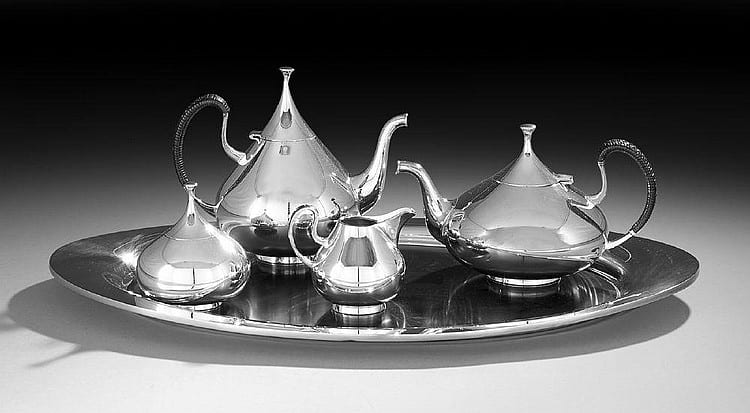
Five-Piece Reed & Barton "Dimension" Silverplate Tea and Coffee Set, the pattern designed in 1960 by John Prip (1922-2009), Taunton, Massachusetts, including a coffeepot, h. 8-1/4", l. 9-3/4", dia. 5-3/4", a teapot, h. 6-1/4", l. 10-1/4", dia. 6-1/4", a covered sugar bowl, h. 4-3/4", dia. 4-1/4", a cream jug, h. 4", l. 4-3/4", dia. 3-1/2", and a tray, l. 25-1/2", w. 16", in a striking modernist design with tall waisted finial lid, the arched handles with black plastic wicker-wrapped handles, the oval tray with conforming black Formica insert. In 1957, Reed & Barton president Roger Hallowell introduced its Design Program in an effort to promote innovative modern design and return the creation of silverware to true artisans. To this end, he hired silversmith John Prip, a former teacher at the School for American Craftsmen in Rochester, New York, as craftsman-in-residence. One of Prip's first assignments was to bring his design sensibilities to creating companion hollowware to Reed & Barton's 1958 "Diamond" pattern flatware designed by the famous Italian architect Gio Ponti (1891-1979). Prip designed two more tea sets during his tenure (1957-1960): "Denmark" and "Dimension", the present lot. "Dimension" was patterned after his 1954 hand-crafted "Onion" teapot, now conserved in the Boston Museum of Fine Arts. The fluid lines and drop shapes create a subtle visual metaphor for the contents within. Prip also designed "Dimension" flatware, though this was not exactly a companion to the tea set. Although Prip left his permanent position with Reed & Barton in 1960, he remained a consulting and freelance designer for the firm for another decade. A set identical to the present lot is conserved in the Jewel Stern Modern Silver Collection at the Dallas Museum of Art and is discussed and illustrated in the collection's catalogue: see Jewel Stern, Modernism in American Silver: 20th Century Design (New Haven: Yale University Press, 2005), pp. 242-252, passim, illustrated p. 243 and 250, fig. 12.8.