Have one like this?
Upload a photo for a free check of what yours may be worth.
Lot description
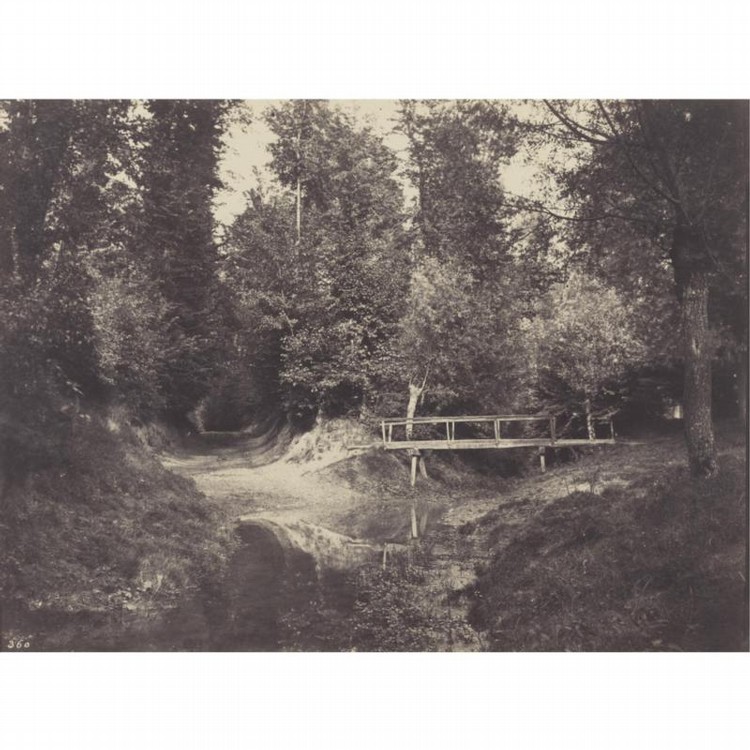
'VILLAGE DE RIVIÈRE' measurements note 10 by 13½ in. (25.4 by 34.3 cm.) salt print, numbered '360' by the photographer in the negative, mounted, titled in an unidentified hand in pencil on the mount, matted, 1860s PROVENANCE The collection of John Chandler Bancroft, Middletown, Rhode Island Gustave J. S. White Co., Auctioneers, Newport, Rhode Island, 1989 Acquired from the above by a New England antiques dealer To the present owners, 1989 EXHIBITED New York, The Metropolitan Museum of Art, Eugène Cuvelier, Photographer in the Circle of Corot, October 1996 - January 1997 Stuttgart, Staatsgalerie Stuttgart, Eugène Cuvelier oder Die Legende vom Wald, March - May 1997 Paris, Musée d'Orsay, Eugène Cuvelier (1837-1900) Photographe de la Forêt de Fontainebleau, June - August LITERATURE Ulrike Gauss, Henning Weidemann, and Daniel Challe, Eugène Cuvelier (Stuttgart, 1996, in conjunction with the exhibition), no. 360 (this print) NOTE While the exact locale pictured in this photograph is unknown, it is almost certainly within the environs of Fontainebleau. The simple ~-shaped wooden structures used to support the small footbridge in this image are also visible in Cuvelier's 'Bornage de Barbizon' (Lot 33), there unused and resting alongside a road. It is likely that Village de Rivière shows a portion of one of the walking trails blazed by Claude-François Denecourt in the forest. While a champion of the natural splendor of Fontainebleau, Denecourt was not above altering the landscape for effect, or, for that matter, nailing large blue directional arrows onto the forest's trees. Cuvelier, for the most part, seems to have avoided Denecourt's programmed tourist routes through the forest. And while glimpses of both logging and quarrying can be seen in a number of Cuvelier's images, Village de Rivière is the only photograph in the collection that documents evidence of what was becoming Fontainebleau's other chief industry: tourism. Village de Rivière, with its complex composition, expert use of light, and surprising rendering of space, rises well above the level of a picturesque view of a shaded forest pathway. In it, Cuvelier uses the light to illuminate strategic details throughout the focal plane: the footbridge in the foreground; the highlighted hedge by the left-hand pathway in the middle distance; and the thick sunlit trunk of a tree on the right side of the image in the far distance. It is through Cuvelier's deft handling of the available light that he convincingly conveys a sense of the forest's depth. Creating such a photograph would have posed a number of technical challenges: the limitations of the photographic materials available to Cuvelier, and the low and shifting light of the forest, among them. In no other photograph is Cuvelier's technical skill as a photographer, not to mention his sophisticated talent for composing a picture, so capably demonstrated. Gauss accounts for only one print of this image: the salt print offered here. The astonishing level of clarity and detail present in this print, suggests that it was made from a glass, as opposed to a paper, negative (see Lots 12, 17, and 25).