Lot description
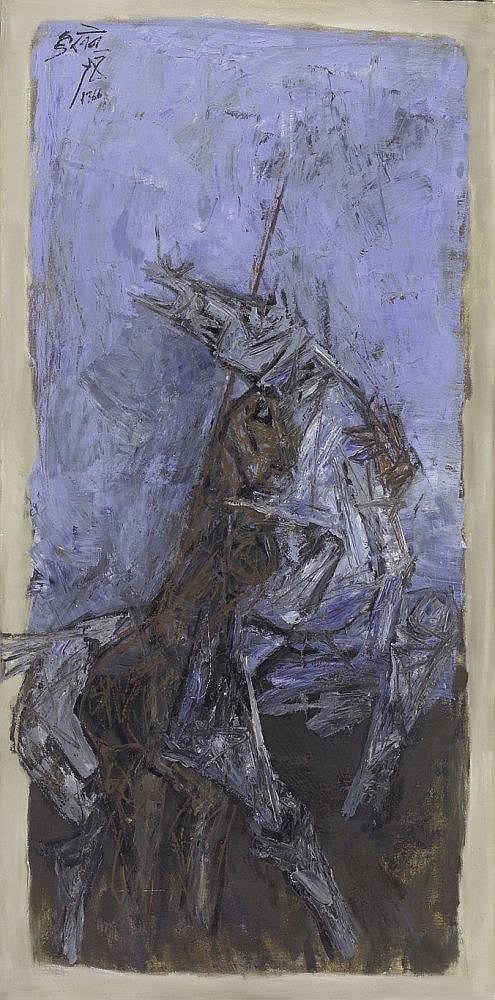
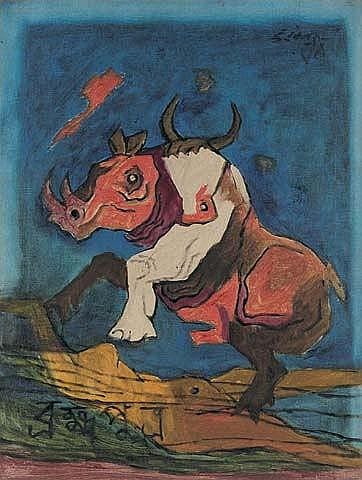
MAQBOOL FIDA HUSAIN (1915 - 2011) Brahmaputra Acrylic on canvas 27 1/4 x 20 1/2 in. (69 x 52 cm.) Signed in Devanagari upper right, inscribed in Bengali lower left and further signed and inscribed 'Husain / 'BRAHAMPUTRA" ' on reverse The Brahmaputra is roughly two thousand nine hundred kilometres long. It originates in western Tibet and is known by many names - Tsangpo in Tibet, Lohit or Brahmaputra in India and Jamuna in Bangladesh. Its waters are shared by China, India, and Bangladesh. When the Brahmaputra merges with the Ganges and Meghna they form the largest river delta in the world. The Brahmaputra floodplains in Assam contain the Kaziranga National Park, which support healthy populations of Bengal tigers, elephants, deer, water buffalo, boar, monkeys, reptiles and birds. The park's most famous resident is the Great Indian one-horned rhinoceros. Within the context of Hindu mythology the river's name is equally unusual in that most Hindu rivers are associated with river goddesses whilst here the river has a rare male name 'son of Brahma'. It was perhaps the river's unusual blend of historical, religious and ecological importance that inspired Husain to paint a picture named after the river. In characteristic style, Husain has chosen his own multifarious symbolism to form an image that captures the essence of what the rivers represents. In Hindu traditions the River Goddesses are frequently depicted with their vahanas; Ganga is depicted with her Makara and Yamuna with Kurma. In this instance it appears that Husain has created a mythical beast of composite form to become the vahana for Brahmaputra that reflects the wildlife that the river's own ecosystem currently supports. Such composite animals have a long history in Indian art and are seen in both Indian miniature paintings and early Indian temple sculptures, but here Husain has created his own twist that makes the symbol both contemporary and yet timeless.