Lot description
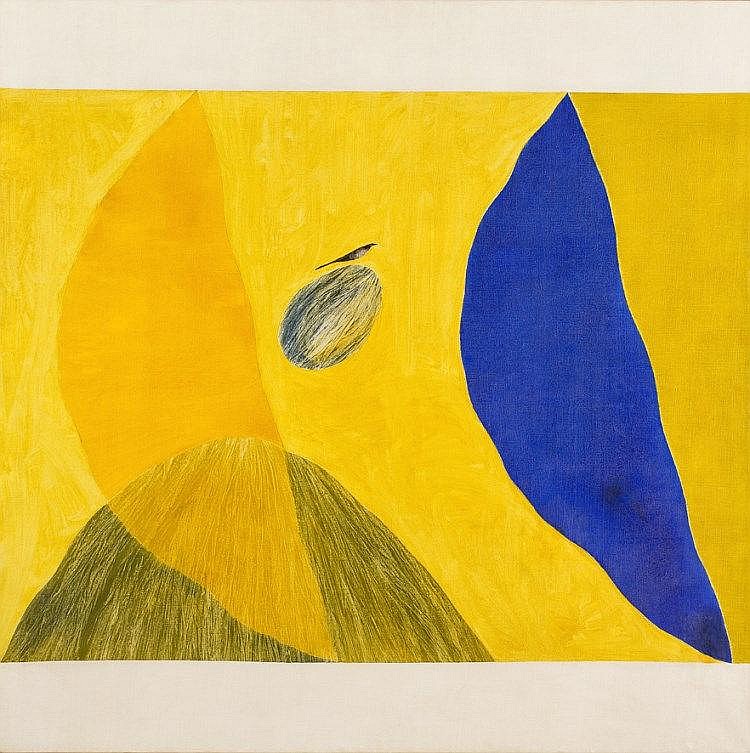
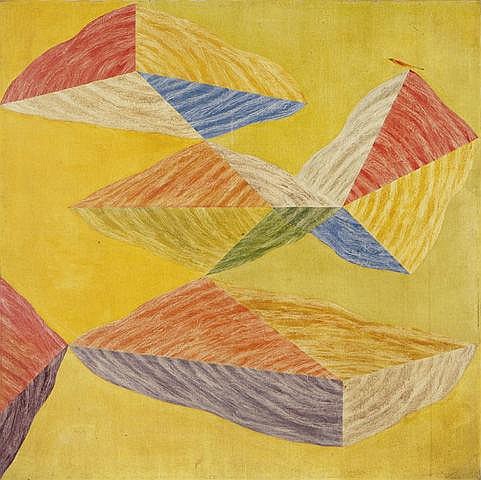
JAGDISH SWAMINATHAN (1928 - 1994) Bird, Tree and Mountain Oil on canvas 49 x 49 in. (124.5 x 124.5 cm.) 1972 Signed and dated 'J. Swaminathan 72' on reverse In August 1962, Swaminathan founded Group 1890. The manifesto of the Group evidently written by Swaminathan, was an attack on the 'vulgar naturalism' and the 'pastoral idealism' of the Bengal School and the 'hybrid mannerism' of European modernism. The manifesto urged artists to see phenomena in their 'virginal state'. Swaminathan's canvases from the 1960's can be seen as his personal search for the virginal state in art. 'His perception of this virginal state of phenomena he tried out in his paintings, creating an alternative pictorial space in dividing purely conceptual landscapes in bright colour fields on which appeared mountains, stretches of water trees, diagonally levitating stones with an archetypal bird form. Painted with captivating simplicity his paintings explored the pictorial possibilities of his limited imagery which were emblematic of elements necessary for man's survival on earth and interpretatively the numerous permutations and combinations of the imagery and bright colours suggested the ascent of man's inner being leaving the gross and the sullied.' (J. Swaminathan, 20th Century Museum of Contemporary Indian Art, presented online by Vadehra Art Gallery.) The first and last exhibition of Group 1890, held in 1963, was introduced by the famous Mexican poet and ambassador to India Octavio Paz, who was himself, hugely influential to Swaminathan. Swaminathan wrote 'Octavio is one of those rare geniuses, who have the power of devising the submerged intelligence in you and then listening to him is an experience in self-discovery.' In 1966 Swaminathan and Paz published the magazine Contra, which included critical articles concerning the overbearing influence of the Paris School on the work of the Progressive Artists Group in India. The 1940's split between the American Abstract Expressionists' concerns with mystical primitivism versus the figurative preoccupation of European painters can be compared to the almost polar views and approaches of Swaminathan and the Progressives in India, two decades later. In stark contrast to the Progressives, Swaminathan's paintings of the 60's resisted any influence from movements in the West, and were instead imbued with symbols drawn almost entirely from Indian tribal art. 'Swaminathan's artistic ambition was to establish a continuum between folk, tribal, and urban contemporary art. Questioning the notion that Modernism developed from an encounter with the West, he sought to redefine contemporary practice by taking into account the philosophical underpinnings of Indian Art. A truly Indian art could only develop, he felt, by overcoming the divide between art and craft.' (Amrita Jhaveri, A Guide to 101 Modern and Contemporary Indian Artists, Mumbai, 2005, p. 93.) 'Swaminathan's artistic ambition was to establish a continuum between folk, tribal, and urban contemporary art. Questioning the notion that Modernism developed from an encounter with the West, he sought to redefine contemporary practice by taking into account the philosophical underpinnings of Indian Art. A truly Indian art could only develop, he felt, by overcoming the divide between art and craft.' (Amrita Jhaveri, A Guide to 101 Modern and Contemporary Indian Artists, Mumbai, 2005, p. 93.) Underlying Swaminathan's iconic conceptual landscapes is a deeply spiritual reverence for the un-witnessed universe. The flat planes of saturated yellows and orange delineate and contrast with asymmetrical segments of fine detailing. The mountainous forms appear to be abstracted in the manner of an aerial map but conceptually the works are more complex. The delicate bird, the only identifiable feature, creates an identifiable scale which suggests that the landscape is instead a magnified view of minutiae. Yet regardless of these intentional ambiguities the painting masterfully resonates calm. 'Given the life of the canvas and its colours, a painting is immutable, fixed and eternal. It does not know growth and decay. Yet it has a life of its own, in as much as it is never the same to any two persons in space or even the same person in time. Like Zeno's arrow, it is moving yet still, changeless yet changing.' (J. Swaminathan, 'The Traditional Numen and Contemporary Art', Lalit Kala Contemporary 29, April 1980, pp. 5-10.)