Have one like this? Check yours freeOr have an appraiser value it
Lot description
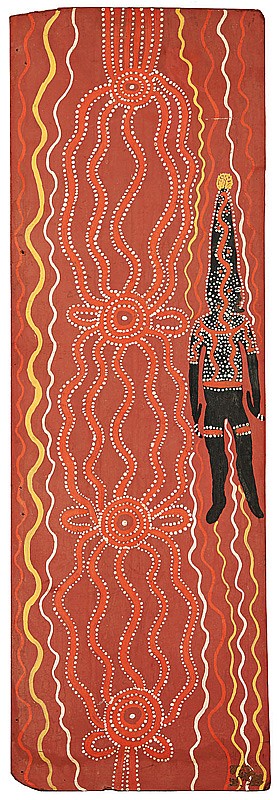
Long Jack Phillipus Tjakamarra born circa 1932 WATER CEREMONY STORY (VERSION 1) (1971) synthetic polymer paint on composition board 87.6 X 34.3CM PROVENANCE Painted at Papunya, Northern Territory (1971) Stuart Art Centre, Alice Springs (stock 5069) Museum Art International, South Australia The John Kluge Collection, United States of America (1991) By descent Private Collection, United States of America LITERATURE Geoffrey and James Bardon, Papunya: A Place Made After the Story: The Beginnings of the Western Desert Painting Movement, The Miegunyah Press, Melbourne, 2004, p. 172 (annoted diagram) Long Jack Phillipus Tjakamarra was born at Kalipinypa, the site celebrated in Water Ceremony Story (Version 1). Kalipinya is an impressive soakage set in a gravelly claypan some 400 kilometers west of Alice Springs. Pintupi, Ngalia and Warlpiri people could anticipate finding water at Kalipinypa during dry times, when more ephemeral water sources had long evaporated. Unsurprising, the well at Kalipinypa was coupled with the presence of a powerful ancestral hero, Winpa, 'the Lightening Boss' and originator of a destructive storm. The importance of Kalipinya to the lives of the people of the Western Desert is reflected in the artistic record. The decorations of the Pintupi spearthrower from Kalipinba (South Australian Museum) collected in 1932 by Theodor Henry Strehlow from Ngalpilala (Johnny Warangkula Tjupurrula's father) reveal graphic elements that have been handed down through generations. These same elements form the basis of contemporary works still produced by Ngalpilala's descendants for Papunya Tjupi Arts. The best-known representations of Kalipinypa are manifest on the early boards of three founding painters of the Western Desert art movement, Walter Tjampitjinpa, Johnny Warangkula and Long Jack Phillipus. It was Walter Tjampitjinpa who first set out the classic iconography for, Water Dreaming (1971 Private Collection). However it is Johnny Warangkula who is indelibly associated with the site, through the series of improvisational masterpieces, including Water Dreaming at Kalipinypa (1972, John and Barbara Wilkerson) that he continued to paint throughout the 1970s. Like Johnny Warangkula, Long Jack Phillipus explored the plasticity of the symbols associated with Kalipinypa in a series of distinctive variations of the story. Three examples of the series from the esteemed John W. Kluge Collection are included in the current auction, (Lots 35, 37 and 40). The realistic representation of Winpa, 'the Lightening Boss', decorated for the original rainmaking ceremony, makes Water Ceremony Story (Version 1) one of the most important of the Kalipinypa variations. The center of the composition is occupied by a symbolic representation of the passage of floodwaters resulting from Winpa's storm, raging across the land from west to east, waterhole to waterhole. This motif echoes earlier works by Walter Tjampitjinpa, several of which were included in Tjukurrtjanu: the origins of Western Desert Art (2011-2012, National Gallery of Victoria). The explicit rendering of the body decorations of Winpa, in association with more recognizable elements makes this painting critical to a fuller understanding of further interpretations of the Kalipinypa story. Winpa is shown fully decorated and holding the boomerangs he clapped as he stamped out the verses allied with the creation of his original storm. His head, with eyes, nose, mouth and beard, is shown in profile, while Winpa's abdomen and legs and arms face the viewer. The decorations that run the full length of Winpa's feather-topped 'corroboree hat', connect seamlessly with body paint on his torso, arms and thighs. Winpa is portrayed as a hero with supernatural powers; each of the sinuous lines, dots and dashes applied to his body is loaded with meaning, alternately embodying lightening, rainclouds, thunder, torrential rain and hail. Half close your eyes and look the red-ochre lines. Do not consider the outline of Winpa's body, just focus on the overall pattern created by the embellishments. Then consider the similarity of Winpa's body decorations with the linear elements of Johnny Warangkula's Big Water Dreaming at Kalipinypa (1971, National Gallery of Australia), Water Dreaming at Kalipinypa (1971, National Gallery of Victoria), Water Dreaming (1972, Art Gallery of Western Australia) and Water Dreaming with Rain and Lightening, (Laverty Collection). These dynamic, musical compositions are based on Warangkula's knowledge of the Water Dreaming songline, its visual lexicon and most significantly, his experience of being painted up for ceremony in the guise of his ancestor, Winpa. Water Ceremony Story (Version 1) 1971 is a commanding painting in its own right however its significance grows when understood in the context of other paintings on the Kalipinypa theme created by the early masters of Western Desert art. Representations of the great storm at Kalipinypa have a special meaning in the driest of continents-they herald the imminence of life-giving water, and the danger of the devastating floods that so often accompany the breaking of drought. John Kean OTHER NOTES GST is applicable to hammer price of this lot PROPERTY FORMERLY IN THE JOHN W. KLUGE COLLECTION, UNITED STATES OF AMERICA