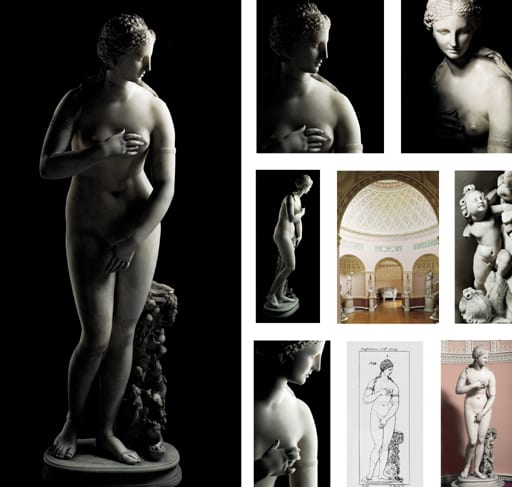
Lot description
CIRCA LATE 1ST/MID-2ND CENTURY A.D., A ROMAN COPY AFTER A HELLENISTIC ORIGINAL OF 2ND CENTURY B.C. Of Parian marble, standing naked, her seductive body with curving hips and buttocks, her breasts and upper body sensuously modelled. Resting on the toes of her right foot, her upper body tilts forwards with right arm drawn across her body to partly hide her breasts, her left hand held pudica. With head turned to her left, the goddess modestly fixes her enigmatic gaze away from the viewer. Her sensitive and softly carved face, the ideal of flawless feminine beauty, is shown with slightly parted lips, almond-shaped eyes and pierced ears. Her face is framed above by curling tresses of hair, centrally parted and swept back under a fillet into a chignon, with two loose locks of hair escaping onto her shoulders. On her upper left arm the goddess wears an armlet decorated in relief with a frieze of dolphins. She stands with her left foot resting on an original base with a support attached to her left leg in the form of an alabastron. The vessel with rim decorated at the front and surmounted by a scallop shell. A winged naked chubby Eros crouches on the ground in front with his hand resting on a wicker basket laden with apples; his hair arranged in curls with topknot and central plait. Two other Erotes climb the leafy tendrils which spiral around the alabastron which is further entwined with vines, grape bunches and branches bearing apples. Rosettes and a flowering plant with acanthus leaves at the back. 633/4 in. (162 cm.) high Condition: the 18th Century restorations are attributed to Cavaceppi by Heyne (along with other early sources), Michaelis and Howard. These include parts of the hair, tip of nose, right arm and armlet, lower left arm, part of left buttock, lower right leg, two toes of left foot, two heads of Erotes, small areas on support, profiled base around the central original base. It has been suggested that the ancient head may be from another statue, perhaps veiled, with reworking of the veil at the back as hair. PROVENANCE Barberini collection, Palazzo Barberini, Rome (itemized inventory: Docum. inedit. per servire alla storia dei Musei d'Italia, IV, 1738, p. 48). Gavin Hamilton. Thomas Jenkins. William Weddell (1736-1792) of Newby Hall. 3rd Lord Grantham, later Earl de Grey (1781-1859). Lady Mary Robinson (1809-1892). Robert de Grey Vyner (1842-1915). Lady (Mary) Alwyne Compton Vyner (1866-1957) and by descent to the Compton family. LITERATURE C. G. Heyne, Sammlung antiquarischer Aufs„tze, I, 1779, p. 140; C. G. Heyne, "Des diff‚rentes maniŠres de repr‚senter V‚nus dans les ouvrages de l'art" in Recueil de pi‚ces int‚ressantes concernant les Antiquit‚s, I, Paris, 1787, pp. 33-34; J. J. Winckelmann (ed. by W. Rehm), Briefe, III, 1956, pp. 42, 44, 103-104 and 106; J. Dallaway, Anecdotes of the Arts in England, London, 1800, pp. 349-350, no. 1; A Sketch of the Life of Charles Townley, London, 1812, p. 6; J. Dallaway, Of Statuary and Sculpture among the Antients, London, 1816, p. 345; Specimens of Antient Sculpture, Selected from Several Collections in Great Britain, II, London, 1835, engraved pl. 13; Le Comte F. de Clarac, Muse‚ de Sculpture, IV, Paris, 1850, p. 114, no. 1394, engraved pl. 622B; A. Michaelis, Ancient Marbles in Great Britain, Cambridge, 1882, pp. 77 and 527-529, no. 20; Newby Hall, Ripon, in Country Life, 13 June 1914; A. T. Bolton, The Works of Robert and James Adam, London, 1922, p. 141; F. Muthmann, Statuensttzen und dekoratives Beiwerk an griechischen und r”mischen Bildwerken, Heidelberg, 1951, pp. 86-87 and 225; C. C. Vermeule, Notes on a New Edition of Michaelis: Ancient Marbles in Great Britain, in American Journal of Archaeology, 59, 1955, p. 143, pl. 45, fig. 23; H. Oehler, Hand list to the Photographic Exhibition 'Classical Sculptures in English Private Collections', Cologne, 1978, pp. 41-42; G. B. Waywell, Classical Sculptures in English Country Houses: a Hand-Guide, London, 1978, p. 37, no. 20; F. Haskell and N. Penny, Taste and the Antique: the Lure of Classical Sculpture 1500-1900, Yale, 1982, p. 326 and pl. on p. 69; H. Oehler, Foto + Skulptur: R”mische Antiken in englischen Schl”ssern, Cologne, 1980, pp. 76-77, no. 73, pl. 3; S. Howard, Eighteenth Century Restorer, New York and London, 1982, pp. 67-69 and 255, no. 8, figs. 152-155; and C. A. Pic¢n, exhibition catalogue, Bartolomeo Cavaceppi: Eighteenth-Century Restorations of Ancient Marble Sculpture from English Private Collections, London, 1983, pp. 4 and 48-51, no. 9. NOTES This is one of the most important and historic classical sculptures ever to be offered for sale at auction. One of the best known Roman copies of the Medici Venus type, she is beautiful in her own right. In addition she holds a seminal place in the history of European taste and collecting. She belonged to the celebrated Barberini collection in Rome before 1738 and was sold for what was generally held to be the highest price paid for any antiquity sent from Rome to England in the 18th Century, at the height of the Grand Tour. (The highest recorded price of œ1000 was paid by the Hon. James Hugh Smith Barry for a colossal statue of Antinous excavated by Gavin Hamilton at Ostia in 1775. The Jenkins Venus was known to have cost significantly more). She held pride of place in the finest gallery ever designed for the display of a collection of ancient sculpture in 18th Century England. The Jenkins Venus represents the sensual aspect of the great goddess of love, nature and fertility, known to the Greeks as Aphrodite and identified as Venus by the Romans. The cult of Aphrodite was widely followed throughout the Classical world, her most well-known sanctuaries and temples being at Corinth, Paphos on Cyprus, Knidos in Caria and on the Greek islands of Kos and Cythera. Praxiteles and The Medici Venus : The renowned 4th Century B.C. Greek sculptor, Praxiteles, inspired later generations to produce variations of the most famous statue in classical antiquity, his graceful sculpture of the naked goddess, the Aphrodite of Knidos. With Praxiteles' characteristic soft and sensitive modelling, the Knidian Aphrodite was created as the absolute feminine ideal, both in bodily form and in pose. With her head turned slightly to the left, glancing downwards, her right hand was drawn across her lower body and the left lifting drapery from a hydria beside her, the upper torso leant forward with weight borne on her right leg. This statue became the standard and inspiration for later sculptors, particularly during Hellenistic times, circa 2nd Century B.C., when a number of variations on the Knidos Aphrodite were created - some of the types, now known from later Roman copies, include the Medici Venus (Uffizi, Florence) and the Capitoline Venus (Capitoline Museum, Rome). The Jenkins Venus is one of the finest Roman copies of the Medici type. With both the Jenkins and the Medici Venus, the most important changes from Praxiteles' Knidian original include her head turned further to the side with gaze ahead not downward, the left rather than right hand shielding her lower body, her right hand across her breasts, and her upper body more upright with weight borne on her left leg. The Birth of Aphrodite : The statue's support in the form of an alabastron is rich with symbolism. Resting on the top of the vessel is a scallop shell, for which the Greek name ( kteis ) also meant the female genitals. The shell alludes to the legend surrounding the marine Birth of Aphrodite, in which the castrated genitals of the god Ouranos (Heaven) were flung into the sea by his son, Cronos. White foam exuded from the genitals as they floated on the surface of the water and from this foam the beautiful goddess was born. The gentle West Wind, Zephyros, carried her on a scallop shell across the sea to the coast of Cythera, finally emerging from the shell and foaming waves on the coast of Cyprus. Here she was greeted, dressed and bejewelled by the Horae (Seasons) who accompanied the goddess to the assembly of the gods on Mount Olympus. The swimming dolphins depicted on the distinctive armlet of The Jenkins Venus allude to the goddess' marine birth, as dolphins were one of her emblems. The Judgment of Paris : The apples hanging from the entwining branches on the alabastron and in the basket below are also attributes of Aphrodite. The beautiful and sensual goddess' appearance on Mount Olympus inflamed feminine jealousies amongst the other goddesses and the apples are a reminder of the Judgment of Paris. At the marriage celebration of Peleus and Thetis, a golden apple inscribed "For the Fairest" was thrown among the guests by Eris (Discord) who was the only deity not to be invited. The three goddesses, Aphrodite, Hera and Athena, all claimed the apple and, to settle the dispute, Zeus chose the mortal Paris to choose between the goddesses. Hera and Athena promised wealth, power and victory in battle to Paris if he chose them. Aphrodite used her seductive feminine charms by loosening and letting fall her robe and promising Paris the most beautiful mortal woman, Helen. As the inevitable winner of the golden apple, Aphrodite's supremacy as the most beautiful of the Immortals was secured. The apple was the attribute not only of Aphrodite but also of the Three Graces who were her handmaidens. "Sine Bacco et Cerere friget Venus" : Around the alabastron of The Jenkins Venus play three Erotes who are companions of the goddess' son, Eros (known to the Romans as Cupid). In Hellenistic times, Eros and his playmates are depicted as chubby naked winged boys, often mischievous and playful, and it is as such that they are depicted here clambering up the statue's support, collecting apples and grapes. In Philostratos the Elder's Imagines, I:6, a scene set in an orchard with a shrine of Aphrodite is described. Here Erotes play before a cult statue of the goddess, pick apples which are sacred to her, and gather them in baskets. So it is that the Roman playwright, Terence, quotes the saying "Sine Baccho et Cerere friget Venus", in The Eunuch, 732 - without Bacchus (symbolising wine) and Ceres (festive food), Venus or Love grows cold. Thus the bunches of grapes and abundant fruit depicted alongside The Jenkins Venus, emphasize not only her aspects of nature and fertility, but also the essential food of love. HOMERIC HYMN TO APHRODITE Golden crowned, beautiful awesome Aphrodite is who I shall sing, she possesses the heights of all sea-wet Cyprus where Zephyros swept her with his moist breath over the waves of the roaring sea in soft foam. In their circles of gold the Hours joyously received her and wrapped the ambrosial garments around her. On her immortal head they laid a crown of gold that was wonderfully made and in the pierced lobes of her ears they hung flowers of copper from the mountains and precious gold. Round her delicate throat and her silvery breasts they fastened necklaces of gold which they, the gold-filleted Hours, wear themselves when they go to the lovely dances of the gods in their father's house. And when they had arranged all these decorations on her body then they led her to the immortal gods who saw her and welcomed her and reached out their hands towards her longing every one of them, to take her home to be his lawful wife, so enraptured were they all with the beauty of the Cytherean crowned in violets. Farewell quick-glancing sweet-smiling goddess. Grant me victory in this contest. Favour my song and in another song also I shall remember you. (First Homeric Hymn to Aphrodite, trans. by J. Cashford) ADDITIONAL BIBLIOGRAPHY: Baring, L. and Cashford, J., The Myth of the Goddess: Evolution of an Image, London, 1991, pp. 349-364. Cornforth, J., Newby Hall, North Yorkshire, in Country Life, 7 June 1979; 14 June 1979; 25 December 1980; and 17 July 1997. Farnell, L. R., The Cults of the Greek States, II, New York, 1977, pp. 618-730. Harris, E., The Genius of Robert Adam: His Interiors, Yale, 2001, pp. 212-231. Hussey, C., Newby Hall, Yorkshire - II, in Country Life, 19 June 1937, p. 688ff. Ingamells, J., A Dictionary of British and Irish Travellers in Italy, 1701-1800, London, 1997, pp. 732 and 986-987. Kenworthy-Browne, J. K., Designing around the Statues, in Apollo, April 1993, pp. 248-252 which discusses the use of the Medici Venus in English sculpture galleries of the 1750s. Lees-Milne, J., The Age of Adam, London, 1947, p. 117. Low, J., Newby Hall: Two Late Eighteenth-Century Inventories, in Furniture History, XXII, 1986, p. 135ff. Montfau‡on, Father, (trans. by D. Humphrey), Antiquity Explained and represented in Sculptures, I, London, 1721, pp. 100-104 on different representations of Venus. Stillman, D., English Neo-Classical Architecture, I, London, 1988, pp. 309-310. Vaughan, G., James Hugh Smith Barry as a Collector of Antiquities, in Apollo, June 1987, pp. 6 and 9.