Have one like this? Check yours freeOr have an appraiser value it
Lot description
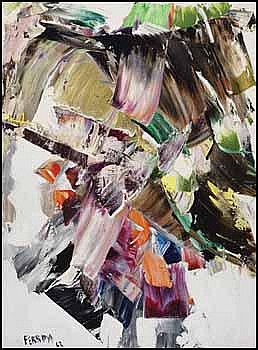
Marcelle Ferron 1924 - 2001 Canadian oil on canvas Sans titre 57 1/2 x 44 3/4 inches 146 x 113.7 centimeters signed and dated 1962 Provenance:Private Collection, Toronto In 1962, Marcelle Ferron was in France, having left the oppressive societal atmosphere of Quebec in 1953. Paul- Émile Borduas had died in Paris in 1960, but Jean-Paul Riopelle and Fernand Leduc were living there. Of all the Automatists, Ferron was perceived as the one closest to Borduas in her method of painting - she used a spatula and heavy impastos. But this is a rather superficial approach to her style. In Ferron's paintings of the 1960s, three elements stand out as specifically her own: the gestural quality of her handling of the paint medium, the transparency of her colour and a definitively Canadian sense of space. However, in 1961 and in 1963, when she showed her recent paintings at Agnès Lefort Gallery in Montreal, some local critics spoke of the "danger of decorativism" in her painting, as if her use of subtle colouring, as in this work - mauve and orange - could be the means of being decorative. And, to tell the truth, why not? Henri Matisse is decorative and Alfred Pellan also. Is it an irremediable defect or something to be ashamed of? I think that this is not the real issue here. In fact, the real feeling that this specific Ferron painting conveys, with its tumbling of masses from above, with its sliding of colours and blacks into a snowy landscape at the bottom and its mysterious recesses in the middle, is the feeling of the sublime rather than the decoratively beautiful. It is the feeling one has facing an avalanche, not in reaction to pretty colours. You have to respond to the movement conveyed by each stroke of the spatula to understand the kind of vehemence which is expressed here, a vehemence I would qualify, knowing how Ferron felt about life and painting, as almost political. What is important about the colour is not the easy association one can make with the colour of flowers or lingerie; it is the transparency of that colour, creating the effect of deep recesses or of hanging planes wrapped above the void. One range of effects that painters who used the palette knife, like Ferron or Riopelle, could not achieve was the effect of a smooth surface with gradual changes of tone and colour, such as Dali accomplished with his academic technique à la Meissonnier. The work of the painters that used the spatula suggested on the contrary a range of more geologic associations, and in the case of Ferron, of ice, waves or gems. It is not surprising that she would later be interested in glass and would create huge stained glass murals for a metro station in Montreal (Champ-de-Mars) and for the Court of Justice in Granby, Quebec. Finally, there is a sense of the fragmented landscape, of something violent and almost chaotic in this painting. This is her Canadian dimension, although I know she would have preferred that I say Québécois. However, the historian gets the better of me in this. In 1962, when she painted this work, she was in France, building up her international reputation. She was perceived by Herda Wescher and others as a Canadian painter, not yet as a Québécois. The Quiet Revolution had just begun in Quebec and Ferron would not go back there until 1966. Her commitment to the Quebec milieu, with her grand stained glass projects and her return to painting, would be of another era. We thank François-Marc Gagnon of the Gail and Stephen A. Jarislowsky Institute of Studies in Canadian Art, Concordia University, for contributing the above essay.