Have one like this? Check yours freeOr have an appraiser value it
Lot description
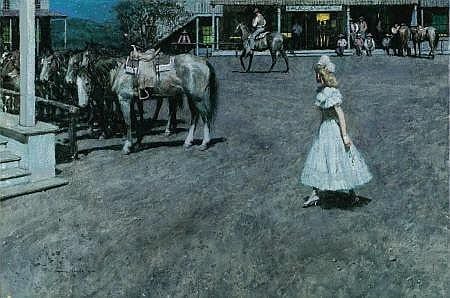
DONALD TEAGUE (American, 1897-1991) New Girl, 1978 Watercolor on paper 18 x 27 inches (45.7 x 68.6 cm) Signed lower left: Donald Teague N.A. Inscribed verso: New Girl / Donald Teague PROVENANCE: Cowboy Artists of America sale, Phoenix Art Museum, 1978 (purchased from artist); Private collection, Dallas. EXHIBITED: Thomas Gilcrease Museum, Tulsa, "Clymer, Lovell and Teague at the Gilcrease", 1987, B.87.25 (label verso). LITERATURE: Western Art Digest, Jan/Feb 1987, illus. "I have never believed that all the girls who lived in the so-called Wild West were hard-drinking, hard-bitten types. The movies have tried to promote that idea, but in my opinion it was only to add 'color'... I think my 'New Girl in Town' would have fit into any society, and if you look real close you'll see that she is carrying the yellow rose of Texas." -Donald Teague Donald Teague was born in Brooklyn and attended the Art Students League of New York, where he studied under Dean Cornwell. Teague began his career as an illustrator in 1921 due in part to Cornwell's encouragement and soon became the primary illustrator for The Saturday Evening Post. During this time, he also did illustrations for Collier's, a rival publication, but signed that work "Edwin Dawes" to avoid any professional conflict of interest. As a young man, Teague had spent several summers in Colorado, and in 1938 he moved out West permanently. Despite distancing himself from the New York art market, the demand for his work followed him to California. When Collier's ceased publication in 1958, Teague switched gears after more than thirty-five years as an illustrator and focused almost exclusively on painting. Throughout his career, Teague has been recognized with numerous awards from the National Academy of Western Art (five First Prizes, Morse Gold Medal), the American Watercolor Society (Gold and Silver Medals), and the Cowboy Artists of America (two Gold Medals). He was elected to the National Academy of Design in 1948 and was a founding member of the National Academy of Western Art. Best known as an illustrator and painter of the American West, Teague was inherently a narrator. He understood the history of his subject matter as well as human nature, both of which are evident in his painting New Girl. Women were few and far between in the predominantly male Old West, and the arrival of a new girl was understandably a major social event. In this painting by Teague, a young woman crosses Main Street in front of the saloon. She wears a pale blue dress and carries the classic iconography of Texas... a yellow rose. The male saloon patrons spill out of the swinging door, and a passing cowboy turns in his saddle. All eyes in town are fixed on the new girl. Teague's composition thins around the figure of the girl while the men are all condensed into the upper region of the painting. This compositional structure creates clear juxtapositions between female and male, subject and viewer, individual and community, and private and public. The exchange of gazes is not equally matched, and yet the new girl's social power enables her to balance the collective gaze of the men. In this work, Teague has successfully realized his belief that the artist's job was to discover "something worth seeing." This work was featured in a major exhibition devoted to Donald Teague and two of his contemporaries in the Cowboy Artists of America, Tom Lovell and John Clymer, organized by the Gilcrease Museum in 1987.