Have one like this? Check yours freeOr have an appraiser value it
Lot description
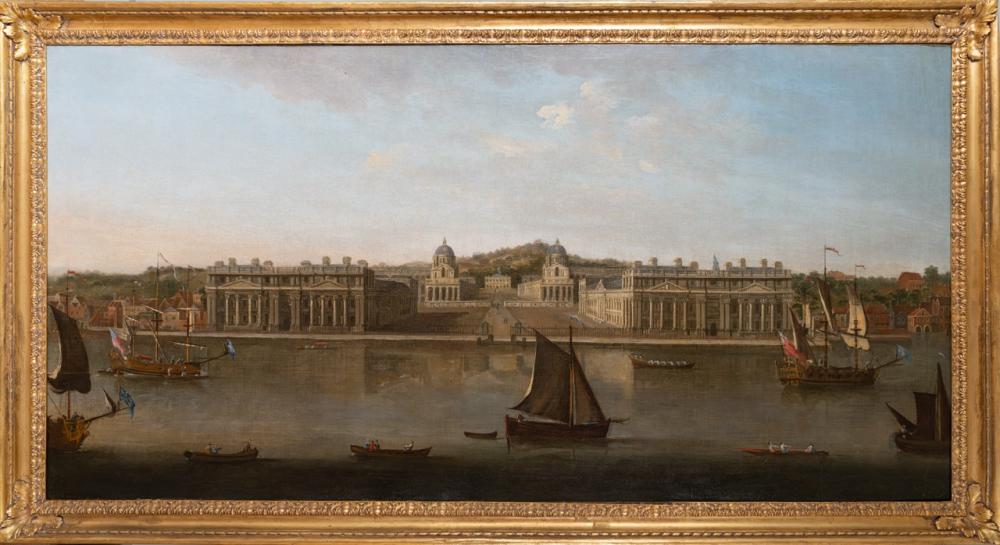
Samuel Scott (English, 1702-1772) Circa 1750 A view across the river to the Royal Hospital Greenwich from the north bank of the river Thames Oil on canvas Samuel Scott was the son of Robert Scott (d. 1737). His earliest pictures date from 1726 or thereabouts, and show the refined influence of the style of the leading marine paintersWillem van der Velde II and his son Cornelius whose busy studio was located at Greenwich. 1732 Scott started to paint topographical views around Wapping and Limehouse in east London. By 1740 he had moved upstream to central London. A substantial proporion of his oeuvre depicts the Thames, the buildings serving as backdrops to water-borne activity. The 1740’s and early 1750’s saw Scott establish himself as the leading native-born marine and topographical painter, the market for such works having been vastly enlarged by the presence in London of Giovanni Canaletto.. Scott moved to Twickenham in 1755, where he painted versions of Pope’s villa. The Five Days Peregrination, a journal of a trip to Kent made with Hogarth, Thornhill, and others in 1732, which included four drawings by Scott, was published in 1782. Elected a governor and custodian of the Foundling Hospital in 1746, Scott was also a member of the committee which proposed the foundation of the Royal Academy in 1755. He exhibited A View of the Tower of London at the Royal Academy in 1771, two works at the Society of Artists in 1761, another in 1764, and again in 1765. His apprentices were Sawrey Gilpin, William Marlow, etc. Scott’s principal patrons for his sea battles were the Vernon, Yorke, Anson, and Sandwich families. He also worked for the duke of Bedford, Viscount Folkestone, the earl of Montagu, the earl of Devon, Sir Edward Littleton, the St.Quintin and Windham families, and the East India Company. Sir Robert Walpole was one of his earliest patrons; Edward Walpole, who acquired four of his pictures, was accustomed ‘when in London to sup every Tuesday at Scott’s house’ (Farington, Diary, 2.625) and proposed elopement to Ann Scott in ‘a very humorous letter’, and Horace Walpole eulogized Scott in his Journal, Anecdotes of Painting, and notes on the exhibitions of the Society of Artists and the Free Society of Artists. He also encouraged his friends to buy Scott’s pictures, of which he himself owned eight. From 1765 to 1769 Scott lived in Ludlow, Shropshire. Following his daughter’s death he retired to Bath in 1769, and died in 1772. His collection of his own paintings was sold by Langfords in January 1773. The Royal Hospital for Seamen at Greenwich was created on the instructions of Queen Mary II, who had been deeply touched by the sight of wounded sailors returning from the Battle of La Hogue in 1692. She ordered the King Charles wing of the palace—originally designed by architect John Webb for King Charles II in 1664—to be remodelled as a naval hospital to provide a counterpart for the Chelsea Hospital for soldiers. Sir Christopher Wren and his assistant Nicholas Hawksmoor gave their services free of charge as architects of the new Royal Hospital. Sir John Vanbrugh succeeded Wren as architect, completing the complex to Wren’s original plans. It fulfilled its role as a hospital and rest-home for sailors from 1692-1868. It is without question at the aesthetic pinnacle of classical architecture in Britain. Provenance: The collection of Sir Lionel Phillips Bart (1855-1936) of Tylney Hall in Hampshire Descended to the vendor by inheritance Provenance: The collection of Sir Lionel Phillips Bart (1855-1936) of Tylney Hall in Hampshire Descended to the vendor by inheritance Dimensions: (Canvas) 30.5 in. (H) x 59.5 in. (W) (Frame) 35.25 in. (H) x 64.5 in. (W)