Have one like this?
Upload a photo for a free check of what yours may be worth.
Lot description
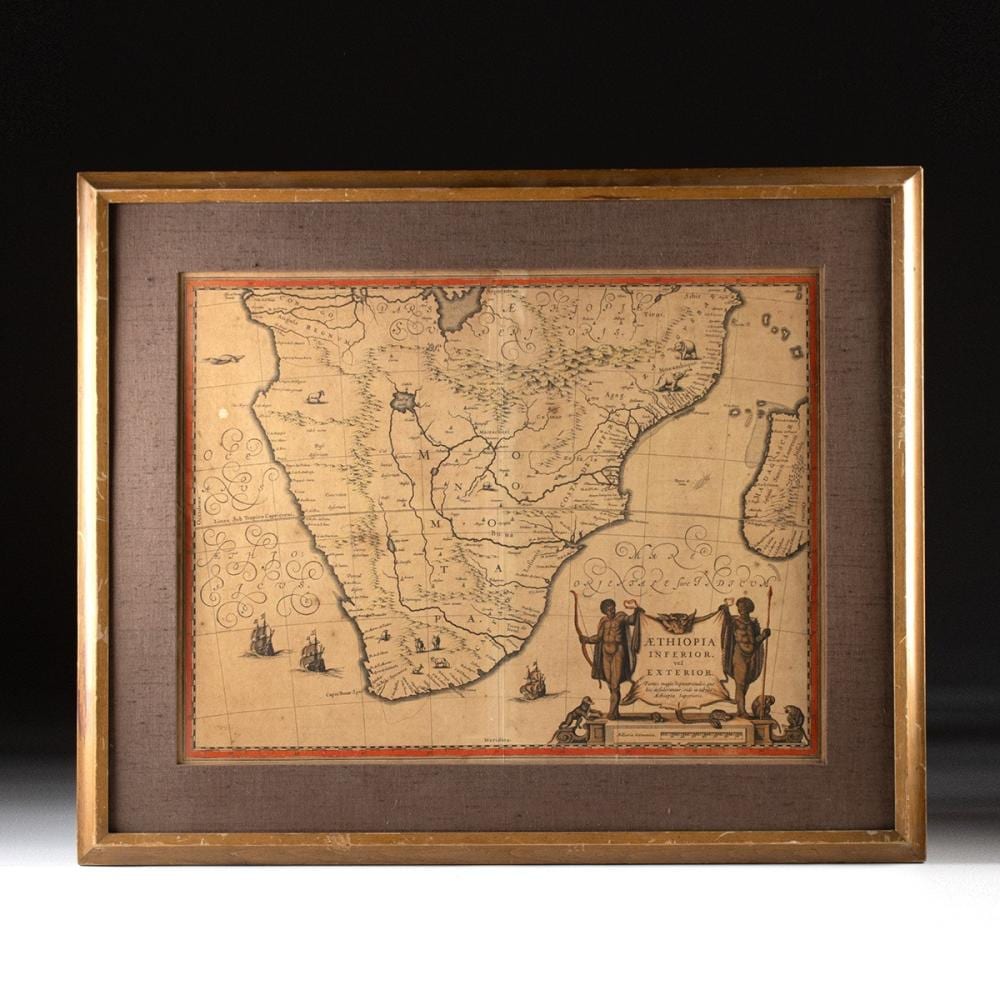
Johannes "Jan" Janssonius also known in English as Jan Jansson (Dutch, 1588-1664). "AEthiopia Inferior vel Exterior. Partes magis Septentrionales, que hic desiderantus, vide in tabula AEthiopiæ Superioris" hand-colored engraving on laid paper, ca. 1636 to 1680. A copperplate window onto the southern half of a continent still half-imagined, hand-colored and crowned by an animal-skin cartouche held aloft by two African figures, one drawing a bow, the other shouldering a spear. Engraved by Johannes Janssonius of Amsterdam and first issued in 1636 for the Mercator-Hondius 'Novus Atlas,' the plate is a close cousin to Willem Blaeu's celebrated map of the same title, distinguished from it by the path of the 20th parallel directly through the 'G' of MADAGASCAR and by the absence of the galleon Blaeu had set sailing in the Mozambique Channel. Size of map: 19.75" W x 15" H (50.2 cm W x 38.1 cm H); of frame: 26.5" W x 21.75" H (67.3 cm W x 55.2 cm H) The geography belongs to a moment before European boots reached the interior. Coastlines charted by Portuguese pilots rounding the Cape are convincing, while inland, the kingdoms of Monomotapa and Monomugi and the Empire of Congo unfold in a Ptolemaic dream-cartography, complete with a great inland lake from which the Zambere (the Zambezi) is shown to issue, perhaps a distant echo of reports of Lake Ngami, a body of water Europeans would not confirm until 1849. Elephants and other beasts of the interior populate the blanks where rivers and ranges run thin; Dutch and Portuguese vessels ride the southern Atlantic on the very routes that made the Cape the hinge of the early modern world. The cartouche itself is rich theater, a beast-mask leering from its crown, monkeys perched on volutes, turtles and lizards drowsing at the figures' feet, the whole composition a Dutch baroque fantasia on African exoticism executed at the height of Amsterdam's cartographic supremacy. Janssonius issued the plate from the lively rivalry of Damrak booksellers, his shop and the Blaeu shop standing within easy spitting distance, and his plate continued in service through successive atlas editions into the 1660s, a workhorse of the Dutch Golden Age and a foundational image of the southern continent in the European imagination. Provenance: private Valley Glen, California, USA collection SHIPPING: We coordinate worldwide shipping in-house through specialist international forwarders experienced with fine art and antiquities customs manifests. International buyers must confirm, prior to bidding, that their country's customs authority will accept the item. All duties, taxes, clearance fees, and any costs arising from customs delays, seizures, re-export, returns, or loss in transit are the buyer's sole responsibility. Artemis assumes no liability for items refused entry, detained, or lost after export. We cannot ship ancient items to their country of origin (Egyptian to Egypt, Greek to Greece, etc.). PAYMENT EXCEPTION: For clients not previously established with Artemis, payment for all gold, precious metal, and gemstone lots must be made by bank wire transfer or certified bank check/money order, without exception. Item # 193432