Have one like this? Check yours freeOr have an appraiser value it
Lot description
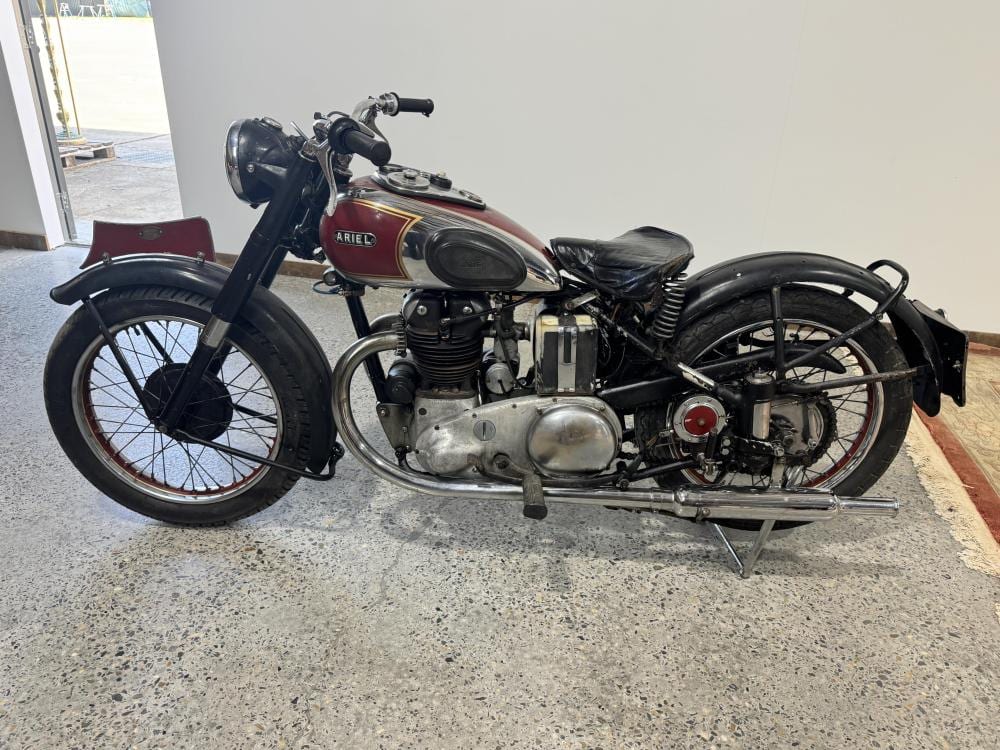
ARIEL - 1950 Twin 500 The 1950 Ariel KH500 Red Hunter Twin - a bike that arrived just as Britain was finding its feet again after the war, and promptly reminded everyone why Birmingham could build motorcycles better than almost anywhere else on earth. Val Page's parallel twin design was honest, straightforward engineering at its best. No exotic layouts, no mechanical trickery - just a well-sorted 500cc vertical twin that did exactly what it promised, reliably, mile after mile. It sat in the shadow of the glamorous Square Four in Ariel's lineup, but riders who knew their onions often preferred it. Lighter, more flickable, and considerably less likely to cook your legs in traffic. Engine Type: OHV parallel twin, 360-degree firing interval Displacement: 499cc Bore x Stroke: 63mm x 80mm Power: ~25bhp @ 6,000rpm Cylinder block: cast-iron Head: cast-iron Lubrication: dry sump, separate oil tank Carburetion: single Amal carburettor Ignition: Lucas magneto Transmission Gearbox: Burman four-speed, foot-change Clutch: multi-plate cork insert Primary drive: chain Cycle Parts Frame: single loop tubular steel Front suspension: telescopic forks Rear suspension: plunger units - twin hydraulically damped plungers either side of the rear wheel spindle Seat: traditional sprung saddle seat, single or dual options Brakes: 7-inch SLS drum front and rear Wheels: 19-inch front and rear, WM2 rims Weight: ~390lbs wet The Plunger Rear End This is worth dwelling on. The plunger suspension — sometimes called "candlestick" units — was Ariel's mid-period solution between the rigid frame and full swingarm. Twin short-travel plunger units sit either side of the rear axle, offering around 2–3 inches of wheel travel. It's not sophisticated by any measure — lateral location is poor by modern standards and the damping is basic — but it transformed long-distance comfort over a rigid, and in 1950 that mattered enormously. Riders who'd spent the war years on rigid army machines thought it was wonderful. Purists today either love the period authenticity or immediately start shopping for a swingarm conversion. The Saddle Seat The sprung saddle on the 1950 KH is a lovely period detail — mounted on its own set of springs independent of the frame, it adds a further layer of compliance that works surprisingly well in combination with the plunger rear. It also looks absolutely correct on the bike. A dual seat was available as an option, but the solo saddle with a pillion pad is the configuration that makes the KH look exactly as it should.