Have one like this?
Upload a photo for a free check of what yours may be worth.
Lot description
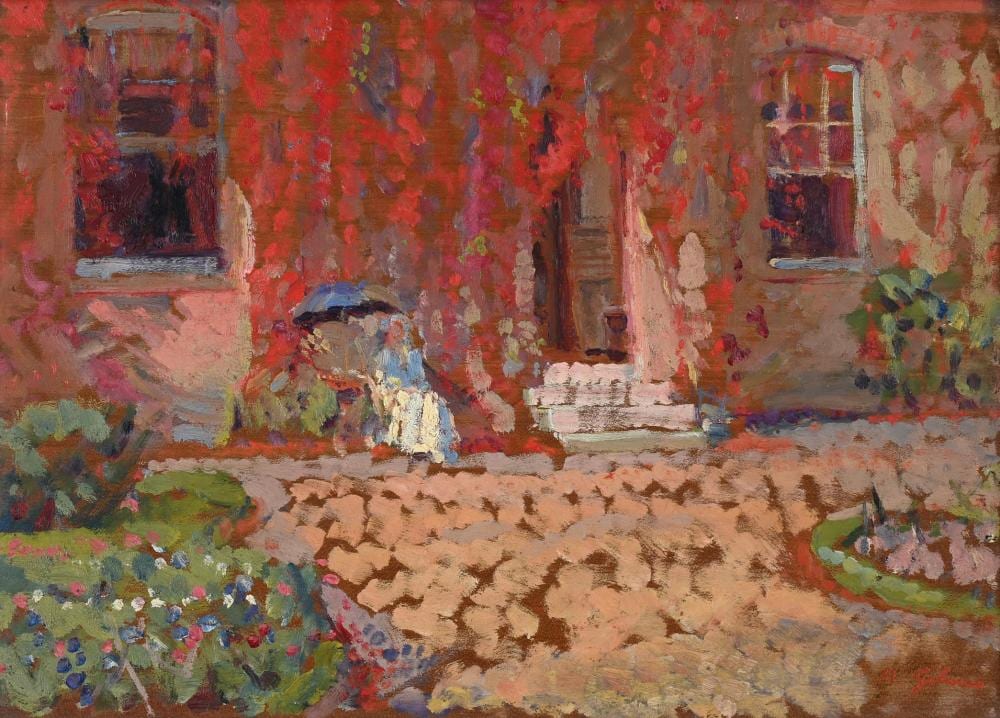
HAROLD GILMAN (BRITISH 1876-1919)THE RECTORYOil on boardSigned (lower right) and further signed (verso)28.5 x 38cm (11 x 14¾in.)Provenance:Lefevre Gallery, LondonWith an abandoned study versoBorn in Rode, Somerset in 1876, Harold Gilman was the second son of John Gilman, an Anglican clergyman, and Emily Purcell Gulliver. On becoming the rector of Snargate in Kent, John moved the family to the Southeast and Harold attended Tonbridge School. However, he badly injured his hip in an accident and spent eighteen months convalescing at home so curtailing his education. It was during this time recuperating that he first became interested in drawing and painting. Following a brief spell at Oxford University and teaching in Odessa he began his studies at the Hastings School of Art, moving to the Slade in 1897 where his contemporaries included Spencer Gore, Wyndham Lewis, and Augustus John, all tutored by Henry Tonks and Philip Wilson Steer. Upon leaving the Slade in 1901, Gilman spent a year in Spain studying in the works of Velásquez and Goya in the Prado. Although interested in European movements, both past and present, it was not until 1907, when he met Walter Sickert that his painting style significantly shifted. Together they founded the Fitzroy Street Group, and then the Camden Town Group. In 1908 Gilman showed at the Salon des Indepéndants in Paris, and then at the Royal Albert Hall in the same year as part of the Allied Artists' Association which he helped to form as a contemporary alternative to exhibiting at the Royal Academy. Although he had travelled in Europe, often with Charles Ginner and Walter Sickert, Roger Fry's landmark 1910 exhibition Manet and the Post Impressionists, had a significant impact on him. Introducing British audiences to contemporary European painters such as Vincent Van Gogh, Paul Gauguin, Paul Cezanne, and Henri Matisse, the exhibition was publicly derided but deeply affected the artists of the day who discovered a bold alternative to the Whistlerian tonalities and formalised subject matters that were so dominant in pre-war British art.The current painting depicts a woman seated under a parasol outside a country house. The location is the family home in Snargate, Kent. This was a place that Gilman had grown up in, convalesced in, and escaped to when London became too overbearing. It was a safe place for Gilman and this can be felt in the carefree energy that radiates from the surface. It has been painted quickly, with confident, short strokes and swift dabs of the brush. The subject differs from many of his urban interior views and still lives that have strong, clear colours to create structure and atmosphere in a considered, tightly controlled way. The present work has none of this. Away from the artistic discourses of London The Rectory owes more to the emotional freedom of Van Gogh than the tight structure of Paul Cezanne. It is a painting full of joy, radiating a real sense of affection for the place that it depicts.