Have one like this?
Upload a photo for a free check of what yours may be worth.
Lot description
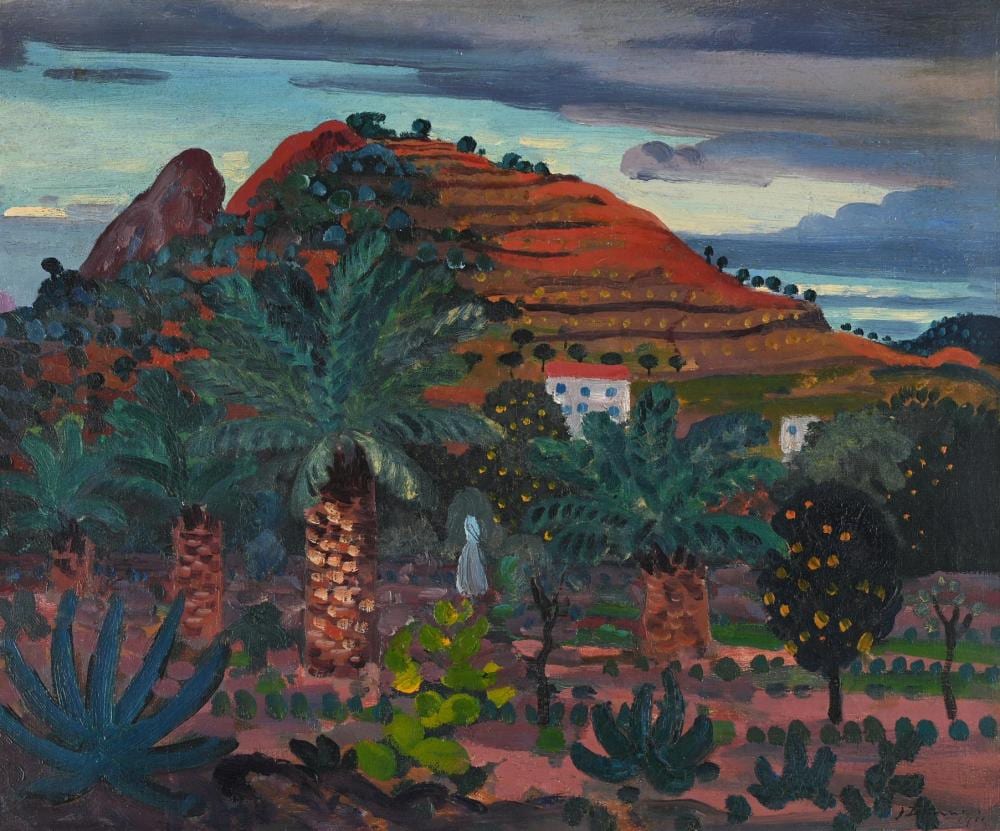
JAMES DICKSON INNES (BRITISH 1887-1914)PALM TREES AT COLLIOUREOil on canvasSigned and dated 1911 (lower right)37.5 x 46cm (14¾ x 18in.)Provenance:John Quinn EsqExhibited:New York, The Armory Show, 17 February - 15 March 1913Sheffield, Graves Art Gallery, Swansea, Glyn Vivien Art Gallery, Aberystwyth, National Library of Wales, J. D. Innes (1887-1914), March - May 1961, no. 46James Dickson Innes (1887-1914) was one of the most gifted and original British painters of the early twentieth century. Although his career was tragically short, ending with his death from tuberculosis at the age of twenty-seven, he produced a remarkable body of work that helped bridge British landscape painting and European modernism. Among the most significant influences on his artistic development, after his beloved Snowdonia in North Wales, were his visits to the small Mediterranean town of Collioure in southern France.Born in Llanelli, Wales, Innes studied at the Slade School of Fine Art in London, where he met and became life-long friends and painting companions with Derwent Lees and Augustus John. His early work reflected a strong interest in landscape and was influenced by the tonal traditions of British painting. However, his travels in France exposed him to new artistic ideas and transformed his approach to colour and composition.Collioure, situated on the French coast near the Spanish border, had already achieved artistic fame through its association with the Fauvist painters Henri Matisse and André Derain. Drawn by its brilliant Mediterranean light, colourful buildings, and picturesque harbour, Innes visited the town on several occasions between 1908 and 1913. The experience proved crucial to his artistic evolution.The intense sunlight and vivid colours of Collioure encouraged Innes to abandon the restrained palette that had characterised much of his earlier work. Instead, he began to experiment with stronger contrasts and more expressive uses of colour. His paintings from this period are notable for their luminous blues, greens, pinks, and oranges, capturing the dazzling atmosphere of the Mediterranean landscape. While he never fully adopted the Fauvist style, the influence of French modernism is clearly visible in his increasingly bold and simplified compositions.Many of Innes's finest paintings were inspired by Collioure and its surroundings. Rather than aiming for precise topographical accuracy, he sought to convey the emotional and visual impact of the place. His brushwork became freer and more spontaneous, reflecting his growing confidence as an artist.The visits to Collioure also provided Innes with an escape from the health problems that increasingly affected his life. The warmer climate was believed to benefit sufferers of tuberculosis, and the relaxed atmosphere of the Mediterranean coast offered respite from the unpredictable Welsh climate and the pressures of London. The sense of freedom and vitality found in his Collioure paintings contrasts poignantly with the knowledge that his health was steadily deteriorating and John Fothergill, a personal friend and contemporary reminisced thatAt best he was a lone star. He seems to have followed no one and no one followed him, though he had an effect upon Augustus John's landscape and still more upon Derwent Lees. Being unable to adopt a recognised style he had to make one of his own, and, impelled by the knowledge that he hadn't long to live, he was in a hurry. Earlier he had worked he had worked with the same charming leisure with which he walked and talked, but latterly, I was told he angrily regretted all that works as wasted time and began to paint at top speed. In much of his work he used oils as if they were watercolours, and in order to relieve the leaden effect, he invented, for I do not know of a precedent, a method of super-imposing corse washes and spots of another colour, without material significance, as a means of giving life and sparkle. For bright colour he is, I think, supreme amongst English landscape painters. One day there may come a kindred soul able to see the end that this extraordinary and independent young man has pointed and get nearer to it.(L. Browse, James Dickson Innes, London, 1946. P.12).The present lot was purchased from the artist by the finance lawyer and hugely influential American collector, John Quinn (1870-1924). Initially Quinn collected books and prints but on a trip to Europe in 1909 he met Augustus John who introduced him to avant garde French painting. The following year Roger Fry's Manet and the Post-Impressionists Exhibition of 1910 at the Grafton Galleries in London further ignited his newfound passion and he started to search out works by Cezanne, Van Gogh, Gauguin with dealers such as Amboise Vollard in Paris.Between 1911 and his death in 1924, Quinn assembled a collection of around 2,500 paintings, works on paper, and sculptures by more than 150 European and American artists which he proudly displayed in his New York apartment.In 1912, Quinn learnt of the plan, through his friend and Art Critic, Frederick James Gregg, for the International Exhibition of Modern Art in New York to be held the following year. He became counsel for the show, successfully lobbying for revisions to the import tariffs levied on modern art coming from Europe and also leant a number of pieces to the show, including the present lot. This exhibition quickly became abbreviated to the Armory Show (due to its location) and is possibly one of the most influential exhibitions to be held in the USA in the Twentieth Century, marking a watershed moment in the psyche of American artistic output.