Have one like this? Check yours freeOr have an appraiser value it
Lot description
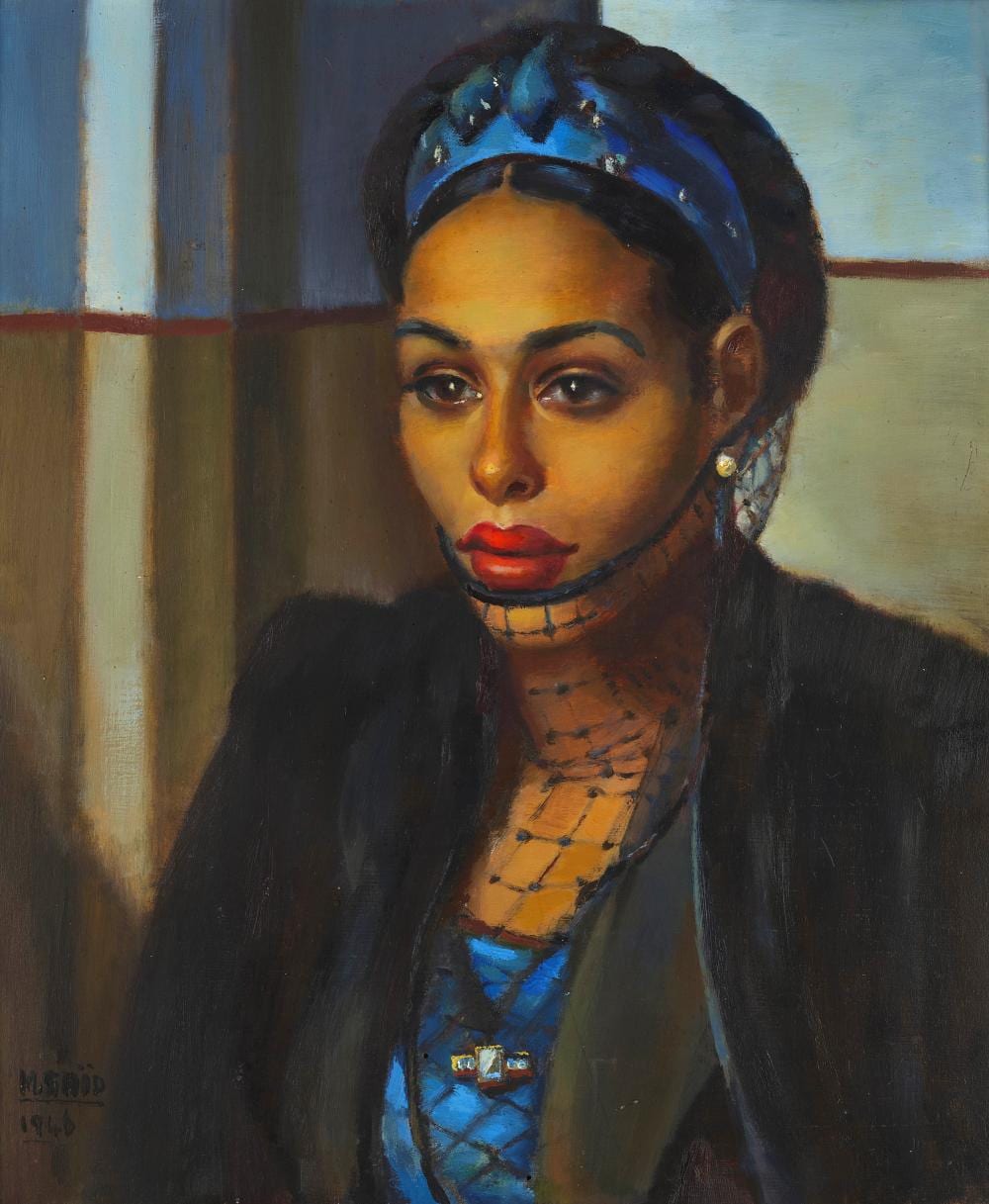
Mahmoud Saïd (Égypte, 1897–1964) Le turban bleu Signé et daté « Saïd 1946 » en bas à gauche ; signé, titré et daté au dos en arabe et en français. Huile sur panneau. 53 × 45 cm. Peint en 1946. L’authenticité de cette œuvre a été confirmée par Valérie Didier Hess et le Dr Hussam Rashwan. Cette œuvre sera reproduite dans : Azar, Aimé ; Didier Hess, Valérie (dir.) ; Rashwan, Hussam (dir.), Modern Painting in Egypt, à paraître. Provenance René Cattaui Bey, Égypte ; Par descendance à la famille Cattaui ; Conservée dans la même collection familiale jusqu’à ce jour. *** Signed and dated “Saïd 1946” lower left; signed, titled, and dated on the reverse in both Arabic and French. Oil on panel. 53 × 45 cm. Painted in 1946. The authenticity of this work has been confirmed by Valérie Didier Hess and Dr. Hussam Rashwan. This work will be illustrated in: Azar, Aimé; Didier Hess, Valérie (eds.); Rashwan, Hussam (eds.), Modern Painting in Egypt, forthcoming. Provenance René Cattaui Bey, Egypt; By descent within the Cattaui family; Preserved in the same family collection to the present day. Cette œuvre inédite de Mahmoud Saïd, datée 1946, appartient à la période de pleine maturité de l’artiste, moment où son langage pictural atteint une synthèse particulièrement aboutie entre la tradition picturale européenne et l’affirmation d’une identité plastique égyptienne moderne. Peint sur panneau, Le Turban bleu présente un portrait féminin frontal, traité avec la monumentalité silencieuse et la densité psychologique qui caractérisent les grandes compositions de Saïd. Le visage, modelé par une lumière chaude et diffuse, révèle l’attention quasi sculpturale que l’artiste accorde à la construction des volumes : pommettes hautes, lèvres pleines, regard sombre et pénétrant. Cette présence hiératique, presque intemporelle, est renforcée par l’économie du décor et la frontalité de la pose. La composition s’organise autour d’une harmonie chromatique dominée par le bleu, visible dans le turban qui coiffe la figure ainsi que dans le corsage lacé du modèle. Ce bleu profond, vibrant, contraste avec les tonalités plus sourdes du manteau sombre et de l’arrière-plan, créant une tension subtile entre la figure et l’espace environnant. Le fond, traité en larges aplats brun et gris bleuté, demeure volontairement indéterminé afin de concentrer l’attention sur la présence du modèle. Certains détails graphiques, notamment les motifs linéaires visibles sur le cou et le menton, introduisent une dimension décorative singulière. Ils évoquent les ornements, parures ou motifs issus des traditions populaires qui nourrissent régulièrement l’imaginaire de Saïd. Cette hybridation entre réalisme psychologique et stylisation décorative constitue l’une des signatures de son œuvre. Au cours des années 1930 à 1950, Mahmoud Saïd développe une iconographie devenue emblématique de la modernité artistique égyptienne : portraits de femmes, scènes populaires, pêcheurs, paysages d’Alexandrie et figures du Nil. Les figures féminines occupent cependant une place centrale dans sa production. Chez Saïd, elles ne sont pas seulement des modèles mais deviennent les vecteurs d’une réflexion sur l’identité nationale, la dignité et la modernité du pays. Dans ces portraits, l’artiste combine un sens aigu de la construction classique, hérité de sa formation et de sa connaissance de la peinture européenne, avec une sensibilité profondément ancrée dans la culture visuelle égyptienne. Les volumes pleins, les contours nets et la monumentalité des figures confèrent à ses portraits une puissance plastique immédiatement reconnaissable. Réalisé à une époque où Saïd est déjà reconnu comme l’un des principaux artistes du pays, Le Turban bleu illustre parfaitement cette synthèse stylistique. L’œuvre témoigne d’une maîtrise picturale affirmée et d’une recherche constante d’équilibre entre modernité formelle et affirmation culturelle. Considéré aujourd’hui comme le fondateur de la peinture moderne égyptienne, Mahmoud Saïd occupe une place centrale dans l’histoire de l’art du monde arabe au XXe siècle. Ses œuvres figurent dans les principales institutions du Moyen-Orient ainsi que dans de grandes collections internationales. Par la force de ses portraits et la singularité de son langage pictural, il a contribué à définir une modernité artistique propre à l’Égypte, distincte mais dialoguant avec les avant-gardes européennes. L’œuvre a été acquise à l’origine par René Cattaui Bey, sénateur égyptien et membre de l’Institut d’Égypte, figure importante de la vie intellectuelle et politique égyptienne du XXe siècle. Conservée au sein de la famille pendant plusieurs décennies, elle témoigne du rôle essentiel joué par certaines grandes familles levantines et alexandrines dans le soutien et la préservation de l’art moderne égyptien. La famille Cattaui compte parmi les figures marquantes de la société cosmopolite égyptienne de la première moitié du XXe siècle. Joseph Cattaui Pacha, membre éminent de cette dynastie, occupa une place importante dans la vie politique et économique du pays, tandis que la famille entretenait des liens étroits avec les milieux culturels et artistiques d’Alexandrie et du Caire. Cette provenance historique renforce l’importance patrimoniale de l’œuvre et inscrit ce portrait dans l’histoire des grandes collections égyptiennes du XXe siècle. *** The Blue Turban, 1946 This previously unpublished work by Mahmoud Saïd, dated 1946, belongs to the artist’s mature period, a moment when his pictorial language achieved a particularly accomplished synthesis between the European painting tradition and the assertion of a modern Egyptian visual identity. Painted on panel, The Blue Turban presents a frontal female portrait rendered with the quiet monumentality and psychological depth that characterize Saïd’s finest compositions. The face, modeled by a warm and diffused light, reveals the almost sculptural attention the artist devoted to the construction of volume: high cheekbones, full lips, and a dark, penetrating gaze. This hieratic, almost timeless presence is further reinforced by the economy of the setting and the frontal nature of the pose. The composition is organized around a chromatic harmony dominated by blue, visible both in the turban crowning the sitter and in her laced bodice. This deep, vibrant blue contrasts with the more subdued tones of the dark cloak and the background, creating a subtle tension between the figure and the surrounding space. The background, treated in broad passages of brown and bluish-grey, remains deliberately undefined, allowing the viewer’s attention to focus entirely on the sitter’s presence. Certain graphic details, notably the linear motifs visible on the neck and chin, introduce a distinctive decorative dimension. These elements evoke ornaments, adornments, and motifs derived from popular traditions that frequently nourished Saïd’s imagination. This fusion of psychological realism and decorative stylization is one of the hallmarks of his artistic language. During the 1930s, 1940s, and 1950s, Mahmoud Saïd developed an iconography that became emblematic of Egyptian artistic modernity: portraits of women, popular scenes, fishermen, Alexandrian landscapes, and figures associated with the Nile. Female figures, however, occupy a particularly central place within his oeuvre. For Saïd, they were not merely models but became vehicles for a broader reflection on national identity, dignity, and the modernity of Egypt itself. In these portraits, the artist combined a profound understanding of classical construction, inherited from his training and his deep knowledge of European painting, with a sensibility firmly rooted in Egyptian visual culture. The fullness of the volumes, the clarity of the contours, and the monumentality of the figures endow his portraits with an immediately recognizable visual power. Executed at a time when Saïd was already acknowledged as one of Egypt’s foremost artists, The Blue Turban perfectly illustrates this stylistic synthesis. The painting demonstrates a mature command of pictorial means and a constant search for balance between formal modernity and cultural affirmation. Today regarded as the founder of modern Egyptian painting, Mahmoud Saïd occupies a central place in the history of twentieth-century Arab art. His works are held in major institutions throughout the Middle East as well as in important international collections. Through the strength of his portraits and the singularity of his pictorial language, he contributed decisively to the definition of a distinctly Egyptian artistic modernity—one that remained rooted in local culture while engaging in dialogue with the European avant-garde. The painting was originally acquired by René Cattaui Bey, Egyptian senator and member of the Institut d’Égypte, an important figure in the intellectual and political life of twentieth-century Egypt. Preserved within the family for several decades, it bears witness to the essential role played by prominent Levantine and Alexandrian families in supporting and preserving modern Egyptian art. The Cattaui family ranks among the notable figures of Egypt’s cosmopolitan society during the first half of the twentieth century. Joseph Cattaui Pasha, a distinguished member of this influential dynasty, occupied a prominent position in the country’s political and economic life, while the family maintained close ties with the artistic and cultural circles of Alexandria and Cairo. This distinguished provenance further enhances the historical significance of the work and places this portrait within the lineage of the great Egyptian collections of the twentieth century.