Have one like this? Check yours freeOr have an appraiser value it
Lot description
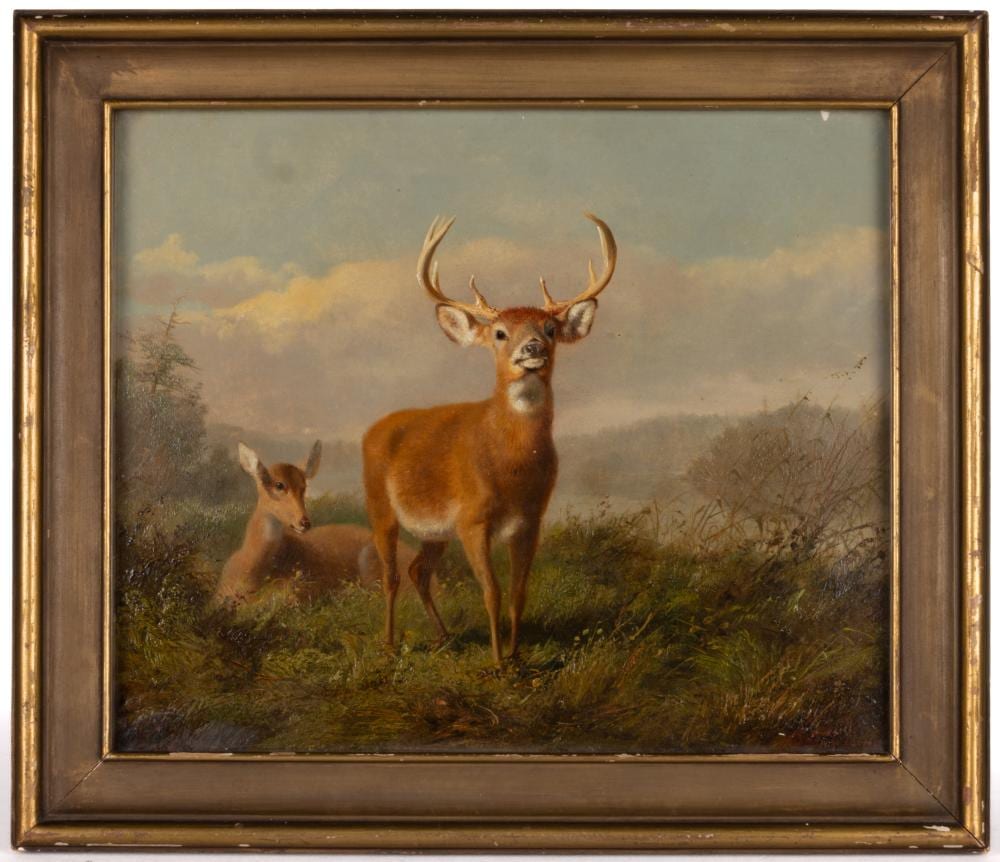
ARTHUR FITZWILLIAM TAIT (BRITISH-AMERICAN, 1819-1905) PORTRAIT OF DEER IN A LANDSCAPE, oil on board, featuring a majestic standing stag with a reclining doe behind him and mountainous terrain beyond, signed and inscribed lower right "A. F. Tait / N. Y. 1864", also bearing period inscription verso "No. 304 / A. F. Tait / Morrisania / Westchester Co., N.Y. / March 186[?] / N.Y. Fair for U.S. Sanitary Com." as well as an early label giving the title for the present work as "The Monarch". Housed under glass in possibly original frame. Dated 1864. 9 1/2" x 11 1/2" sight, 12 1/2" x 14 1/2" OA. Catalogue Note: Born near Liverpool, England, Arthur Fitzwilliam Tait (1819-1905) immigrated to the United States in 1850. Largely self-taught, Tait primarily learned by studying the works of others in museums and collections. Always drawn to nature, he established early on a camp in the Adirondacks as a base for painting excursions and would remain a resident of New York State thereafter. Tait exhibited regularly in major venues and was extremely popular in his lifetime. To wit, his work depicting animals and sporting subject matter was frequently reproduced by the prolific printmakers, Currier and Ives. The present painting is particularly interesting given its association with the United States Sanitary Commission and the conclusion of the Civil War, a pivotal moment in the nation's history. Given the artist's inscription verso, it appears that the present work was an entry in one of the many exhibitions held in New York City in the spring of 1864 under the sponsorship of the U.S. Sanitary Commission. Known collectively as the Metropolitan Fair, the event brought together artists, merchants, and performers in an effort to raise funds for disabled Civil War veterans. Hugely successful, the Fair brought in over 1.3 million dollars over a three-week span. Recently discovered and completely fresh to the market, the present painting is a classic example of the artist's work, executed in his prime, that bears additional historical significance.