Have one like this?
Upload a photo for a free check of what yours may be worth.
Lot description
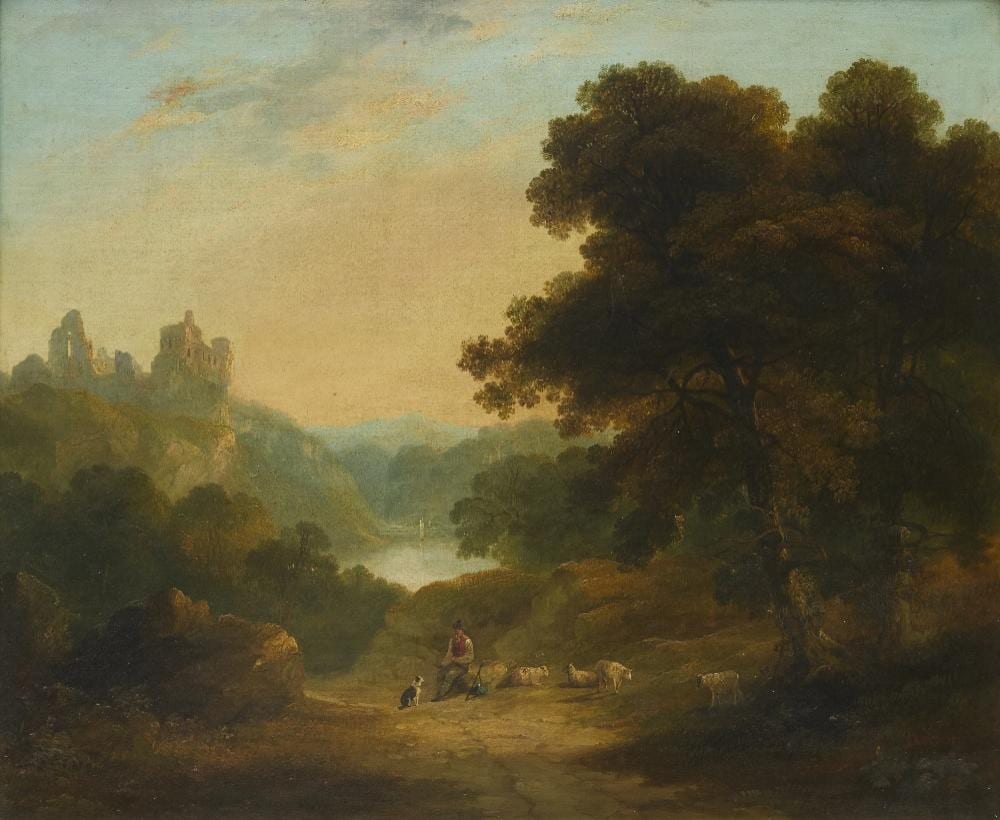
James Arthur O'Connor, Irish 1792-1841- View of an Italianate landscape with a ruined castle on a hilltop, and a shepherd with his flock and dog below; oil on canvas, signed with initials and dated 'J.A.O.C. 1831' (lower right), 63.6 x 76.4 cm. Provenance: Property of Abbott Dunbar, sale, Christie's, London, 23 November 1889, lot 46 [purchased by Fyler]. Property of the above, sale, Christie's, London, 2 December 1907, lot 85 [purchased by Mullins]. Private Collection, UK (by descent). Note: O'Connor was the son of engraver and printmaker William O'Connor, and received some artistic tuition from the painter William Sadler (c.1782-1839). In 1813, he travelled with fellow Irish painters Francis Danby (1793-1861) and George Petrie (1790-1866) to London, after which Danby and O'Connor walked from London to Bristol together. Immediately after the completion of this journey the two collaborated on a painting which sold recently at Roseberys on 12 November 2025, lot 150. O'Connor returned to Ireland shortly after this, where he established himself as a painter, enjoying the support of prominent contemporaries, particularly the Marquess of Sligo (1788-1845), before settling in London again in 1821, and exhibiting at the Royal Academy in 1822. O'Connor went on to travel across Europe, including to France, Belgium, the Netherlands, and the Rhineland, with the landscapes he encountered undoubtedly influencing the sweeping landscapes which define the artist's later oeuvre. John Hutchinson, in his catalogue for the 1985 retrospective exhibition of O'Connor's work in the National Gallery of Ireland, has described how the artist's work can be separated into three distinct phases: early topographical paintings, mid-period picturesque, and late romantic. The present work evidently fits into this latest category, which defines the artist's output from around 1830, and which was heavily inspired by the compositions of the Italian painter Salvator Rosa (1615-1673).