Have one like this?
Upload a photo for a free check of what yours may be worth.
Lot description
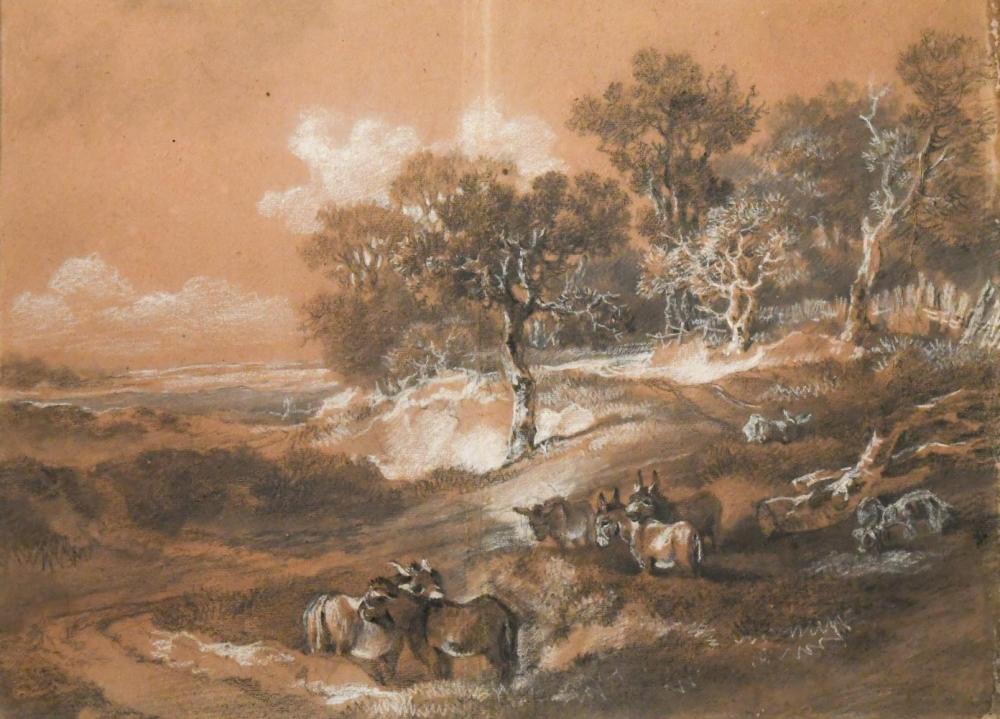
Thomas Gainsborough (British, 1727-1788) Landscape with Donkeys, c.1748 black chalk heighted with white chalk on two joined pieces of buff paper 36.5 x 51cm Exhibited: International Exhibition, 1862; Exhibition of Paintings by Thomas Gainsborough, R.A. and J.M.W. Turner, R.A. for the benefit of the Artists' Fund and Artists' Aid Societies, at the Galleries of M. Knoedler & Co, New York, 14th-31st December 1914, exhibited with a List of Drawings by Thomas Gainsborough, no. 12; Exhibition of Pictures by Thomas Gainsborough, 1727-1788, at the Galleries of M.Knoedler & Co, New York, 3rd-15th December 1923, no. 16; Exhibition of Paintings and Drawings by Thomas Gainsborough, R.A., at the Cincinnati Art Museum, 1st-31st May 1931, no. 67, repr. pl. 51; Exhibition of early English Watercolours, Fine Art Society, London, March 1944, no. XX; Landscapes by Thomas Gainsborough, at The Nottingham University Art Gallery, 1st-25th November 1962, no. 32; Thomas Gainsborough, at The Tate Gallery, 8th October 1980-4th January 1981, no. 3 repr.; Gainsborough 1727-1788, organised by the The British Council and Réunion des musées nationaux, at the Grand Palais, Paris, 6th February-27th April 1981, no. 80 repr. Literature: G W Fulcher, The Life of Thomas Gainsborough (2nd ed.), London 1856, p. 241; Mary Woodall, Gainsborough’s Landscape Drawings, London 1939, pp. 34–35, 130, no. 334, pl. 20; John Hayes, 'The Gainsborough Drawings from Barton Grange', Connoisseur, CLXI, February 1966, pp. 88, 93, pl. 3; John Hayes, The Drawings of Thomas Gainsborough, London and Ithaca 1970, pp. 22, 57, 134, no. 82, pl. 12 We are grateful to Hugh Belsey for preparing the following catalogue entry. This drawing is the earliest of a group of fourteen sheets that were given to—some perhaps purchased by—Goodenough Earle of Barton Grange near Taunton in Somerset. Earle had a house in London and he may have acquired this drawing from Panton Betew, a Huguenot dealer who offered Gainsborough’s work for sale in his shop in Old Compton Street, Soho in the 1750s. Earle clearly had a continuing admiration for the artist’s landscape drawings and once Gainsborough moved to Bath in 1760 he travelled the sixty miles to visit Earle at the Grange and deepened their friendship. Their association was a lasting one as Gainsborough continued to give exceptional drawings to his host throughout the rest of his life. Following their sale in 1913 the sheets are now scattered throughout the world in public and private collections. This sheet shows a track meandering through sandy dunes beside one of the estuaries on the Suffolk coast. A group of donkeys and a few pigs provide a focus for the composition and compliment the trees that form a screen on the right. Early references identify the view as Pembrokeshire which must be a fantasy as Gainsborough is not known to have visited Wales. The drawing was made when Gainsborough was about twenty years old and, even at this early age, it shows the artist’s extraordinary capabilities as a draughtsman. Most drawings from this early date are studies of hedgerows, thickets and individual trees that embedded the forms in Gainsborough’s visual memory, but this sheet is a compositional drawing intended as a work that had a life beyond Gainsborough’s studio. Several drawings in the Royal Collection are drawn on the same French buff-coloured paper and one of them includes a pair of donkeys. None of the drawings in the library at Windsor are as ambitious as the present drawing, however, they all show determination and skill that Gainsborough finally realised in the Earle drawing. The style of the drawing not only shows a concentrated determination in his studies in the fields and woods around Sudbury, but it also reflects the artist’s interest in 17th century Dutch landscape painting that he could have studied in the London auction sales. It reflects the influence of drawings by Dutch 17th century artists such as Antonie Waterloo and Jacob van Ruisdael, whose work, La Forêt, the young artist copied at this date (Whitworth Art Gallery, Manchester). Technically, Gainsborough has used the buff paper to provide a third colour in the drawing and the skilful tonal gradations of the black chalk and the white highlighting provides form and recessional depth in the drawing. The zig-zag highlights reappear in contemporary studies of trees and give the drawings a sense of energy and spontaneity. This is an unequalled drawing that shows Gainsborough’s exceptional ability at the start of his extraordinary career.