Have one like this?
Upload a photo for a free check of what yours may be worth.
Lot description
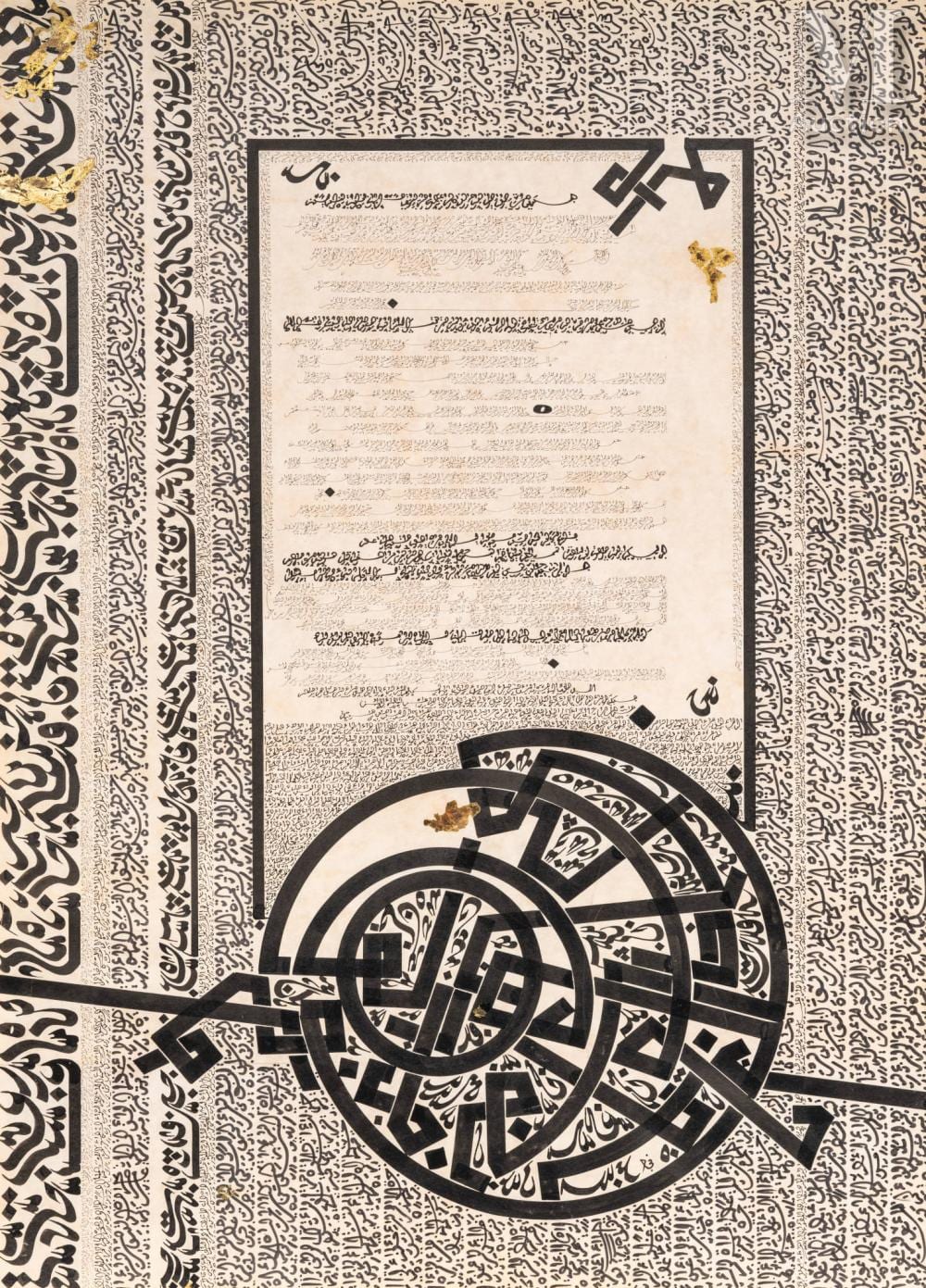
Nja MAHDAOUI (Tunis, 1937) Untitled, circa 1975 India ink and gold leaf on parchment paper 68.5 x 49.5 cm Signed 'Nja' in Arabic, lower right *** India ink and gold leaf on vellum, signed lower right in Arabic (27 × 19½ in.) Painted circa 1975 We would like to thank the Mahdaoui Foundation for kindly confirming the work's authenticity. A certificate of authenticity may be issued at the purchaser's expense. Provenance : Private collection, France This piece belongs to the first sets of a major series on parchment paper, begun in 1972 and continued until the early 1990s, based around two main formats: 50 × 70 cm and 70 × 100 cm. "I didn't approach the graphic sign to use it as a 'mode' of the moment, or to use it as an element of civilization - as a contribution, or addition, to my plastic work.... I studied at length the problematic of the calligraphic sign and its possible consequences, both from the linguistic point of view and the meaning of the word, and from the visual point of view and the immediacy of sensation - external and internal. So it was that, after a number of personal experiments in painting - collage, free expression, gestalt painting, integration of natural elements and use of molten paint - I had to realize that a man belonging to a given civilization must necessarily ( be ) - and to be, to exist globally, implies a double intellectual and conceptual effort, in terms of the way he assumes his self, I explain. It was somewhere in Europe, in Milan, I think, during an international exhibition at the Galerie Cortina, around 1967, that I became aware that by dint of wanting to be universal, I was in danger of dissolving into an ALL, where the self (individual, civilization) slipped in favor of other cultures... I then opted, step by step, to question my practical approach to art, which led me to deepen my research in the field of calligraphy. my research into calligraphy, which, taken as a science, naturally imposes its dictates, in force, with codes, canons and rules; this demanded an extraordinary effort, both from a theoretical and a practical point of view, because before tackling the technique of the sign element, I had to start again from the beginning, learning the different calligraphic techniques: 1° How to use the sign without it carrying its own meaning or scholarly discourse? Every word, every phraseology imposes an imaginary suggestion and distances the viewer (I) from the relationship between work and individual. So, from the outset, I've eliminated all verbal meaning. The letter loses its role as signifier of a message and becomes a signified, abstract element. 2° I orient my research towards free surfaces, so that the sign itself, freed and emptied of dialectical content, simply imposes an almost physical, sensual spatial architecture." Nja Mahdaoui, "À propos de ma démarche picturale", Revue Echanges, Tunis, 1980, pp. 139-141. Born in Tunisia in 1937, Nja Mahdaoui trained at the Academy of Fine Arts in Rome (graduating in 1967), then at the École du Louvre (1968) and the Cité Internationale des Arts in Paris. He began exhibiting in 1959 and returned to Tunisia in 1977. Internationally recognized as the "choreographer of letters", he played a pioneering role in the development of calligraphic abstraction: liberating the Arabic letter from its scriptural function to turn it into a purely visual, musical and rhythmic form, he developed a language of "calligrams" and "graphemes" emptied of all literal content - what he himself calls a writing emancipated from meaning. His work, which spans more than six decades, embraces media as diverse as parchment, ceramics, textiles, sculpture and stained glass. He has completed numerous monumental commissions - Jeddah and Riyadh (1981-1984), the KAUST University campus in Saudi Arabia (2010), Facebook headquarters in Menlo Park (2018) - and received the Grand Prix of the Tunisian Ministry of Culture (2006) and the UNESCO Prize for Arab Crafts (2005). His work can be found in the collections of the British Museum, the Smithsonian Institution, the Institut du Monde Arabe, the Mathaf and the Barjeel Foundation.