Have one like this?
Upload a photo for a free check of what yours may be worth.
Lot description
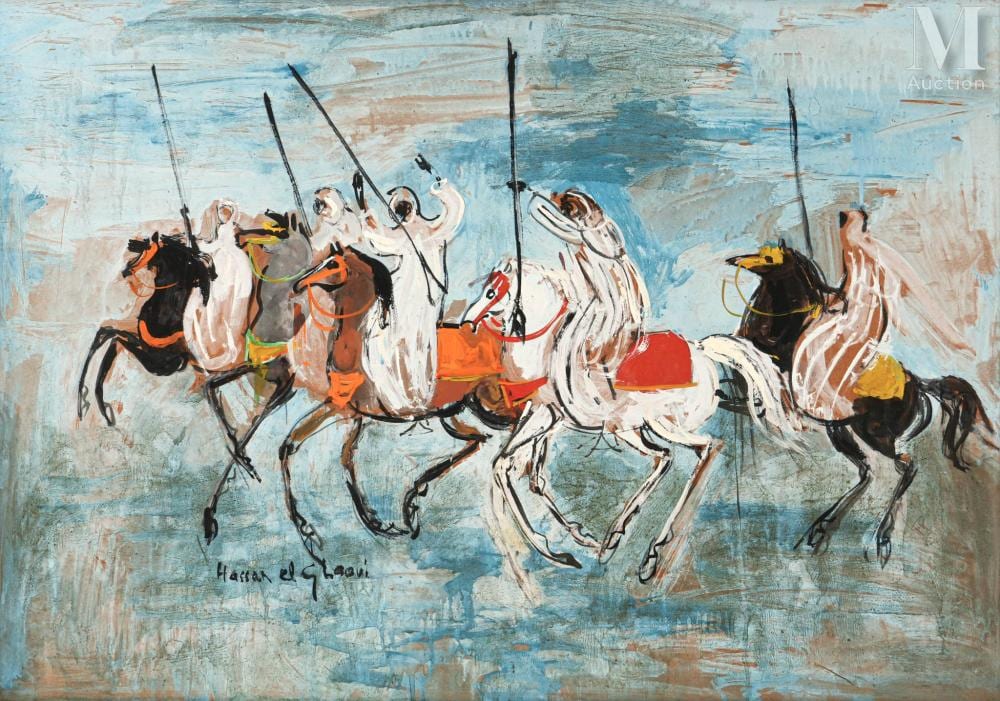
Hassan EL GLAOUI (Morocco 1923 - 2018) Fantasia Gouache on isorel 74 x 104.5 cm Signed lower center Hassan el Glaoui Painted before 1975. *** Gouache on hardboard (masonite), signed lower center (29⅛ × 41⅛ in.). Painted before 1975 The authenticity of this work has been confirmed by the El Glaoui family. A certificate can be issued at the purchaser's expense. Provenance Private Franco-Spanish collection; gift from the artist on the occasion of the current owner's wedding, 1975. "Fantasia is not a show: it's a galloping memory, a song of dust and fire." Ahmed Sefrioui, in Le Maroc des peintres, Casablanca, 1987. Born into a large family of Berber warriors from the Atlas Mountains, Hassan El Glaoui was the eldest son of the last pasha of Morocco, Thami, and of Lalla Zineb El Mokri, daughter of the grand vizier El Mokri. A pioneer of modern painting in his country, he was immersed from an early age in a world of ancestral traditions, from which he escaped through drawing and painting. He cultivated his taste for the arts in secret, for fear of family judgment, until the British Prime Minister, Winston Churchill, and the founder of New York's Museum of Modern Art, General Goodyear, discovered his work and encouraged him to pursue it. Hassan El Glaoui was sent to France at the end of the 1940s, where he remained for some fifteen years. He attended Jean Souverbie's classes at the Ecole des Beaux-Arts de Paris, as well as the studio of painter Emilie Charmy. His first solo exhibition took place in Paris in 1950, followed by one in New York in 1952. In 1957, he took part in the 2nd Alexandria Biennial and in 1963 in the exhibition "Deux mille ans d'art au Maroc", at the Galerie Charpentier in Paris. In 1964, after a meeting with Prince Moulay Abdallah, he settled permanently in Morocco. His most emblematic works depict horses and riders in full cavalcade, notably at fantasias. For El Glaoui, horses were a passion, and he mastered their anatomy and movement. Moreover, his father's role and function made him a privileged witness to the public life of the court, and in particular of the King, whose public outings he portrayed.