Have one like this?
Upload a photo for a free check of what yours may be worth.
Lot description
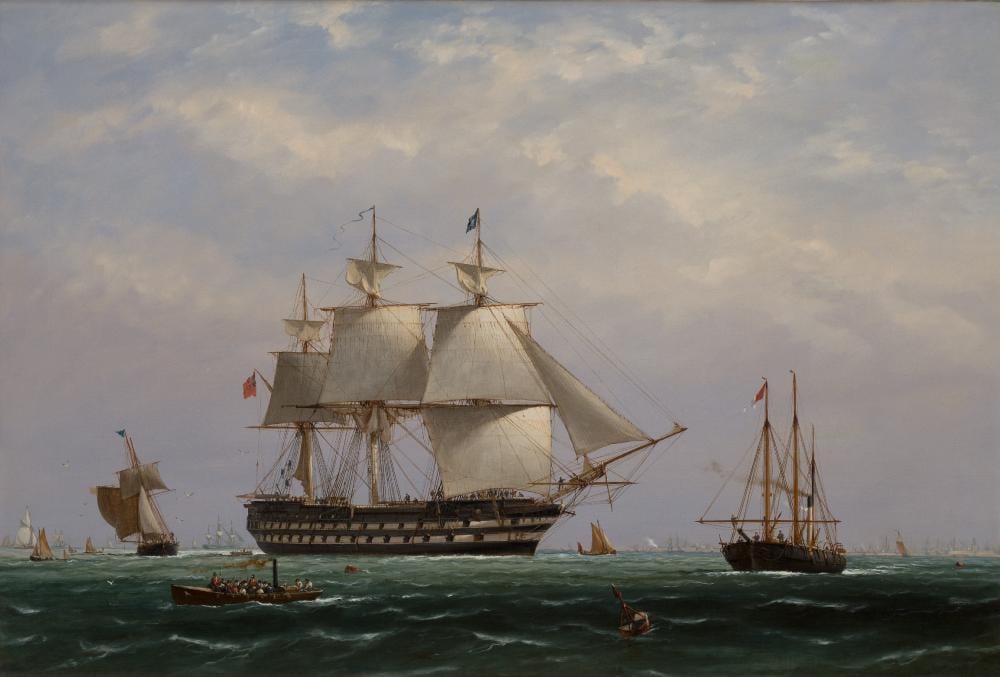
RICHARD HENRY NIBBS (BRITISH, C.1816-1893) H.M.S. ‘Canopus’ returning from sea trials through a busy anchorage, Spithead, circa 1845 Signed ‘R H Nibbs’ (lower right) Oil on canvas 27 x 40½in. (68.5 x 103cm.) Provenance: Christie's London: Maritime, 15 November 1996, lot 490. Even by the standards of the Royal Navy, H.M.S. Canopus proved an extremely long-lived ship. Built for the French Navy at Toulon in 1797, she was a large two-decker of 2,257 tons and carried 80 guns. Named Franklin, in honour of Benjamin Franklin, the first ambassador of the United States to serve in Paris after the American War of Independence, she went straight into Admiral Bruey’s fleet upon completion and accompanied him to Alexandria as one of the vessels escorting Napoleon’s Egyptian expeditionary force in May 1798. Ordered to stop this invasion of Egypt, Nelson spent many fruitless weeks searching the eastern Mediterranean and although he was too late to prevent the army from disembarking, he eventually located the French fleet as it lay at anchor in Aboukir Bay, at the mouth of the Nile, on 1st August. Even though it was already late in the day, Nelson surprised the French - who expected him to delay any offensive action until the next morning - and attacked at once. It was a brilliant show of daring and the ensuing ‘Battle of the Nile’ proved one of the greatest victories in British naval history. Franklin, the flagship of Rear-Admiral Blanquet, Bruey’s second-in-command, fought valiantly but was so severely damaged that she was forced to strike her colours and surrender. Initially towed to Gibraltar for temporary repairs, she and the five other French prizes-of-war were then sent to Plymouth where they were completely refitted, and it was at this point that Franklin was renamed Canopus, the ancient name for Aboukir. Back in service as soon as she was ready, she then remained at sea until the Napoleonic Wars finally came to an end having played a prominent rôle in numerous notable actions, including the battle off St. Domingo in February 1806. Considered such an excellent ship that she was used as the model for the new 'Formidable'-class of 84-gun 2nd Rates built after peace came in 1815, she was still winning sailing trials as late as 1847, by which time she was fifty years old. ‘Sweeping the crests like a seagull’ was how one admiral described her reputation for speed and after seventy years in commission and a further eighteen as a hulk, she was eventually sold for breaking in 1887. Relined, mild scattered retouching to sky Framed 33 x 46in.