Have one like this?
Upload a photo for a free check of what yours may be worth.
Lot description
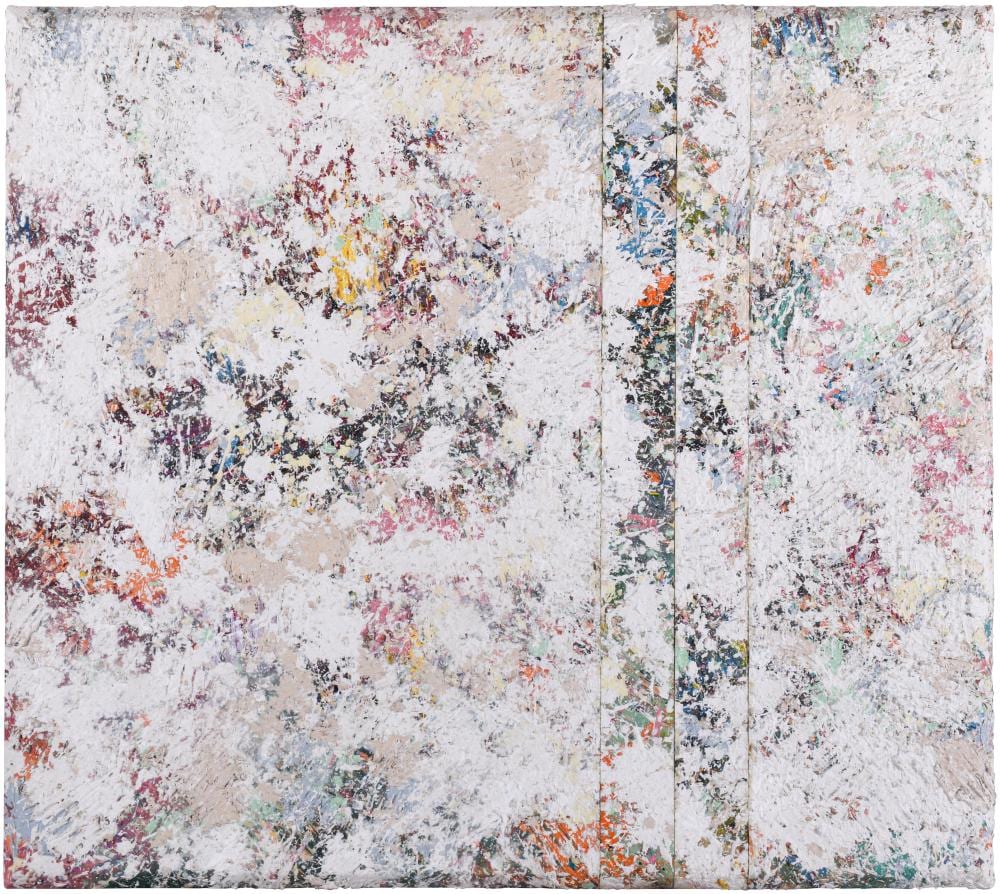
SAM GILLIAM WASHINGTON DC, 1933-2022 CHILDREN THREE, 1976 Acrylic and canvas collage on beveled edge canvas Verso titled and signed: Children Three '76 / Sam Gilliam Verso Gallery Label: DART GALLERY, INC., / DC-4-77-31 / SAM GILLIAM / CHILDREN THREE. 1976 / 48 X 54" / SUITE 205/ 612 N. MICHIGAN AVE. / CHICAGO, IL. Catalogue note: CHILDREN THREE (1976) is an important work from Sam Gilliam's ‘White and Black' series of paintings from 1975–77, a time of a radical reinvention for the artist. At this time, Gilliam moved away from his ethereal, draped canvases and, instead, returned to his bevel-edged constructed canvases on which he incorporated collaged canvas strips, multiple layers of prismatic-hued paint, and heavily-impastoed all-over surfaces. The picture plane of CHILDREN THREE is encrusted with a scumbled monochromatic layer of hardened paint that reveals shifting veins and pools of vibrant color beneath. Two vertical strips of differently painted canvas and three seams (the children) are collaged onto the picture providing an area of stasis amid the dynamism of the surface. The overall effect of CHILDREN THREE is surprisingly complex and lyrical, shifting between: dynamic and static, projecting and receding, revealing and concealing, colorful and monochromatic. The title of the painting likely refers to the artist's three daughters, who, although rarely referenced by name, factor into Gilliam's oeuvre. A similar work from the ‘White and Black' series titled DOROTHY'S MONDAY (1977) is a direct homage to Gilliam's wife, the pioneering civil rights journalist Dorothy Butler Gilliam. In both works, strongly defined collaged-canvas elements provide havens of stillness and consistency on the all-over, dynamic and shifting surfaces. As an African-American, Sam Gilliam and members of his family experienced first-hand the advances and retreats of the Civil Rights movement of the twentieth century; and as a socially-engaged artist, Gilliam discussed these concerns and translated them into his artwork, visible here in CHILDREN THREE.