Have one like this?
Upload a photo for a free check of what yours may be worth.
Lot description
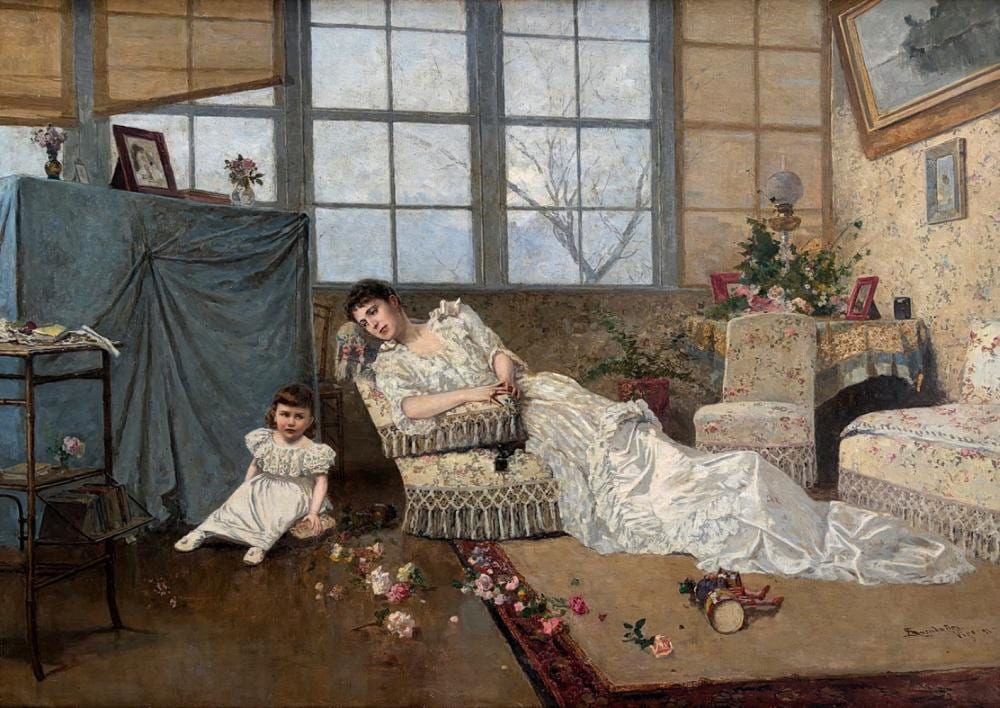
SERAFÍN AVENDAÑO (Vigo, Pontevedra, 1838 - Valladolid, 1916). "In the living room", 1891. Oil on canvas. Signed and dated in the lower left corner. Measurements: 70 x 100 cm; 87 x 117 cm (frame). Serafín Avendaño offers us an intimate and bourgeois scene in which a young woman rests next to a girl in a luminous and carefully decorated interior, emphasizing the delicacy of the whites, the attention to the fabrics and flowers and the silent and melancholic atmosphere. It is characteristic of Serafín Avendaño's style for its subtle treatment of natural light, the elegant brushstroke and the combination of realism and poetic sensitivity, features influenced by his contact with Italian painting and by a lyrical vision of everyday life typical of the painting of the late nineteenth century. Serafín Avendaño is one of the clearest and most brilliant examples of pre-impressionism, not only Galician but also Spanish. Nowadays of slow international recognition, during his lifetime he enjoyed considerable prestige, especially in Italy, where he lived for several years. Although Galician by birth, Serafín Avendaño moved to Madrid at a very young age with his brother Teodomiro, with a decidedly romantic attitude. There he trained as a disciple of Antonio Esquivel and Jenaro Pérez Villaamil, and was a student at the Royal Academy of Fine Arts of San Fernando. He was very passionate about light, the painter from Vigo went to the countryside with his easel, seeking to capture reality directly, from the chromatism and not from the norm. At a very young age he began to make himself known and to be awarded prizes, and in 1858 he won the silver medal at the Galician Exhibition. His style was to some extent based on the landscape school created by Carlos de Haes, although he soon separated from this somewhat precious and cold way to approach the landscape in a freer and more direct way. In this sense, he identifies himself more with the landscape conception of Martín Rico and Aureliano de Beruete. After finishing his studies in San Fernando, Avendaño began to travel around the world, and in the sixties he visited the United States, where he achieved fame with his paintings of torrents and Niagara Falls. He also visited England, France and Switzerland. On his return, he was awarded by competition the pension for Rome. He competed with Martin Rico, and the quality of both forced the jury, for the first time, to double the scholarship. He returned briefly to Spain and again settled in Italy between 1876 and 1891, joining the landscape school of Rivara, who had a notable influence on his work. During this period he returned to Spain occasionally to participate in official competitions. He was awarded a third medal at the National Exhibition of Fine Arts in 1864 and 1892, and a second medal in 1899. He spent the last years of his life in Valladolid. His prestige led him to form part of the jury of National Exhibitions, and to collaborate in the magazine "Blanco y Negro" between 1893 and 1911. After his death, numerous posthumous exhibitions of his work were held in Italy between 1930 and 1990, in Rome, Turin, Genoa and Milan. Avendaño is currently represented in the Prado Museum, the Ministry of Public Works, the Museums of Huelva and Cuenca, the Municipal de San Telmo in San Sebastian, the Nova Caixa Galicia Collection and other collections, both public and private.