Have one like this? Check yours freeOr have an appraiser value it
Lot description
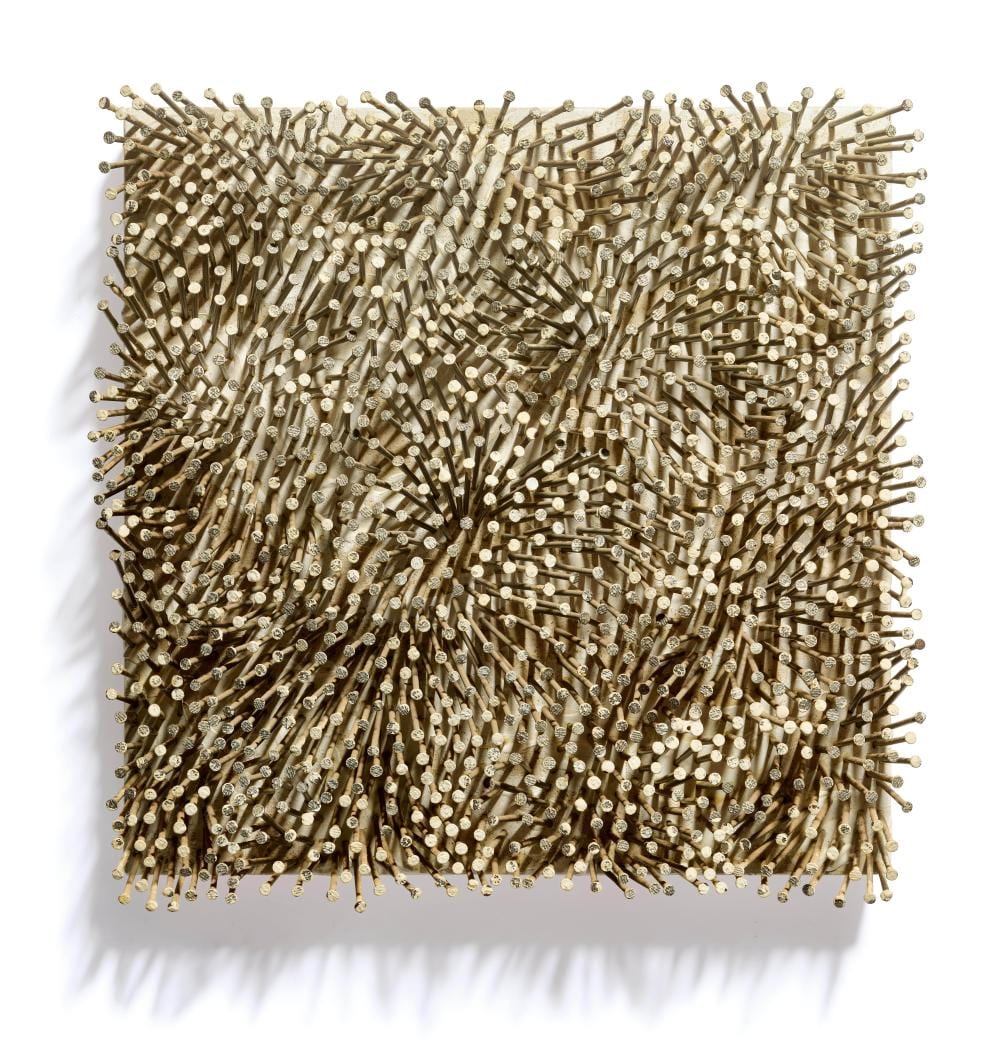
GÜNTHER UECKER (Wendorf 1930–2025 Düsseldorf) Weisses Feld. 1990. Nails and acrylic on canvas on wood. Verso signed, titled, dated and with directional arrow: WEISSES FELD 90 uecker. 40 × 40 × 9 cm. Provenance: - Artist's studio. - Private collection Switzerland, acquired directly from the artist. - Private collection Switzerland, acquired from the previous owner. - Private collection Switzerland, received through inheritance. Günther Uecker’s strictly square ‘Weisses Feld’ (white field), created by the artist who passed away last year, unfolds its effect through the tension between order and irritation. The homogeneously white-grey surface – an allusion to the monochromy of modernism from Kazimir Malevich to Yves Klein – reveals itself, on closer inspection, as a vibrating structure of driven-in nails. Their arrangement does not appear violently forced, but rather like a naturally rhythmised surface: a pulsating field whose dynamics unfold in the interplay between painting and sculpture, particularly through the shifting effects of light and shadow. Depending on the viewpoint, perception oscillates between calm and unrest, between meditative stillness and optical movement. The positioning of the nails appears at once controlled yet open to chance, as though following – much like the surface of the sea – an inner logic or current that never fully reveals itself to the eye. Uecker’s group of works known as ‘Weisses Feld’ stands, through its combination of radical reduction and ascetic aesthetics, firmly in the tradition of the ZERO movement. Since the early 1960s, the artist has effectively driven painting out of the pictorial space in his nail works – not through spatial expansion, but rather through motivic condensation, formal concentration and material transformation: the hammer becomes a brush, the nail a painterly medium, and only in the interplay of viewpoint and incidence of light is the work ultimately completed. These works are, however, more than formal experiments. They simultaneously reveal both the act of reduction and that of intensification: the nail, a trivial industrial object, functions here as a symbol of energy and time; each driven-in metal spike leaves not only a material trace, but also constantly recalls the performative act that placed it. In today’s era of visual overstimulation, the ‘Weisses Feld’ asserts its enduring relevance. It demands attention not through loudness, but through silence – in the midst of visual excess, it functions as a counter-image: still, concentrated, and at the same time charged with inner tension. ------------------------------------------------- GÜNTHER UECKER (Wendorf 1930–2025 Düsseldorf) Weisses Feld. 1990. Nägel und Acryl auf Leinwand auf Holz. Verso signiert, betitelt, datiert und mit Richtungspfeil: WEISSES FELD 90 uecker. 40 × 40 × 9 cm. Provenienz: - Künstlerstudio. - Privatsammlung Schweiz, direkt vom Künstler erworben. - Privatsammlung Schweiz, von vorherigem Besitzer erworben. - Privatsammlung Schweiz, durch Erbschaft erhalten. Das vorliegende, streng quadratische "weisse Feld" des erst im letzten Jahr verstorbenen Künstlers Günther Uecker entfaltet seine Wirkung aus der Spannung zwischen Ordnung und Irritation. Die homogen weissgraue Fläche – ein Verweis auf die Monochromie der Moderne von Kasimir Malewitsch bis Yves Klein – offenbart sich bei näherer Betrachtung als vibrierendes Gefüge aus eingeschlagenen Nägeln. Deren Anordnung wirkt nicht gewaltsam forciert, sondern eher wie eine auf natürlichem Wege rhythmisierte Oberfläche: Ein pulsierendes Feld, das seine Dynamik zwischen Gemälde und Plastik changierend und insbesondere im Wechselspiel von Licht und Schatten entfaltet. Je nach Standpunkt kippt die Wahrnehmung zwischen Ruhe und Unruhe, zwischen meditativer Stille und optischer Bewegung. Die Positionierung der Nägel erscheint zugleich kontrolliert aber auch offen für Zufälligkeit, als folge sie, ganz ähnlich der Meeresoberfläche, einer inneren Logik oder Strömung, die sich dem Blick aber nie vollständig erschliesst. Ueckers Werkgruppe der "weissen Felder" steht mit ihrer Verbindung aus radikaler Reduktion und asketischer Ästhetik ganz in der Tradition der ZERO-Bewegung. Seit den frühen 1960er-Jahren treibt der Künstler in seinen Nagelbildern die klassische Malerei richtiggehend aus dem Bildraum hinaus – nicht durch eine räumliche Erweiterung, sondern im Gegenteil durch motivische Verdichtung, formale Konzentration und materielle Umdeutung: Der Hammer wird zum Pinsel, der Nagel zum Malmedium, und erst im Zusammenspiel von Blickwinkel und Lichteinfall vollendet sich schliesslich das Werk. Die Arbeiten sind dabei jedoch mehr als blosse formale Experimente. Sie zeigen zeitgleich den Akt der Reduktion als auch den der Aufladung: Der Nagel, triviales industrielles Objekt, fungiert hier als Sinnbild für Energie und Zeit; jeder eingeschlagene Metallstift hinterlässt nicht nur eine materielle Spur, sondern erinnert auch stets an die performative Handlung, die ihn platzierte. In der heutigen Zeit der optischen Überreizung behauptet das «weisse Feld» seine ungebrochene Aktualität. Es verlangt keine Aufmerksamkeit durch Lautstärke, sondern durch Stille – inmitten visueller Überfülle wirkt es als Gegenbild: still, konzentriert und zugleich von innerer Spannung getragen.