Have one like this?
Upload a photo for a free check of what yours may be worth.
Lot description
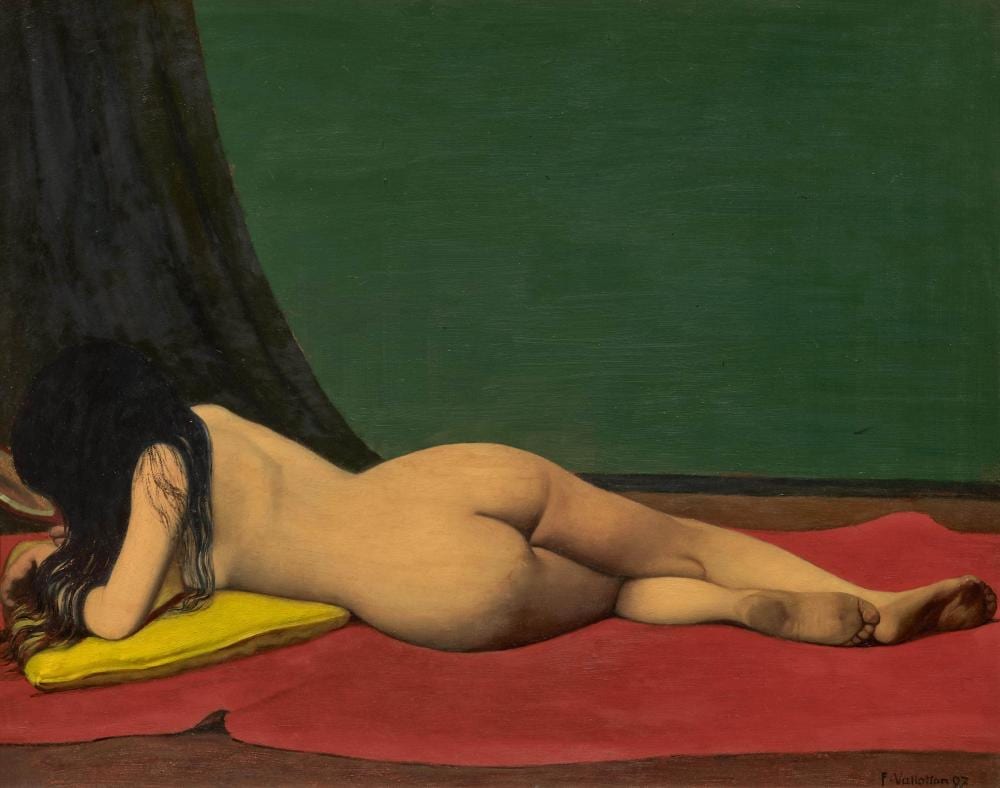
FÉLIX VALLOTTON (Lausanne 1865–1925 Paris) Femme nue couchée de dos. 1897. Oil on cardboard. Signed and dated lower right: F. Vallotton 97. 47.5 × 60 cm. Provenance: - Collection Alexandre Natanson, acquired directly from the artist in 1898. - Auction Drouot, 16 May 1929, lot 106. - Probably collection Gibour or Giboun, acquired at the above auction (indistinctly noted in the sales book). - Auction Drouot, 5 December 1940, lot 40. - Collection Louis le Bomin, Paris, acquired at the above auction. - Private collection, Switzerland. Exhibited: - Probably Paris 1898, Exposition des œuvres de MM. P. Bonnard; M. Denis Ibels; Ranson; X. Roussel; Sérusier; Vallotton; Vuillard, Galerie Vollard, 27 March–30 April 1898. - Probably Paris 1935, Félix Vallotton 1865-1925, Galerie Druet, 14–25 October 1935, no. 2, as 'Nu couché'. Literature: - Félix Vallotton: 'Livre de raison. Liste de mes œuvres, peintures et gravures, faite dans l'ordre chronologique, à partir de 1885', in: Catalogue 1938, Zurich, Félix Vallotton. 1865–1925, pp. 37–99, no. 360, as 'Peinture femme nue couchée, dos'. - Thadée Natanson: 'Petite gazette d'art', in: La Revue blanche, 15 April 1898, p. 618. - Charles Kunstler: 'Les expositions. Felix Vallotton', in: Le Figaro, supplément artistique, 2 May 1929, p. 496, no. 231. - Didier Romand: 'En vogue. Felix Vallotton', in: Le spectacle du monde, 1974, p. 95, no. 150. - Marina Ducrey: Félix Vallotton (1865–1925). L’œuvre peint. Catalogue raisonné, Zurich and Lausanne 2005, vol. II, p. 137, no. 238 (illustrated). Félix Vallotton ranks among the most distinctive artists of European Modernism around 1900. Although closely associated with the Les Nabis, he had already developed, by the 1890s, a highly individual pictorial language that differs markedly from the poetic atmosphere of artists such as Pierre Bonnard or Édouard Vuillard. His works combine decorative flat planes with psychological distance; formal rigour with a peculiarly cool eroticism. The present painting of 1897 stands as an exemplary work from this decisive phase of his oeuvre. The precise yet simplified depiction of the nude lends the painting its particular artistic quality. The body occupies almost the entire foreground, while the space is reduced to a few large areas of colour: the deep red of the carpet, the greenish zone of the wall and the dense black of the falling hair. It is precisely this tension between the pale skin of the model and the complementary red and green tones that belongs to Vallotton’s characteristic means of expression. His nudes appear neither idealised nor sentimental; rather, they possess a quiet, almost unsettling presence. The models appear distant and self-contained. The painterly simplification and the precise contour are likewise characteristic of Vallotton. Anatomy is defined through clear lines and large, almost unmodulated fields of colour. This flat conception owes much to the influence of Japonisme and Japanese colour woodcuts, which Vallotton studied intensively. At the same time, his art is closely connected to his activity as a major innovator of the modern woodcut. The sharply defined contours and the strong reduction to contrasts of light and dark found in his graphic works correspond directly to his paintings of the late 1890s. Technically, too, the work is typical of Vallotton’s production of this period. The use of oil on cardboard reflects his preference for smooth supports, which reinforce the matte appearance of his painting. Numerous major works from the years around 1898 were executed on board or panel and underline the decorative and consciously anti-illusionistic character of his art. Within his oeuvre, this important work stands at the transition from Symbolism and the Nabi style towards a more objective pictorial conception of the early 20th century. Vallotton’s detached depiction of the human body and the quiet tension of his composition appear remarkably modern. His nudes thus combine the elegance of the ‘Fin de Siècle’ with the emergence of early Modernism. ------------------------------------------------- FÉLIX VALLOTTON (Lausanne 1865–1925 Paris) Femme nue couchée de dos. 1897. Öl auf Karton. Unten rechts signiert und datiert: F. Vallotton 97. 47,5 × 60 cm. Provenienz: - Sammlung Alexandre Natanson, 1898 direkt beim Künstler erworben. - Auktion Drouot, 16.5.1929, Los 106. - Wohl Sammlung Gibour oder Giboun, an obiger Auktion erworben (im Verkaufsbuch undeutlich vermerkt). - Auktion Drouot, 5.12.1940, Los 40. - Sammlung Louis le Bomin, Paris, an obiger Auktion erworben. - Schweizer Privatsammlung. Ausstellungen: - Wohl Paris 1898, Exposition des œuvres de MM. P. Bonnard; M. Denis Ibels; Ranson; X. Roussel; Sérusier; Vallotton; Vuillard, Galerie Vollard, 27.3.–30.4.1898. - Wohl Paris 1935, Félix Vallotton 1865-1925, Galerie Druet, 14.–25.10.1935, Nr. 2, als "Nu couché". Literatur: - Félix Vallotton: "Livre de raison. Liste de mes œuvres, peintures et gravures, faite dans l'ordre chronologique, à partir de 1885", in: Catalogue 1938, Zürich, Félix Vallotton. 1865–1925, S. 37–99, Nr. 360, als "Peinture femme nue couchée, dos". - Thadée Natanson: "Petite gazette d'art", in: La Revue blanche, 15.4.1898, S. 618. - Charles Kunstler: "Les expositions. Felix Vallotton", in: Le Figaro, supplément artistique, 2.5.1929, S. 496, Nr. 231. - Didier Romand: "En vogue. Felix Vallotton", in: Le spectacle du monde, 1974, S. 95, Nr. 150. - Marina Ducrey: Félix Vallotton (1865–1925). L’œuvre peint. Catalogue raisonné, Zürich und Lausanne 2005, Bd. II, S. 137, Nr. 238 (mit Abb.). Félix Vallotton gehört zu den eigenständigsten Künstlern der europäischen Moderne um 1900. Obwohl er der Gruppe der Nabis nahestand, entwickelte er bereits in den 1890er Jahren eine unverwechselbare Bildsprache, die sich deutlich von der poetischen Atmosphäre eines Bonnard oder Vuillard unterscheidet. Seine Werke verbinden dekorative Flächigkeit mit psychologischer Distanz, formale Strenge mit einer eigentümlich kühlen Erotik. Das vorliegende Gemälde von 1897 steht exemplarisch für diese entscheidende Phase seines Schaffens. Die präzise und zugleich vereinfachte Darstellung des Aktes verleiht dem Gemälde seine besondere künstlerische Qualität. Der Körper füllt den Vordergrund nahezu vollständig aus, während der Raum auf wenige grosse Farbflächen reduziert bleibt: das tiefe Rot des Teppichs, die grünliche Wandzone und das dichte Schwarz des herabfallenden Haares. Gerade diese Spannung zwischen der hellen Haut des Modells und den komplementären Rot- und Grüntönen gehört zu den charakteristischen Ausdrucksmitteln Vallottons. Seine Akte wirken weder idealisiert noch sentimental; vielmehr besitzen sie eine stille, beinahe unbequeme Präsenz. Die Modelle erscheinen distanziert und in sich geschlossen. Die malerische Vereinfachung und die präzise Kontur sind ebenfalls typisch für Vallotton. Die Anatomie wird durch klare Linien und grosse, nahezu ungebrochene Farbfelder definiert. Diese flächige Auffassung verdankt sich nicht zuletzt dem Einfluss des Japonismus sowie der japanischen Farbholzschnitte, die Vallotton intensiv studierte. Zugleich steht seine Kunst in engem Zusammenhang mit seiner Tätigkeit als bedeutender Erneuerer des modernen Holzschnitts. Die scharf gesetzten Konturen und die starke Reduktion auf Hell-Dunkel-Kontraste seiner Druckgraphik finden in seinen Gemälden der späten 1890er-Jahre eine direkte Entsprechung. Auch technisch ist das Werk typisch für Vallottons Arbeiten dieser Zeit. Die Ölmalerei auf Karton entspricht seiner Vorliebe für glatte Bildträger, die den matten Eindruck seiner Malerei verstärken. Zahlreiche Hauptwerke der Jahre um 1898 entstanden auf Karton oder Holz und unterstreichen den dekorativen sowie bewusst antiillusionistischen Charakter seiner Kunst. Innerhalb seines Œuvres steht dieses bedeutende Werk am Übergang vom Symbolismus und dem Nabi-Stil zu einer sachlicheren Bildauffassung des frühen 20. Jahrhunderts. Vallottons distanzierte Darstellung des menschlichen Körpers und die ruhige Spannung seiner Komposition wirkt bemerkenswert modern. Seine Akte verbinden dabei die Eleganz des "Fin de Siècle" mit dem Aufbruch in die frühe Moderne.