Have one like this?
Upload a photo for a free check of what yours may be worth.
Lot description
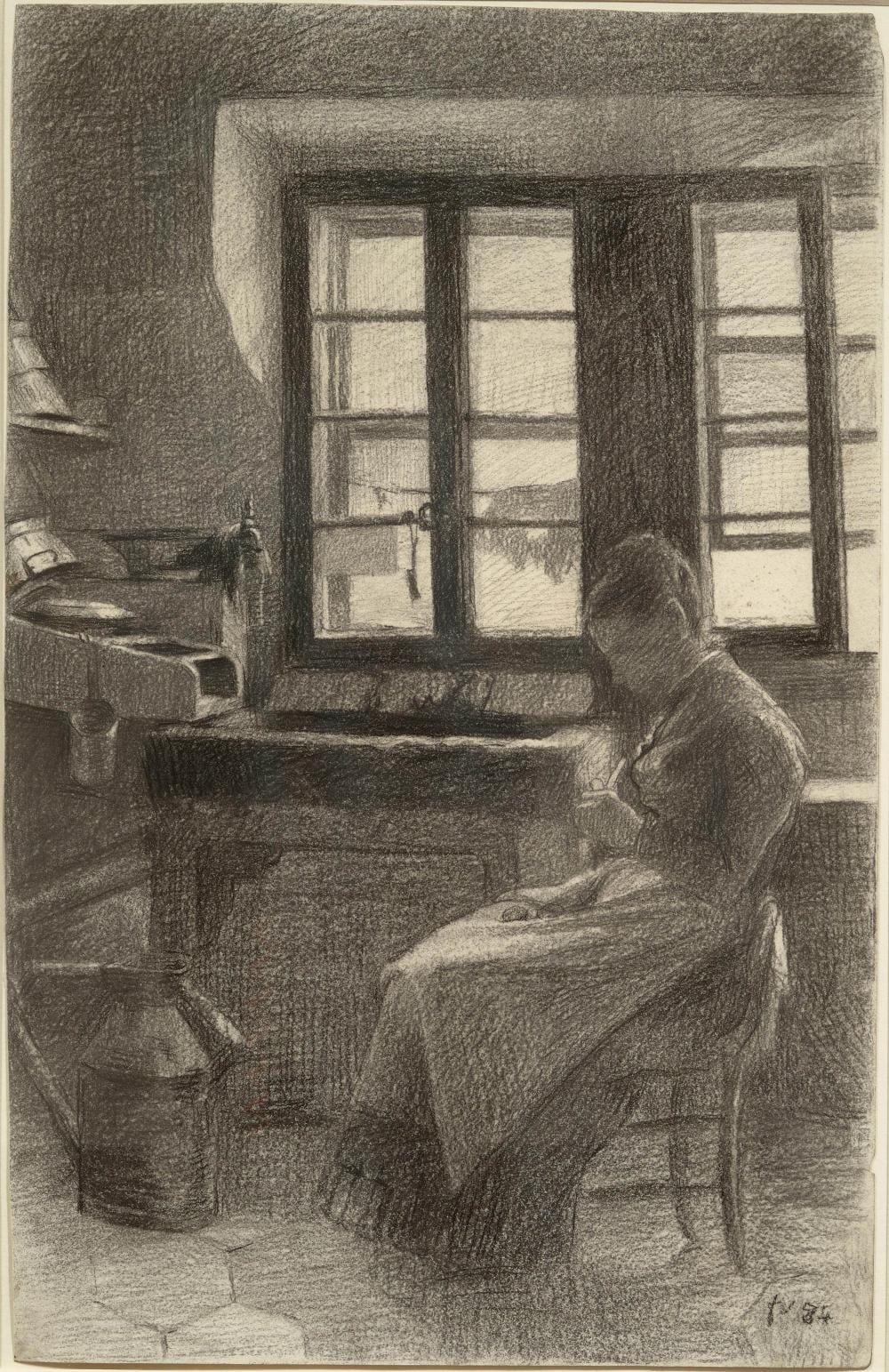
FÉLIX VALLOTTON (Lausanne 1865–1925 Paris) Femme dans sa cuisine – La mère de l’artiste dans la cuisine. 1884. Black chalk on paper. Monogrammed and dated lower right: fv 84. 42 × 26.5 cm. Provenance: - Galerie Paul Vallotton, Lausanne. - Collection Alfred Vallotton, Paris. - Private collection, Paris. - Auction Galerie Kornfeld Bern, 18 June 2010, lot 144. - Private collection, Germany. Exhibited: - Zurich 1928, Félix Vallotton, Kunsthaus Zürich, 20 January–26 February 1928, no. 187. - Bern 1930, Max Bill. Jakob Probst. Leo Steck. Félix Vallotton. Walo von May, Kunsthalle Bern, 15 June–13 July 1930, no. 51, as 'Intérieur de cuisine'. - Winterthur, Bremen, Düsseldorf, Paris and Geneva 1978/79, Félix Vallotton: Bilder. Zeichnungen. Graphik, Kunstmuseum Winterthur, 1 October–12 November 1978; Kunsthalle Bremen, 2 December 1978–28 January 1979; Kunsthalle Düsseldorf, 16 February–25 March 1979; Musée de Petit Palais, April–June 1979; Musée Rath, July–September 1979, no. 183, as 'Junge Frau in der Küche'. - Solothurn and Winterthur 2012, Félix Vallotton. Zeichnungen, Kunstmuseum Solothurn, 12 May–12 August 2012; Kunstmuseum Winterthur, 15 September–25 November 2012, no. 3. Literature: - Exh. cat. Max Bill. Jakob Probst. Leo Steck. Félix Vallotton. Walo von May, Bern 1930, p. 5, no. 51. - Marina Ducrey, Félix Vallotton. L’œuvre peint. Catalogue raisonné, Milan 2007, vol. II, p. 9. - Exh. cat. Félix Vallotton. Zeichnungen, Solothurn and Winterthur 2012, p. 40, no. 3 (illustrated). Félix Vallotton created this masterful drawing shortly after the beginning of his studies at the Académie Julian in Paris. The sheet was most likely executed during the summer of 1884 while staying with his family in Lausanne and thus belongs to the artist’s early works, still closely connected to his immediate surroundings. As Rudolf Koella has demonstrated, the scene depicts Vallotton’s mother, Emma Vallotton-Roseng, in the interior of the family apartment on Rue Haldimand. Withdrawn into herself, she sits at the table engaged in a simple domestic activity. The identification of the figure can be confirmed through comparison with contemporary depictions. Nevertheless, she is conceived less as an actual portrait than as an element integrated into the overall structure of the room. The focus lies on the interior as a self-contained pictorial space. Vallotton captures the scene with great precision and develops a balanced composition from the interplay of light, window opening and furnishings. The figure appears as part of this order, not as its centre. It is precisely this restraint that lends the sheet its particular tension and, in its conception, recalls the tradition of Dutch genre painting, with which the young artist was deeply engaged. Against this background, Vallotton’s drawing should not be understood solely as the result of his own intensive study of the Old Masters he so greatly admired. Rather, a comparison suggests itself that reveals both thematic and stylistic correspondences. Striking parallels may be observed in particular with the early drawings, created at almost the same time, of another passionate admirer of Rembrandt: Vincent van Gogh (1853–1890) [Fig. 2]. ------------------------------------------------- FÉLIX VALLOTTON (Lausanne 1865–1925 Paris) Femme dans sa cuisine – La mère de l’artiste dans la cuisine. 1884. Schwarze Kreide auf Papier. Unten rechts monogrammiert und datiert: fv 84. 42 × 26,5 cm. Provenienz: - Galerie Paul Vallotton, Lausanne. - Sammlung Alfred Vallotton, Paris. - Pariser Privatsammlung. - Auktion Galerie Kornfeld, Bern, 18.6.2010, Los 144. - Privatsammlung, Deutschland. Ausstellungen: - Zürich 1928, Félix Vallotton, Kunsthaus Zürich, 20.1.–26.2.1928, Nr. 187. - Bern 1930, Max Bill. Jakob Probst. Leo Steck. Félix Vallotton. Walo von May, Kunsthalle Bern, 15.6.–13.7.1930, Nr. 51, als "Intérieur de cuisine". - Winterthur, Bremen, Düsseldorf, Paris und Genf 1978/79, Félix Vallotton: Bilder. Zeichnungen. Graphik, Kunstmuseum Winterthur, 1.10.–12.11.1978; Kunsthalle Bremen, 2.12.1978–28.1.1979; Kunsthalle Düsseldorf, 16.2.–25.3.1979; Musée de Petit Palais, April–Juni 1979; Musée Rath, Juli–September 1979, Nr. 183, als "Junge Frau in der Küche". - Solothurn und Winterthur 2012, Félix Vallotton. Zeichnungen, Kunstmuseum Solothurn, 12.5.–12.8.2012; Kunstmuseum Winterthur, 15.9.–25.11.2012, Nr. 3. Literatur: - Ausst.-Kat. Max Bill. Jakob Probst. Leo Steck. Félix Vallotton. Walo von May, Bern 1930, S. 5, Nr. 51. - Marina Ducrey, Félix Vallotton. L’œuvre peint. Catalogue raisonné, Milano 2007, Bd. II, S. 9. - Ausst.-Kat. Félix Vallotton. Zeichnungen, Solothurn und Winterthur 2012, S. 40, Nr. 3 (mit Abb.). Félix Vallotton schuf diese meisterhafte Zeichnung kurz nach Beginn seiner Ausbildung an der Académie Julian in Paris. Das Blatt dürfte im Sommer 1884 während eines Aufenthalts bei seiner Familie in Lausanne entstanden sein und gehört damit zu den frühen, noch eng am unmittelbaren Umfeld orientierten Arbeiten des Künstlers. Wie Rudolf Koella dargelegt hat, zeigt die Szene Vallottons Mutter, Emma Vallotton-Roseng, im Interieur der elterlichen Wohnung an der Rue Haldimand. In sich gekehrt sitzt sie am Tisch und geht einer einfachen häuslichen Tätigkeit nach. Die Identifikation der Figur lässt sich durch den Vergleich mit zeitgleichen Darstellungen sichern. Gleichwohl ist sie weniger als eigentliches Porträt aufgefasst, sondern vielmehr in die Gesamtstruktur des Raumes eingebunden. Das Interesse gilt dem Interieur als geschlossenem Bildraum. Vallotton erfasst die Situation mit grosser Genauigkeit und entwickelt aus dem Zusammenspiel von Licht, Fensteröffnung und Mobiliar eine ausgewogene Komposition. Die Figur erscheint als Teil dieser Ordnung, nicht als ihr Zentrum. Gerade diese Zurücknahme verleiht dem Blatt seine besondere Spannung und erinnert in ihrer Anlage an die Tradition der niederländischen Genremalerei, mit der sich der junge Künstler intensiv auseinandersetzte. Vor diesem Hintergrund ist Vallottons Zeichnung nicht allein als Resultat seiner eigenen, intensiven Beschäftigung mit den von ihm hochverehrten Alten Meistern zu verstehen. Vielmehr legt sich ein Vergleich nahe, der sowohl thematische als auch stilistische Übereinstimmungen erkennen lässt. Auffallende Parallelen zeigen sich insbesondere zu den frühen, nahezu zeitgleich entstandenen Zeichnungen eines weiteren leidenschaftlichen Rembrandt-Bewunderers: Vincent van Gogh (1853–1890) [Abb. 2].