Have one like this? Check yours freeOr have an appraiser value it
Lot description
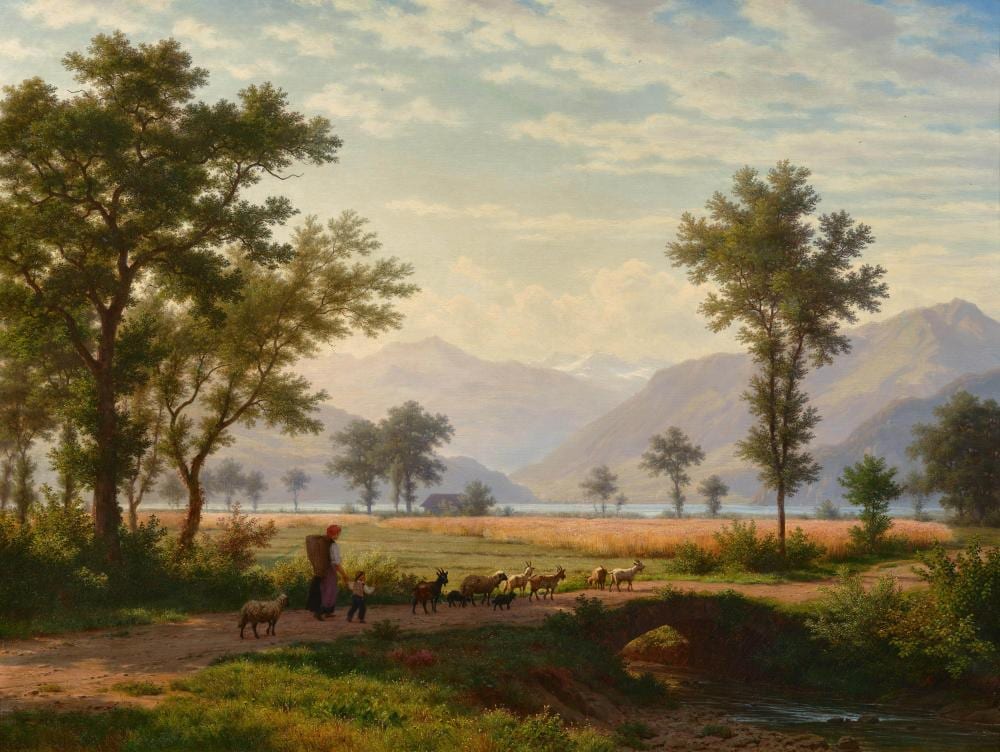
ROBERT ZÜND (1827 Lucerne 1909) Am Vierwaldstättersee. Oil on canvas. Signed lower left: R. Zünd. 60 × 80 cm. Provenance: - Private collection, Switzerland, acquired in 1991. - By descent to the present owner. The present landscape of Lake Lucerne depicts the Seefeld between Wegscheide and Ennethorw, with a view across the lake towards the foothills of Central Switzerland. For Robert Zünd, however, the topographically identifiable location serves merely as the point of departure for his composition. In keeping with his ideal conception of nature, he condenses and reorganises what he observed, so that direct observation and artistic imagination merge into an idealised pictorial reality. As characteristic of Zünd’s working method, this work, too, was most likely based on careful studies from nature, which the artist subsequently developed into a unified composition in the studio. The landscape therefore does not appear as a mere depiction of a specific view, but rather as a timeless ideal image. Subjects, lighting and spatial arrangement combine to form a calm and self-contained world. Characteristic is the absence of any signs of modern industrialisation. Instead, a rural idyll unfolds: shepherds, herds and small figures are harmoniously embedded within the luminous landscape and guide the eye into the depth of the pictorial space. From today’s perspective, this idealisation acquires an additional historical dimension: since the area depicted has meanwhile become heavily shaped by modern development, Zünd’s painting not only preserves the memory of an earlier state of the landscape, but simultaneously appears as a counter-image to modern progress. ------------------------------------------------- ROBERT ZÜND (1827 Luzern 1909) Am Vierwaldstättersee. Öl auf Leinwand. Unten links signiert: R. Zünd. 60 × 80 cm. Provenienz: - Schweizer Privatsammlung, 1991 erworben. - Durch Erbfolge in heutigen Besitz. Die vorliegende Landschaft am Vierwaldstättersee zeigt das Seefeld zwischen Wegscheide und Ennethorw mit Blick über den See auf die Innerschweizer Voralpen. Der topografisch bestimmbare Ort bildet für Robert Zünd jedoch nur den Ausgangspunkt seiner Komposition. Im Sinne seiner idealen Naturauffassung verdichtet und ordnet er das Gesehene neu, sodass unmittelbare Beobachtung und künstlerische Vorstellung in einer idealisierten Bildwirklichkeit ineinander übergehen. Wie für Zünds Arbeitsweise charakteristisch, dürfte auch dieses Werk auf sorgfältigen Naturstudien beruhen, die der Künstler im Atelier zu einer geschlossenen Komposition weiterentwickelte. Die Landschaft erscheint daher nicht als blosse Wiedergabe eines konkreten Ausschnitts, sondern als zeitloses Idealbild. Motive, Lichtführung und räumliche Staffelung fügen sich zu einer ruhigen, in sich geschlossenen Welt. Bezeichnend ist das Fehlen moderner oder industrieller Zeichen. Stattdessen entfaltet sich ein ländliches Idyll: Hirten, Herden und kleine Staffagefiguren sind harmonisch in die helle Landschaft eingebettet und leiten den Blick in die Tiefe des Bildraums. Aus heutiger Sicht erhält diese Idealisierung eine zusätzliche historische Dimension: Da das dargestellte Gebiet inzwischen stark durch moderne Nutzungen geprägt ist, bewahrt Zünds Gemälde nicht nur die Erinnerung an einen früheren Zustand der Landschaft, sondern erscheint zugleich als Gegenbild zur modernen Entwicklung.