Have one like this?
Upload a photo for a free check of what yours may be worth.
Lot description
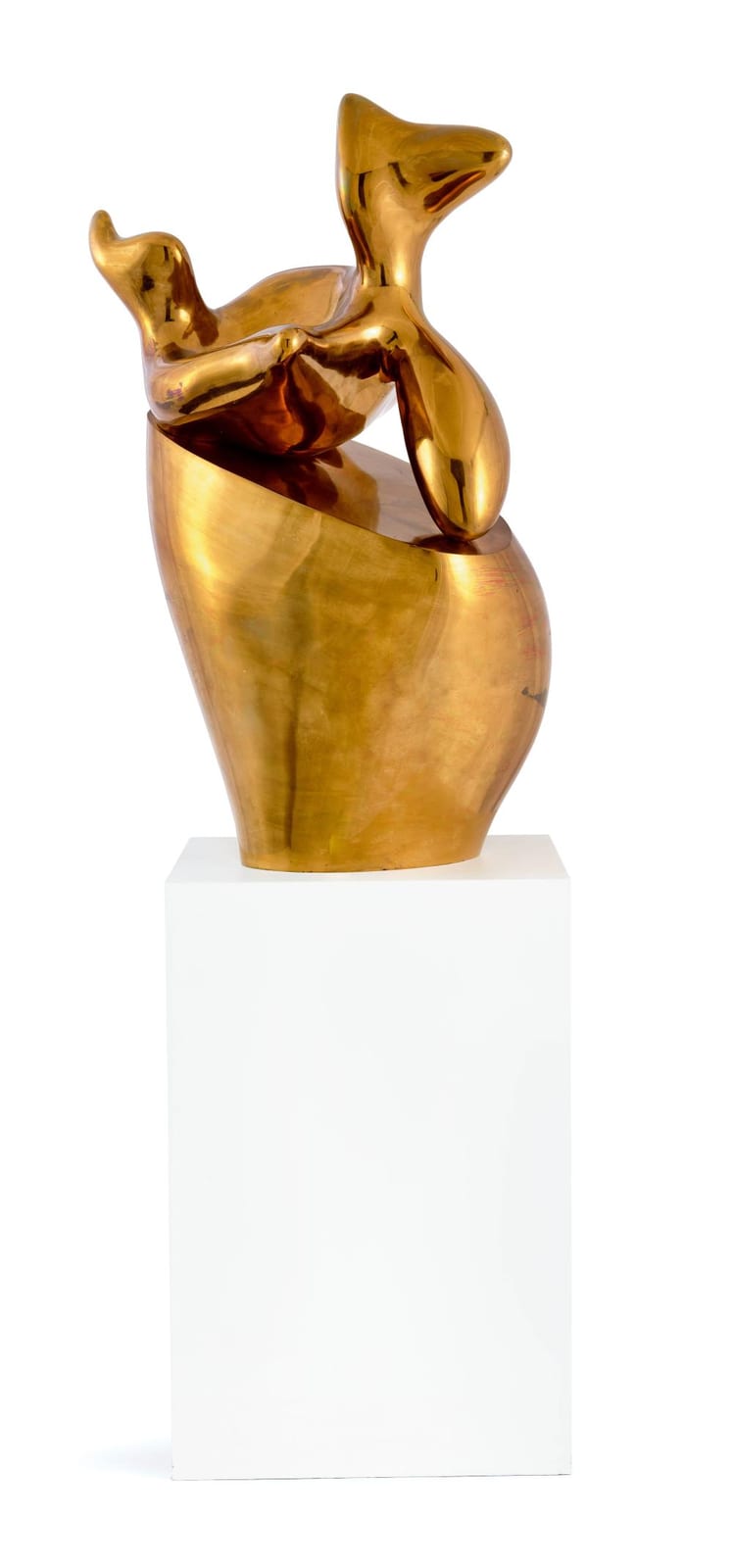
HANS (JEAN) ARP (Strasbourg 1886–1966 Basel) Coupe chimérique. 1947. Bronze, polished. 1/3. Cast c. 1947. H 80 cm. Provenance: - Buchholz Gallery, Curt Valentin, New York. - Mr and Mrs George Henry Warren, New York. - Auction Christie’s, New York, 11 May 1989, lot 355. - Galerie Le Point, Monaco. - Auction Christie’s, New York, 1 July 1999, lot 634. - Private collection Switzerland, acquired at the above auction and by descent to the present owners. Exhibited: - New York 1949, Jean Arp, Buchholz Gallery, 18 January–12 February 1949, no. 23. - New York 1958, Jean Arp. A retrospective, Museum of Modern Art, 8 October–30 November 1958, no. 86. Literature: - Arie Hartog and Kai Fischer: Hans Arp. Skulpturen. Eine Bestandsaufnahme, Ostfildern 2012, p. 99, no. 86 (with ill.). - Carola Giedion-Welcker: Jean Arp, New York 1957, p. 59, no. 86 (with ill.). - Stefanie Poley: Hans Arp. Die Formensprache im plastischen Werk, Stuttgart 1978, ill. 31. Around 1930, Hans Arp began to transfer his biomorphic forms from paintings and reliefs into sculpture. He worked primarily in plaster, as the material can be easily applied and removed, allowing for a flexible process of shaping. These plaster forms served as the basis for his later bronze casts. Until 1943, Arp worked intensively on his sculptural oeuvre, producing several works each year. When Sophie Taeuber-Arp died unexpectedly in a tragic accident in 1943, Arp fell into a deep crisis that led to a multi-year interruption of his sculptural activity. Over the following four years, he processed his grief in works on paper and in poetry. It was not until 1947 that he resumed his sculptural practice with renewed energy. He returned to the style of the preceding years, remaining faithful to rounded, organic volumes, while further developing his sculptures through a greater conceptual density. He increasingly drew on themes of nature, myth, and transformation, and engaged deeply with organic structures as well as with the idea of allowing art to emerge as something "natural". The gold-toned bronze "Coupe chimérique", offered in this auction, dates precisely to this pivotal year of 1947. The two-part work consists of a diagonally cut vessel or bowl forming the base, upon which rests an organic yet undefined form. The title’s term "chimérique" refers to the imaginary and hybrid, evoking associations with a mythological composite creature. Characteristic of Arp, the work presents biomorphic forms that do not imitate nature but instead appear as if they have grown autonomously. The underlying plaster model is now held in the collection of the Centre Pompidou in Paris. The present work is the first of three bronze casts that Arp had made from this model. This version has already been included in several major Arp exhibitions. ------------------------------------------------- HANS (JEAN) ARP (Strassburg 1886–1966 Basel) Coupe chimérique. 1947. Bronze, poliert. 1/3. Guss um 1947. H 80 cm. Provenienz: - Buchholz Gallery, Curt Valentin, New York. - Mr. und Mrs. George Henry Warren, New York. - Auktion Christie's, New York, 11.5.1989, Los 355. - Galerie Le Point, Monaco. - Auktion Christie's, New York, 1.7.1999, Los 634. - Privatsammlung Schweiz, an obiger Auktion erworben und durch Erbschaft an die heutigen Besitzer. Ausstellungen: - New York 1949, Jean Arp, Buchholz Gallery, 18.1.–12.2.1949, Nr. 23. - New York 1958, Jean Arp. A retrospective, Museum of Modern Art, 8.10.–30.11.1958, Nr. 86. Literatur: - Arie Hartog und Kai Fischer: Hans Arp. Skulpturen. Eine Bestandsaufnahme, Ostfildern 2012, S. 99, Nr. 86 (mit Abb.). - Carola Giedion-Welcker: Jean Arp, New York 1957, S. 59, Nr. 86 (mit Abb.). - Stefanie Poley: Hans Arp. Die Formensprache im plastischen Werk, Stuttgart 1978, Abb. 31. Bereits um 1930 beginnt Hans Arp, seine biomorphen Formen aus den Gemälden und Reliefs in die Plastik zu übertragen. Dabei arbeitet er bevorzugt mit Gips, da sich das Material leicht auftragen und wieder abtragen lässt, und so eine flexible Formgebung ermöglicht. Diese Gipsformen dienen ihm als Ausgangspunkt für seine späteren Bronzeabgüsse. Bis 1943 arbeitet Arp intensiv an seinem plastischen Œuvre, es entstehen mehrere Objekte pro Jahr. Als Sophie Taeuber-Arp 1943 unerwartet durch einen tragischen Unfall stirbt, stürzt Arp in eine tiefe Krise, die zu einer mehrjährigen Unterbrechung seiner skulpturalen Tätigkeit führt. Seine Trauer verarbeitet er in den folgenden vier Jahren in Arbeiten auf Papier und in Gedichten. Erst 1947 beginnt er wieder, sich mit neuer Energie der Plastik zu widmen. Er knüpft an den Stil der Vorjahre an, bleibt den gerundeten, organischen Volumina treu, entwickelt seine Skulpturen jedoch weiter, indem sie eine inhaltliche Verdichtung erfahren. Er greift nun verstärkt auf Aspekte von Natur, Mythos und Transformation zurück und beschäftigt sich intensiv mit organischen Strukturen sowie mit dem Gedanken, Kunst als etwas "Naturhaftes" entstehen zu lassen. Die zur Auktion kommende goldfarbene Bronze "Coupe chimérique" fällt genau in diese Zeit. Das zweiteilige Werk besteht aus einem schräg geschnittenen Gefäss oder einer Schale, die die untere Basis bildet. Darauf sitzt eine organische und zugleich undefinierte Form. Der titelgebende Begriff "chimérique" verweist dabei auf das Imaginäre und Hybridhafte und evoziert Assoziationen an ein mythologisches Mischwesen. Typisch für Arp zeigt das Werk biomorphe Formen, die nicht die Natur nachahmen, sondern quasi eigenständig gewachsen wirken. Die zugrunde liegende Gipsform befindet sich heute in der Sammlung des Centre Pompidou in Paris. Bei dem vorliegenden Werk handelt es sich um die erste der drei Bronzen, die Arp nach diesem Modell anfertigen liess. Diese Fassung war bereits Teil mehrerer bedeutender Arp-Ausstellungen.