Have one like this?
Upload a photo for a free check of what yours may be worth.
Lot description
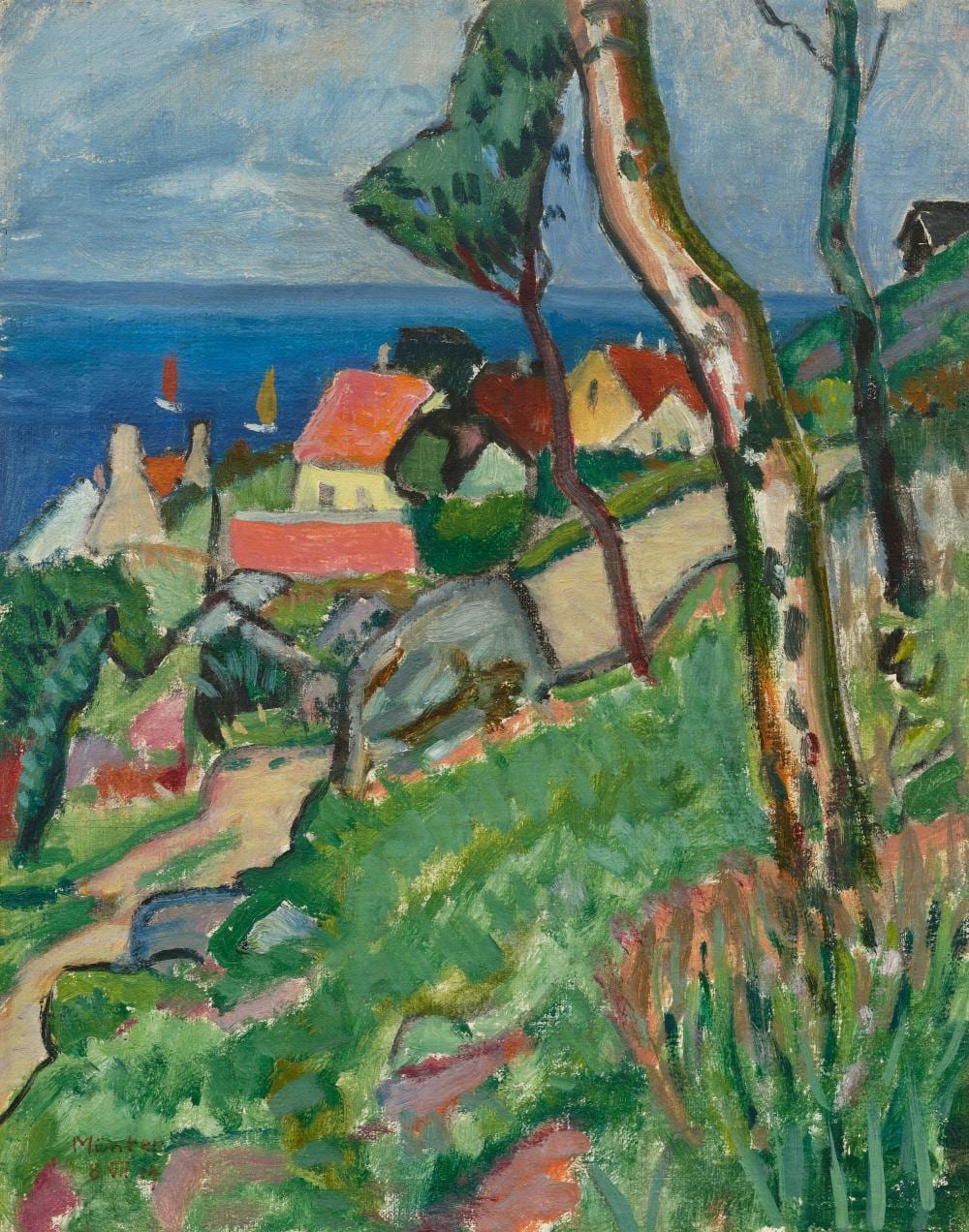
GABRIELE MÜNTER (Berlin 1877–1962 Murnau) Gudhjem. 1919. Oil on canvas. 39.2 × 31 cm. Signed and dated lower left: Münter / 8 VII 19. Verso signed, dated, titled and with the estate stamp: Münter 1919 / Gudhjem I. Provenance: - Evelyn Hagenbeck Galerie und Verlag, Hamburg (verso with label). - Private collection Germany, acquired in the above gallery on 20 March 1977 and since then in the same family ownership. We thank the Gabriele Münter- und Johannes Eichner-Stiftung for confirming the authenticity of the work. It is registered in the estate under the number L 352. Due to the First World War, Gabriele Münter went into exile in 1916 together with her partner Wassily Kandinsky on the Danish island of Bornholm, as he, being a Russian citizen, could no longer remain in Germany. During this period, known as the "Scandinavian exile", Münter produced numerous paintings, primarily landscapes and interiors. At the same time, she developed a more intimate and simplified painterly approach, in contrast to the more experimental and expressive style of the prewar years associated with the group "Der Blaue Reiter". In 1917, Kandinsky returned to Russia and married another woman, marking the definitive end of his relationship with Münter. Left on her own, Münter moved in the summer of 1919 to Gudhjem, a quiet and picturesque village on the northern coast of Bornholm, where she earned her living by giving painting lessons and worked intensively to come to terms with her separation from Kandinsky. There, she developed a more independent and introspective style, creating works characterized by a quiet and reflective atmosphere that nevertheless convey a sense of emotional stability—despite her personal crisis. This is evident in simple, calm, and well-ordered compositions, as well as in a light and harmonious palette. The painting "Gudhjem", created precisely during this phase, depicts a peaceful coastal landscape overlooking the sea. Curving paths lead through a green, hilly terrain. Tall trees with clearly defined contours frame the composition and lend it a sense of structure. The village houses are rendered in simple, clear forms. Their roofs glow in warm shades of red, while the walls are painted in light, friendly tones. The blue of the sea is even and gentle, and the sky appears soft and suffused with light. A calm, contemplative atmosphere prevails, making the scene appear quiet and almost timeless. Münter’s stay in Gudhjem proved highly fruitful for her artistic development. Rather than responding to this difficult personal period with chaos or drama, she turned to order and stability, developing her own independent painterly identity as well as a strong sense of autonomy—something far from self-evident for women of her time. ------------------------------------------------- GABRIELE MÜNTER (Berlin 1877–1962 Murnau) Gudhjem. 1919. Öl auf Leinwand. 39,2 × 31 cm. Unten links signiert und datiert: Münter / 8 VII 19. Verso signiert, datiert, betitelt und mit dem Nachlassstempel: Münter 1919 / Gudhjem I. Provenienz: - Evelyn Hagenbeck Galerie und Verlag, Hamburg (verso mit Etikett). - Privatsammlung Deutschland, am 20.3.1977 in obiger Galerie erworben und seither im selben Familienbesitz. Wir danken der Gabriele Münter- und Johannes Eichner-Stiftung für die Bestätigung der Authentizität des Werks. Es ist im Nachlass unter der Nummer L 352 registriert. Aufgrund des Ersten Weltkriegs begibt sich Gabriele Münter 1916 gemeinsam mit ihrem Lebenspartner Wassily Kandinsky ins Exil auf die dänische Insel Bornholm, da er als russischer Staatsbürger nicht in Deutschland bleiben kann. Während dieser Zeit, die als "skandinavisches Exil" bezeichnet wird, schafft Münter zahlreiche Gemälde, vor allem Landschaften und Interieurs. Gleichzeitig entwickelt sie eine intimere und vereinfachte Malweise im Gegensatz zum experimentelleren und expressiveren Stil der Vorkriegsjahre der Gruppe "Der Blaue Reiter". 1917 kehrt Kandinsky nach Russland zurück und heiratet eine andere Frau, womit die Beziehung zu Münter endgültig endet. Allein gelassen, zieht Münter im Sommer 1919 nach Gudhjem, einem ruhigen und malerischen Ort an der Nordküste Bornholms, wo sie ihren Lebensunterhalt durch Malunterricht verdient und intensiv arbeitet, um die Trennung von Kandinsky zu verarbeiten. Hier entwickelt sie einen eigenständigeren, introspektiven Stil und schafft Werke, die durch eine stille und reflektierte Atmosphäre geprägt sind, aber auch ein Gefühl von emotionaler Stabilität vermitteln – trotz der persönlichen Krise. Dies zeigt sich in einfachen, ruhigen und geordneten Kompositionen sowie in der hellen, harmonischen Farbgebung. Das Gemälde "Gudhjem", das genau während dieser Phase entsteht, zeigt eine friedliche Küstenlandschaft mit Blick auf das Meer. Geschwungene Wege führen durch eine grüne Hügellandschaft. Hohe Bäume mit deutlich abgegrenzten Konturen rahmen die Komposition und verleihen ihr Halt. Die Häuser des Dorfes sind in einfachen, klaren Formen dargestellt. Ihre Dächer leuchten in warmen Rottönen, während die Wände in hellen, freundlichen Farben gehalten sind. Das Blau des Meeres ist gleichmässig und sanft, der Himmel erscheint weich und lichtdurchzogen. Es herrscht eine ruhige, kontemplative Atmosphäre, die die Szene still und beinahe zeitlos wirken lässt. Der Aufenthalt in Gudhjem war äusserst fruchtbar für die künstlerische Entwicklung Münters. Auf die schwierige persönliche Phase reagiert die Künstlerin nicht mit Chaos oder Dramatik, sondern mit Ordnung und Stabilität, indem sie eine eigene malerische Identität sowie ein starkes Gefühl von Unabhängigkeit entwickelt, die für Frauen ihrer Zeit nicht selbstverständlich waren.