Have one like this?
Upload a photo for a free check of what yours may be worth.
Lot description
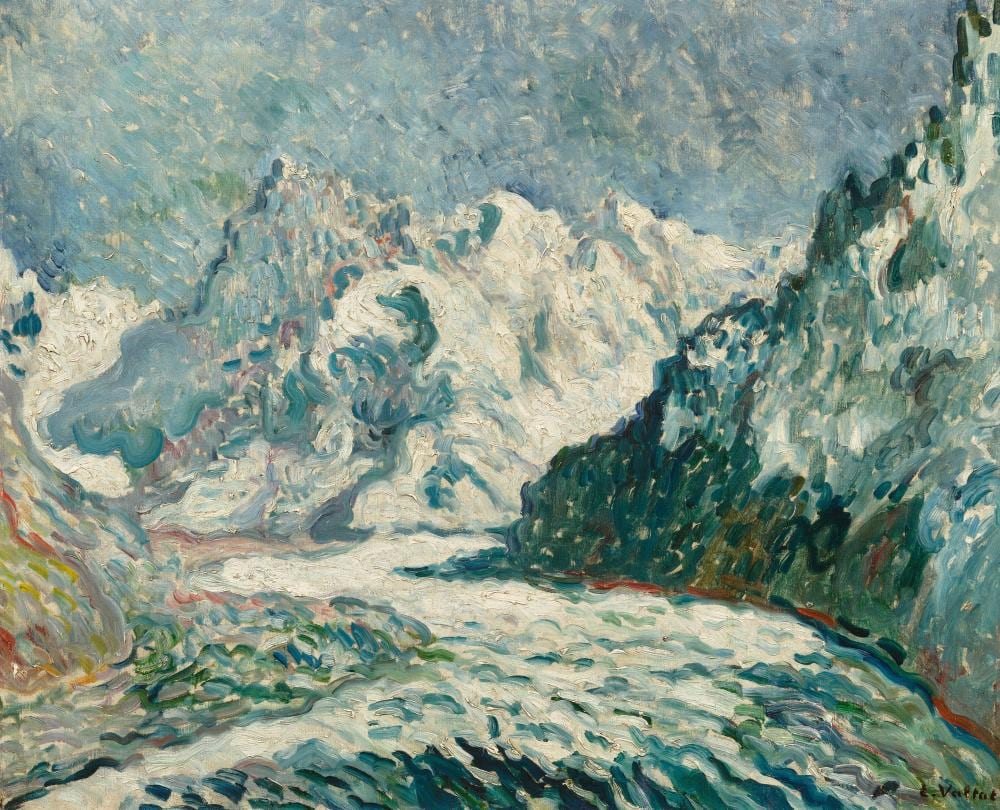
LOUIS VALTAT (Dieppe 1869–1952 Paris) La Mer de Glace à Chamonix-Mont-Blanc. 1903. Oil on canvas. Signed lower right: L. Valtat. 60 × 73 cm. Certificate: Jean Valtat, Paris, 30 January 1979. Provenance: - Private collection France. - Private collection Paris, acquired from the above on 30 June 2000. At the beginning of the 19th century, the region around Chamonix developed into one of the most important centres of early Alpine tourism. The previously difficult-to-access glacial landscape of the Mer de Glace gradually became accessible to travellers and artists through the increasing exploration of the Mont Blanc massif, the construction of pathways and the work of local mountain guides. From as early as the 1820s and 1830s, the glacier ranked among Europe’s most visited natural attractions and drew numerous painters who studied the spectacular interplay of ice, light and high-mountain scenery. For artists such as Louis Valtat, the Mer de Glace around 1900 therefore no longer represented untouched terrain, but rather an established, but still deeply impressive, setting for artistic engagement with Alpine nature. ------------------------------------------------- LOUIS VALTAT (Dieppe 1869–1952 Paris) La Mer de Glace à Chamonix-Mont-Blanc. 1903. Öl auf Leinwand. Unten rechts signiert: L. Valtat. 60 × 73 cm. Gutachten: Jean Valtat, Paris, 30.1.1979. Provenienz: - Privatbesitz Frankreich. - Privatbesitz Paris, am 30.6.2000 von Obigem erworben. Zu Beginn des 19. Jahrhunderts entwickelte sich die Region um Chamonix zu einem der bedeutendsten Zentren des frühen Alpentourismus. Die bis dahin schwer zugängliche Gletscherlandschaft des Mer de Glace wurde durch die zunehmende Erschliessung des Mont-Blanc-Massivs, den Ausbau von Wegen sowie die Tätigkeit lokaler Bergführer allmählich für Reisende und Künstler zugänglich. Bereits seit den 1820er- und 1830er-Jahren gehörte der Gletscher zu den meistbesuchten Natursehenswürdigkeiten Europas und zog eine Vielzahl von Malern an, die das spektakuläre Zusammenspiel von Eis, Licht und Hochgebirgslandschaft studierten. Für Künstler wie Louis Valtat bedeutete das Mer de Glace um 1900 somit kein unberührtes Terrain mehr, sondern ein etablierter, wenn auch weiterhin beeindruckender Schauplatz künstlerischer Auseinandersetzung mit der alpinen Natur.