Have one like this?
Upload a photo for a free check of what yours may be worth.
Lot description
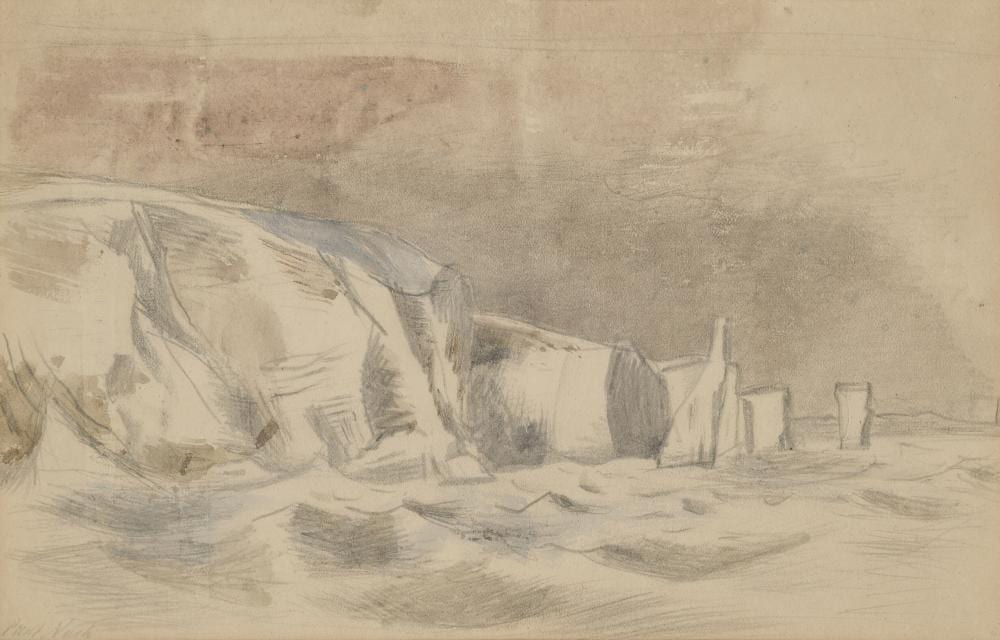
PAUL NASH (BRITISH 1889-1946) OLD HARRY ROCKS AND THE PINNACLES OFF BALLARD DOWN, SWANAGE, DORSET signed Paul Nash lower left pencil and watercolour 12.5 x 20cm; 5 x 8in 33.5 x 39cm; 13 1/4 x 15 1/4in (framed) Property from the Estate of Hans Feibusch, Hampstead Provenance (possibly) Sale, Christie's London, 29th November 1941 (purchased by Mr Roberts) The Leicester Galleries, (Ernest Brown & Phillips Ltd), London Phyllis Bray, London (Phyllis Bray, 1911-1991, had a successful career as a mural painter, assisting the German mural artist Hans Feibusch (1899-1998), a collaboration that lasted over forty years. Bray studied at the Slade,1927-1931, and was a member of the East London Group of artists in the 1930s, interested in Surrealism. She was also a book illustrator.) Hans Feibusch, London (a gift from the above) Thence by descent to the present owner Executed circa 1935. Nash had noted the Surrealist potential of Swanage within days of his first visit in 1934, describing the town as 'just a Surrealist dream'. He had moved to the coastal town to relieve his asthma. His flat in The Parade on Swanage sea front looked out across to the distinctive cliffs of Old Harry Rocks, with its two chalk stack 'Pinnacles' at the foot of Ballard Down to the east of Swanage Bay. Nash immediately saw the opportunity the view represented, and was quick to incorporate it into his work. In 1935 he was preparing for the International Surrealist Exhibition to be held in London the following year. In developing his ideas for the exhibition he revisited the theme of water flooding into a broken room in his watercolour Empty Room of 1935. Andrew Causey describes the appearance of the view from Nash's balcony in the composition: 'the furthest left-hand walls of the room are missing, leaving the room open to the sea; beyond are the Ballard Cliffs, with the Pinnacle Rock jutting out just short of the coast' (see Andrew Causey, Paul Nash, Oxford, 1980, p. 280 & no. 836, Empty Room illustrated). The dramatic prominence of the rocky coastline in Empty Room is markedly similar to that which appears in the present sketch suggesting this work may be a preparatory study for Nash's larger finished composition. The present work may also possibly have been a preparatory sketch for an illustration in Nash's popular Dorset Shell Guide, published in 1936 (see Causey, pp. 430-431, nos. 828, 831, 832 and 843). The cover of the guide features Nash's photograph of a close up of The Pinnacles (fig. 1).