Have one like this? Check yours freeOr have an appraiser value it
Lot description
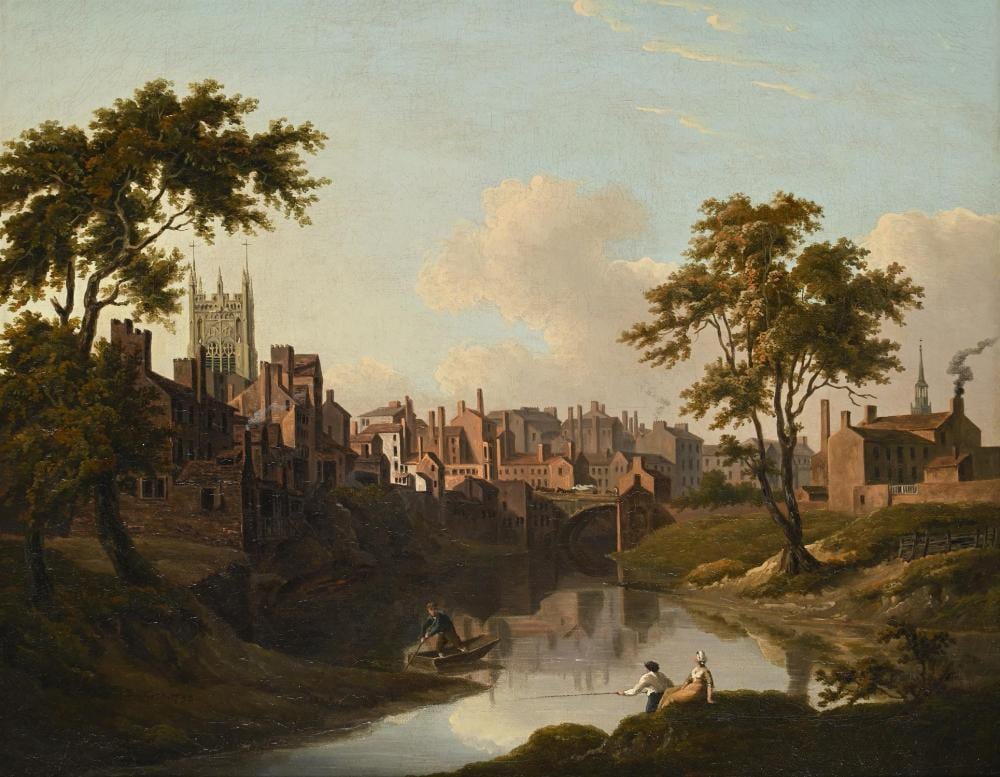
JOHN THOMAS SERRES (BRITISH 1759-1825)ON THE RIVER IRWELL, MANCHESTEROil on canvasSigned and dated '1798' (lower left)51 x 61cm (20 x 24in.)Painted in 1798, whilst Serres was living in Liverpool (1796-99).Generous and spendthrift to a fault, it is believed Serres may have left London to escape his growing debts and find new markets for his work. Liverpool was the busiest port outside the capital, growing rich from Transatlantic trade, and Manchester was rapidly becoming 'the world's first industrial city'. (1) As such, this is one of the earliest views depicting the industrialisation of Manchester, with the river Irwell near the junction with the river Irk, which today runs in culverts beneath the city. To the left is the fifteenth century church of St Mary, today Manchester's Cathedral. In the centre middle ground is Old Salford Bridge, built in the fourteenth century and in 1838 replaced by Victoria Bridge. To the right is the Salford bank of the Irwell, with a factory belching smoke.Serres frames the scene with a foreground of classical serenity and crystalline light which seems to belong to an age rapidly passing. Trees arch delicately into a blue sky. A man punts a boat on the still waters of the Irwell and another fishes while his sweetheart watches. The intricate tower of St Mary's on the left represents the comforting continuity of the past, while the factory chimney on the Salford bank points to the future, the Victorian era when Manchester would be known as Cottonopolis.Water-powered cotton-spinning machines, patented by Richard Arkwright in 1769, had transformed the production of textiles and led to the construction of huge mills, where antlike workers toiled under the factory system. Shipowners and mill owners constituted a new breed of art collector seeking both Old Master and contemporary works, including views of their hometowns. The tall chimneys and large, many-windowed buildings that crowd the horizon are testimony to the extraordinary transformation of Manchester in the last decades of the eighteenth century - mutating from a town of small-scale hand weavers and textile merchants to a powerhouse filled with the 'dark satanic mills' of the Industrial Revolution.In 1783, Richard Arkwright built the six-storey Arkwright's Mill on Shude Hill, in which semi-skilled workers tended machines spinning vast quantities of cotton. Peter Drinkwater's Piccadilly Mill opened in Auburn Street in 1789, powered by a steam-driven Boulton and Watt engine; by the early 1790s it was employing around 500 people. The population of Manchester tripled between 1770 and 1800, as handweaving declined and country dwellers flocked to the town to find work.John Thomas Serres (1759 - 1825) was the son of the marine painter Dominic Serres (1719-1793) who was also his teacher. A brilliant and meticulous draughtsman as well as a fine painter, John Thomas Serres painted naval actions, coastal and river scenes, all of which were considerably influenced by the landscape and theatrical painter Philippe de Loutherbourg (1740-1812).Serres was in France to witness the fall of the Bastille in July 1789 and travelled to Italy with letters of introduction from Sir Joshua Reynolds, a colleague of his father. By 1790, he was back in London, and the following year married his pupil Olivia Wilmot (1772-1835). Three years later, in 1793, he succeeded his father to become Marine Painter to George III and the Duke of Clarence (later King William IV). In 1800, he was appointed Marine Draughtsman to the Admiralty. In this capacity Serres was required to sail around the coast of Britain, western France, Spain and the Mediterranean, making drawings of coastlines to aid navigation and locate enemy installations. Some of these were published in The Little Sea Torch, or True Guide for Coasting Pilots (1801). Serres taught drawing at the Chelsea Naval School; he published a book entitled Liber Nauticus (1805-6), which was designed to help students draw ships. It contained plates of different types of vessels after his own works and those of his father.His wife, Olivia Serres, proved to be a compulsive fantasist who committed numerous infidelities and frauds while her husband was absent on Admiralty business, forging bank drafts so that Serres was declared bankrupt. The couple separated in 1802, but in 1804 Serres abducted one of his daughters and was put in prison. In 1806, against all the odds, Olivia was appointed Landscape Painter to the Prince of Wales. In 1817 Serres became one of the proprietors of the new Coburg Theatre and later its scenic director, which further ruined him financially. The same year Olivia began claiming to be the daughter of George III's brother the Duke of Cumberland, styling herself Princess Olive of Cumberland; her mania lost Serres the patronage of George IV. Serres was imprisoned for debt in 1825 but released in December on grounds of ill-health; he died within the Rules of the King's Bench on 28th December.The work of John Thomas Serres is represented in the Royal Collection; the National Maritime Museum, Greenwich; Waddesdon Manor; Eton College and the Victoria and Albert Museum, London.1) M. Nevell, 'The social archaeology of industrialisation: the example of Manchester during the 17th and 18th centuries', Archaeology North West, vol. 6, issue 16, 2001-3, p.27