Have one like this? Check yours freeOr have an appraiser value it
Lot description
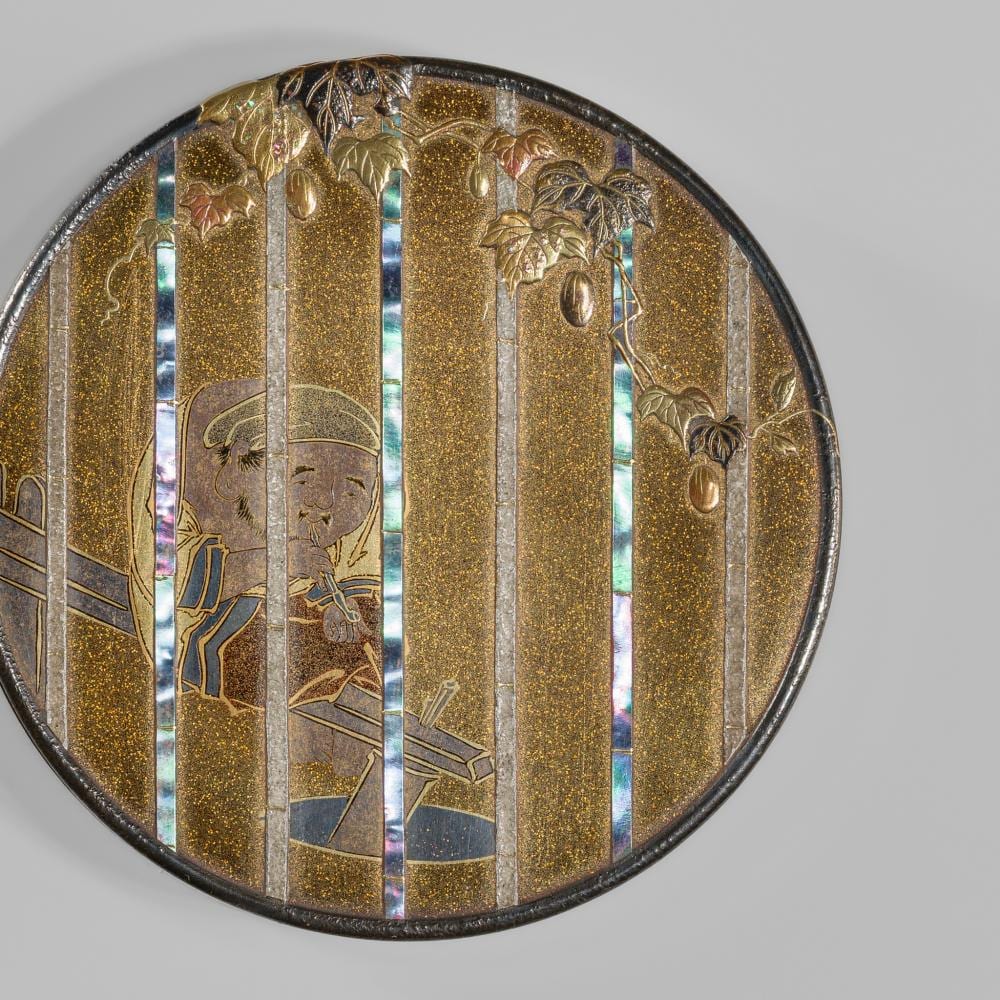
SHIBATA ZESHIN (1807-1891): A MASTERFUL INLAID LACQUER KOGO (INCENSE BOX) DEPICTING DAIKOKU TAKING A SMOKING BREAK By Shibata Zeshin (1807-1891), signed Zeshin Japan, c. 1880s Of circular form, masterfully decorated in delicate gold and silver takamaki-e, hiramaki-e, and sublime togidashi-e on a delicately sprinkled ground. The inrobuta (flush-fitting) lid is adorned with a charming scene set behind a pewter and aogai (mother-of-pearl) inlaid fence, depicting Daikoku seated on a rice pestle beneath trailing ivy vines issuing fruits, leisurely smoking a pipe. The sides and underside are finished in matte silver, while the interior is in nashiji with gold fundame rims. Signed ZESHIN on the underside. DIAMETER 7.5 cm Provenance: From the Collection of Dr. med. Josef Markwalder, Baden, Switzerland, and thence by descent. With a handwritten label ‘’Daikoku’ der Gott des Reichtums als alter Mann Pfeife rauchend. Signatur: ‘Zeshin’’. Josef Markwalder was a Swiss physician active as a spa doctor in Baden in the early 20th century. Though little is documented about his career, his name endures in scholarship on Hermann Hesse (1877–1962), the Nobel Prize–winning German-Swiss author of Siddhartha and Der Steppenwolf, where Markwalder is noted as a trusted medical figure during the writer’s difficult years of illness and recovery. Condition: Excellent condition. Shibata Zeshin (1807-1891) was a Japanese painter, lacquer artist, and printmaker of the late Edo period to early Meiji era. Nominated as one of the first Teishitsu Gigeiin (Imperial Court Artist) in Meiji 23 (1890), Shibata Zeshin excelled in several art forms, including painting, lacquer-making, print design, and calligraphy. He had an outstanding studio with talented students specializing in lacquer, paintings and prints. He has been called ‘Japan's greatest lacquerer.’ His work, unlike the oils being used by so many of his contemporaries, never needed re-touching and never faded. He was a master of emulating oil or ink painting with lacquer and combined groundbreaking techniques with traditional subjects. His studio was situated on the bank of a river, providing him with ample opportunity to observe nature, and the creatures that inhabit the natural world. Like many painters of the 19th century, he was eclectic in his sources and would have been exposed to traditional styles. However, Zeshin's skill level was such that he could fluidly mix techniques, ideas, and stylistic options, thus painting part of a composition in one manner and including elements of another to add variety and dynamics unheard of at the time. Museum comparison: Compare a closely related inro with a near-identical design, by Shibata Zeshin, in the Victoria & Albert Museum, London, accession no. W.298:1, 2-1922. Auction comparison: Compare a related gold lacquer inro showing Daikoku and ebisu, the verso with an oni and similarly inlaid fence, by Shibata Zeshin, dated to ca. 1886, at Bonhams, Patient Detail, Perfect Design, 3 November 2022, London, lot 63 (sold for GBP 38,100 or approx. EUR 50,000 converted and adjusted for inflation at the time of writing).