Have one like this?
Upload a photo for a free check of what yours may be worth.
Lot description
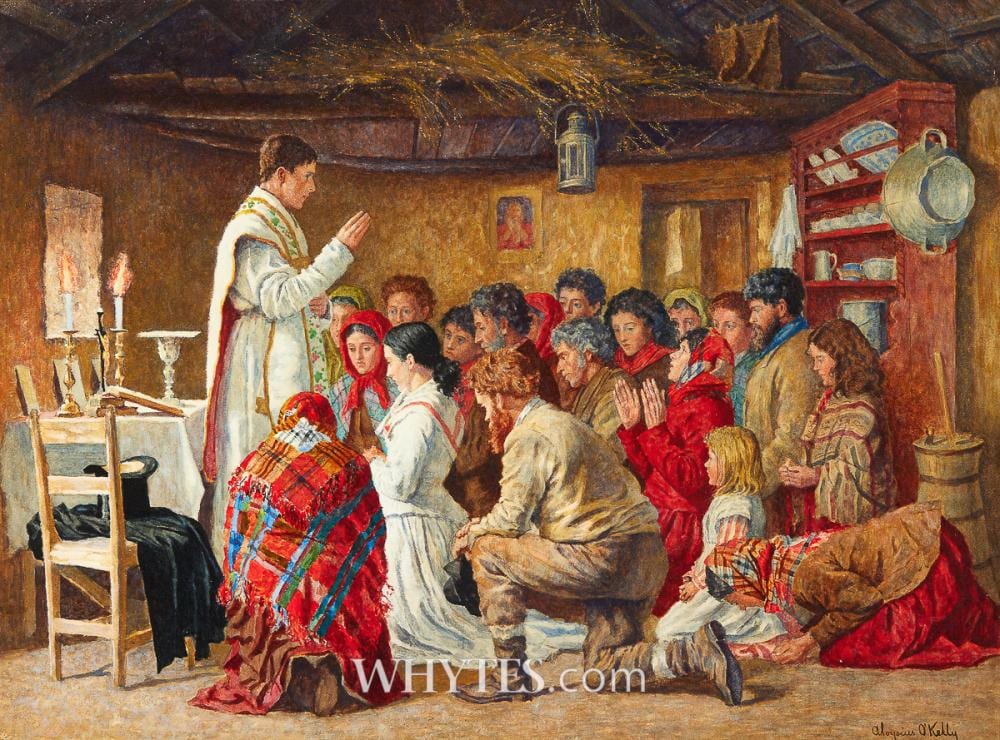
Aloysius C. O'Kelly (1853-1936) MASS IN A CONNEMARA CABIN c.1883 watercolour signed lower right h:16.50 w:22.50 in. Provenance: A New York Rectory by bequest to the previous owner; Gorry Gallery, Dublin, 2005; Private collection Exhibited: 'An Exhibition of 18th, 19th and 20th Century Irish Paintings', Gorry Gallery, Dublin, 2-12 March 2005, catalogue no. 32; 'Rural Ireland: The Inside Story', McMullen Museum of Art, Boston College, 11 February to 3 June 2012 Literature: Niamh O'Sullivan, Re-orientations. Aloysius O'Kelly: Painting Politics and Popular Culture, Dublin, Hugh Lane Municipal Gallery of Modern Art, 1999; 'The Priest and the People: Mass in a Connemara Cabin' in From the Edge: Art and Design in Twentieth Century Ireland', CIRCA Special, Summer 2000; Mass in a Connemara Cabin, Gorry Gallery, Dublin, 2005; 'Mass in a Connemara Cabin: Religion and the Politics of Painting', Eire-Ireland, Vol. 40: 1&2, Earrach/Samhradh/ Spring/Summer 2005; Aloysius O'Kelly: Art, Nation, Empire, Dublin, Field Day Publications, University of Notre Dame, 2010 The discovery of this remarkable watercolour on paper, a version of Aloysius O'Kelly's chef d'oeuvre, Mass in a Connemara Cabin (1883), is of considerable artistic and historical importance. Quite apart from their exceptional quality, the execution of these images, at a moment when radical Fenianism and land agitation sought a rapprochement with the Catholic Church, makes them very interesting images indeed. Born into a pronounced nationalist family in Dublin in 1853, O'Kelly's extended family was steeped in both the art world and the world of militant republicanism. His older brothers, James, Charles and Stephen, were all Fenians, as well as artists, and his sister, Julia, married Fenian, Charles Hopper, brother-in-law of James Stephens, the founder of the Irish Republican Brotherhood. Aloysius's relationship with his radical brother, James, illuminate his own attitudes to politics, painting and religion. While it could be folly to ascribe the beliefs of one brother to another, in many respects these brothers acted in tandem. James had set out to become a sculptor, was a self-professed atheist, was elected a member of parliament for Roscommon in 1880 (despite his underground Fenian and gun-running activities), and was Parnell's most loyal supporter, even when he fell from power. Not to be outdone, Aloysius sought the nomination for election in the adjoining constituency of South Roscommon in 1897. Their close relationship extends to a bigamous marriage, which James sought to conceal by blurring the identities of the two brothers. The underworld of republican politics - secret addresses, disappearances, invisible ink, false passports, dual identities, false names, destroyed letters - were all part of a pattern of pathological secrecy, part of Aloysius' mercurial life. O'Kelly returned to Ireland from France in the early 1880s, to the highly coveted position of Special Artist to the Illustrated London News. His illustrations of the Land League gave vivid expression to the harsh realities of life in the west as it hurtled towards a massive social crisis. He systematically charted the formation of the National Land League, which harnessed growing agrarian unrest, as tenant farmers resisted evictions, refused to pay rent, and clamoured for legislative changes concerning ownership and occupation of the land. It was at this time that he painted Mass in a Connemara Cabin. What is the nature of the ceremony performed in this Connemara cabin? Known as the Stations, the celebration of the sacraments in a rural and/or domestic setting was developed in times of repression when secrecy was necessary, until the mid-nineteenth century when the continuation of the practice was challenged by the Church itself. Moreover, conducting sacraments in cabins generated considerably more income for priests than those performed in chapels. Not surprisingly, being their chief form of support, the clergy were wont to confine the Stations to those who were relatively well-off, as the host was also expected to offer the welcome of the house to attendees. But whether people travelled from far-flung farms to attend religious services, either in neighbours' houses, or the nearest chapel, the Church provided the locus for forging social bonds which were, in turn, the foundation of political ones. The social aspects of the Stations facilitated the seamless transition from socialising to politicising. In the knowledge that such religious practices lingered beyond the tolerance of their religious leaders, the version of worship portrayed here hints at a subversive emphasis on community solidarity and priest-people relations. The position of the church on Fenianism elicited virulent reactions both within its own clerical ranks and among its flock. As an oath-bound secret society, the Irish Republican Brotherhood, was condemned by the Catholic Church. Those priests that did support the Land League did so for the very reason that others did not - fear that the radicalism of the movement would develop ideologically independent of the church and organisationally independent of the clergy. Wary of involvement, and fearing exclusion, the church played hot and cold in relation to the issue of land agitation, although in the West, apprehension about loss of influence resulted in a clergy increasingly more politically engaged than not. But what really alarmed the clergy was Fenian control of the hearts and minds of the peasants of Ireland, the consequences of which, the clergy was in no doubt, was a godless, socialist Ireland. In the interests of maintaining their influence, it was vital to remain connected to the people, and provided they gained the upper organisational hand, many became enthusiastic Land League supporters. When O'Kelly first exhibited Mass in a Connemara Cabin in the Paris Salon, he used both the secret address of his Fenian-MP brother, James, and the known address of the infamous Communard, Henri Rochefort, in Paris - not only a coup de théâtre informative of his connections but revealing of his own dangerous whereabouts at the time. Drawn to the news of the phenomenal victories of the Mahdi, Aloysius and James were in the Sudan with an entourage of French socialists in an effort to connect Irish militancy, French socialism and Sudanese nationalism. Here, as in Connemara, O'Kelly replicated his stance of witness (by virtue of assuming the perspective of the colonised culture) unlike most war artists who acted, in effect, as public relations personnel for British colonial activities overseas. The oil, Mass in a Connemara Cabin was the only painting of an Irish subject ever shown in the Paris Salon (the most prestigious venue of its epoch) when it was exhibited there in 1884. It was also shown in London in 1888, at the Irish Exhibition at Olympia. Although, as the catalogue asserts, the exhibition was devised to 'moderate prejudices... at the very root of misunderstanding between people and people', the exhibition was, in some quarters, more successful in fanning the flames of dissension than dampening them. And, when it was later exhibited in the Royal Hibernian Academy (RHA) in 1889, its exhibition coincided precisely with James J. O'Kelly's examination by the Special Parliamentary Commission, set up to investigate the association of Parnellism with Crime alleged by The Times in 1887. In 1899, the almost identical watercolour version was exhibited in New York where it was highly acclaimed. The painting was also reproduced in line form in Henry Blackburn's Academy Notes (1883), where it was captioned Life in Ireland: Celebrating Mass in a Cabin, as well as being selected by T.P. O'Connor to illustrate his book, Gladstone - Parnell - further evidence of its contemporary impact. (1) In her RHA review of 1889, the novelist, Rosa Mulholland bemoaned the fact that 'the works of art produced in Ireland of which we can be very proud are few', but praised its 'warmth and colour', and noted that 'the kneeling figures are faithfully taken from life'. A certain hardness and clean-sweptness, and a severe determination not to idealise or even notice the grace that often lurks about the rugged truth, forbid us to love the picture … but it gives evidence of power, and the artist, Mr. Aloysius O'Kelly, ought yet to do excellent service to his country after time has somewhat mellowed his method and softened his dealings with the positive fact.' (2) Paradoxically, the negative comments - concerned as they are with realism and ruggedness - were the most stylistically innovative aspect of O'Kelly's work in the 1880s. The discovery of this watercolour gives us the opportunity to appreciate the quality of his execution. Described by the Freeman's Journal (2 June 1888) as being amongst 'the most important of modern artists', O'Kelly's Mass in a Connemara Cabin was described as 'exceptional'. The Irish Daily Express (25 February 1889) considered it 'admirable', noting that the figures were 'finely grouped and carefully drawn', but doubted that the painting was set in a cabin 'in the Connemara we read about, for it is cleaner than a Dutch burgomaster's house and almost as comfortable.' Indeed, the costumes are not only well-observed but denotative of relative prosperity, and the cottage is clearly capacious enough to hold at least twenty people. But this does not give lie to O'Kelly's rendition as we can read the cleanliness as a moral allegory for decency, dignity and industriousness. Commonly described as blighted, stunted, and brutal, 'their huts', Punch insisted 'were monuments to national idleness', while according to Blackwood's Magazine, squalidness, filth and raggedness were 'national tastes'. (3) It is typical of O'Kelly to make corrective adjustments to prevailing characterisations that portrayed the Irish so negatively. Dr Niamh O'Sullivan Professor Emerita of Visual Culture (National College of Art and Design Ireland) Founding Curator of Ireland’s Great Hunger Museum, Quinnipiac University April 2026 Footnotes: 1. Henry Blackburn, Academy Notes, London, Chatto & Windus, 1883; T.P. O'Connor, Gladstone - Parnell and the Great Irish Struggle, Philadelphia, Hubbard,1886. 2 Rosa Mulholland, 'Irish Painters in this Present Year', The Irish Monthly, September 1889. 3. Punch, X1V, 1849; Blackwood's Magazine, L1X, 1846.