Have one like this? Check yours freeOr have an appraiser value it
Lot description
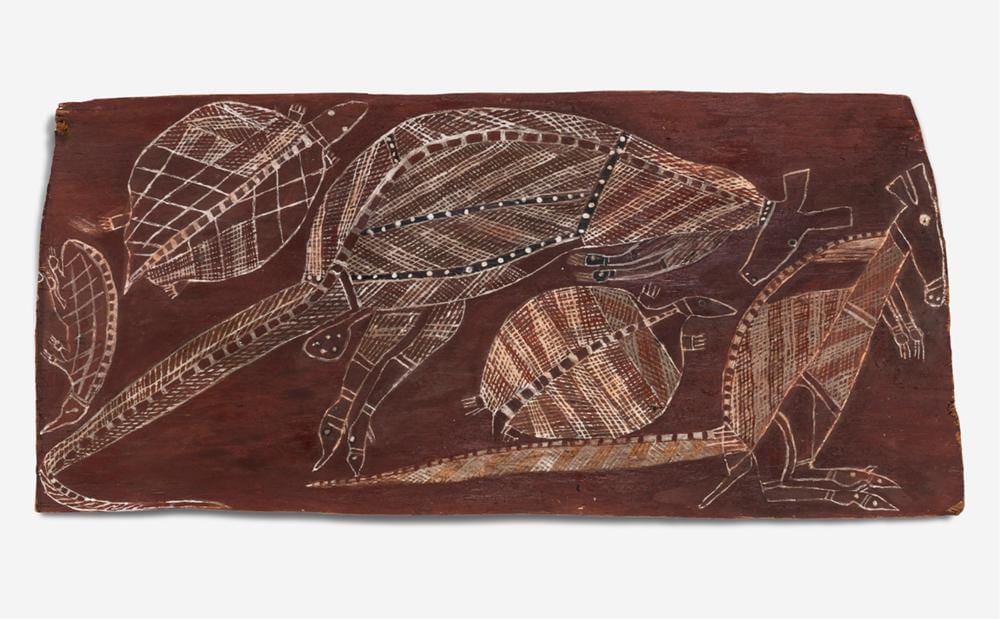
YIRAWALA c.1897 - 1976 Untitled, c.1968 ochre on bark 38 x 82 cm inscribed verso: $250, 3, Yirawala Maraia No PROVENANCE Likely painted on Minjilang (Croker Island), Western Arnhem Land, Northern Territory David Scott Collection, United States of America Thence by descent Private Collection, Victoria Yirawala was born around 1894 at Marugulidban in Arnhem Land, a ceremony leader, law carrier and healer of the Gunwinggu people. He inherited from his father the sacred designs, songs and stories that grounded his practice, and spent a lifetime moving through the ritual life of his country. By the early 1970s his bark paintings had earned him an MBE, the International Art Co-operation Award for best artist in Australia in 1971, and the attention of museums and collectors around the world. The recognition was remarkable. By the early 1970s he had become 'as famous for his bark art, as Albert Namatjira was for his landscapes.'* Pablo Picasso, having seen his works, is reported to have said: 'That is what I have been trying to achieve all my life.'** What struck those who encountered his paintings was their sheer verve, and quality of aesthetic innovation that continues to be acknowledged by contemporary Kuninjku artists and academics alike. Yirawala showed little interest in the art world on its own terms. His innovations came not from artistic ambition but from his role as a ceremonial leader, and the expressive force that others read as modernist energy was inseparable from its ritual origins. His paintings were ceremony, law and country. He resented seeing the cycle of his ceremonial narratives broken up by the mission for sale, and spent years trying to find a way to keep the work whole and properly understood. He wanted, he said, to make balanda understand. Only then did he believe his people would be saved and gain land rights.*** This bark painting is characteristic of his early work, likely painted on Minjilang (Croker Island) in western Arnhem Land around 1968, a period when bark painting was being shared more widely while remaining grounded in long-held cultural practice. Working with natural ochres on stringybark, Yirawala builds the surface through rarrk (cross-hatching), creating a structured field that holds the composition together. Within this framework, figurative and symbolic elements are placed with care, allowing the painting to be read as both image and account of Country. *McLean, Ian W., ed. How Aborigines Invented the Idea of Contemporary Art: Writings on Aboriginal Contemporary Art. Sydney: Power Publications and Institute of Modern Art, 2011, 29 **Holmes, Sandra Le Brun. Yirawala: Painter of the Dreaming. Sydney: Hale and Iremonger, 1992, 1 ***McLean, Ian W., ed. How Aborigines Invented the Idea of Contemporary Art: Writings on Aboriginal Contemporary Art. Sydney: Power Publications and Institute of Modern Art, 2011, 29