Have one like this? Check yours freeOr have an appraiser value it
Lot description
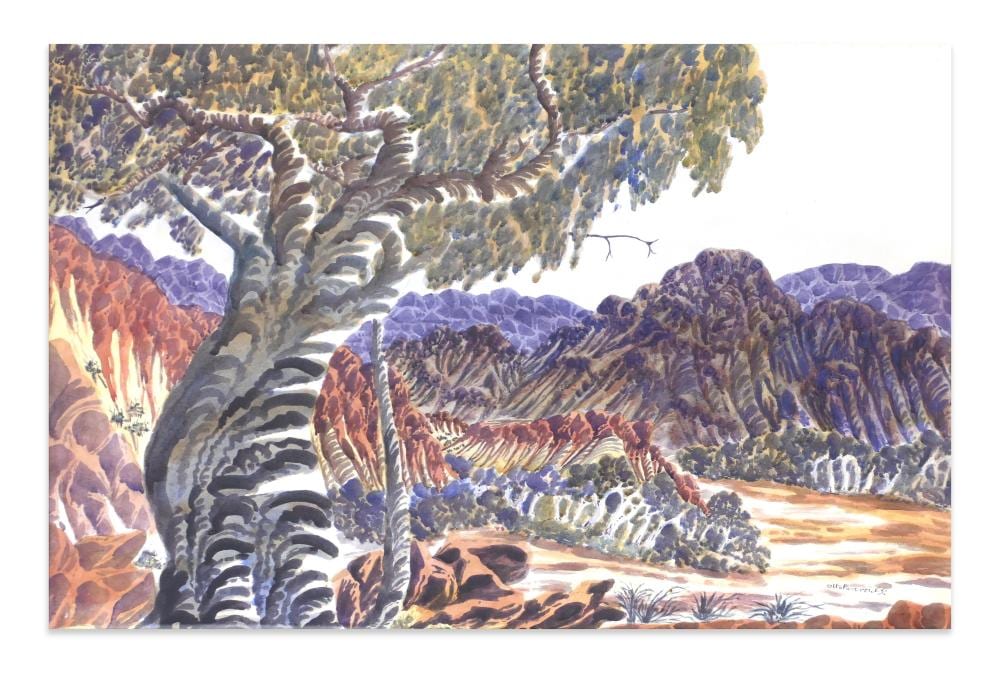
OTTO PAREROULTJA 1914 - 1973 Landscape, c.1960 watercolour on paper 53 x 72 cm; 73 x 92 cm (framed) signed front bottom right ‘Otto Pareroultja'; labels adhered verso: PX6094, Utopia Art Sydney, and Art Gallery of NSW, Sydney exhibition PROVENANCE Utopia Art Sydney, New South Wales Private Collection, New South Wales EXHIBITED One Sun One Moon: Aboriginal Art in Australia, 3 July - 2 December 2007, Art Gallery of New South Wales, Sydney, NSW Otto Pareroultja was just 12 years younger than Albert Namatjira and the oldest of three brothers that Rex Battarbee referred to as the ‘breakaway group' amongst the generation that followed. When he first began painting in 1947, there were those who inferred that his works resonated with those of European modernists such as Vincent van Gogh and Paul Gauguin, in that his landscapes were distinguished by brilliant colour, dense patterning and ‘rhythmic pulsation' . Though Pareroultja never departed from the use of watercolour over the course of his artistic career, his style and subject matter became markedly less westernised, and, with this gradual transition, much stronger. The sense of movement inherent in his paintings is reminiscent of Dreaming narratives. Ted Strehlow and Rex Battarbee both pointed out the connections between the swirling parallel lines and concentric circles of Otto's paintings and the designs found on the sacred ‘tjuringa' stones associated with men's ceremonial life. It is this ‘traditional resonance' in his painting that distinguishes Pareroultja from other artists of the Hermannsburg School. Pareroultja's desert landscapes exhibit a distinct originality. The best of these were painted late in a career that spanned twenty years, ending in 1967 even though he lived until the early 1990s. His paintings predominantly depict sacred sites - although at the time of Pareroultja's painting they may not have been recognised as such outside of their community context. Pareroultja was not overly concerned with correct perspective in his landscape. His forte was not artistic realism. While we have no indication that he aimed for this, the merit of a painting by Otto Pareroultja lies in the visual articulation of certain Indigenous elements, rendered through European technique. © OTTO PAREROULTJA / Copyright Agency, 2026