Have one like this? Check yours freeOr have an appraiser value it
Lot description
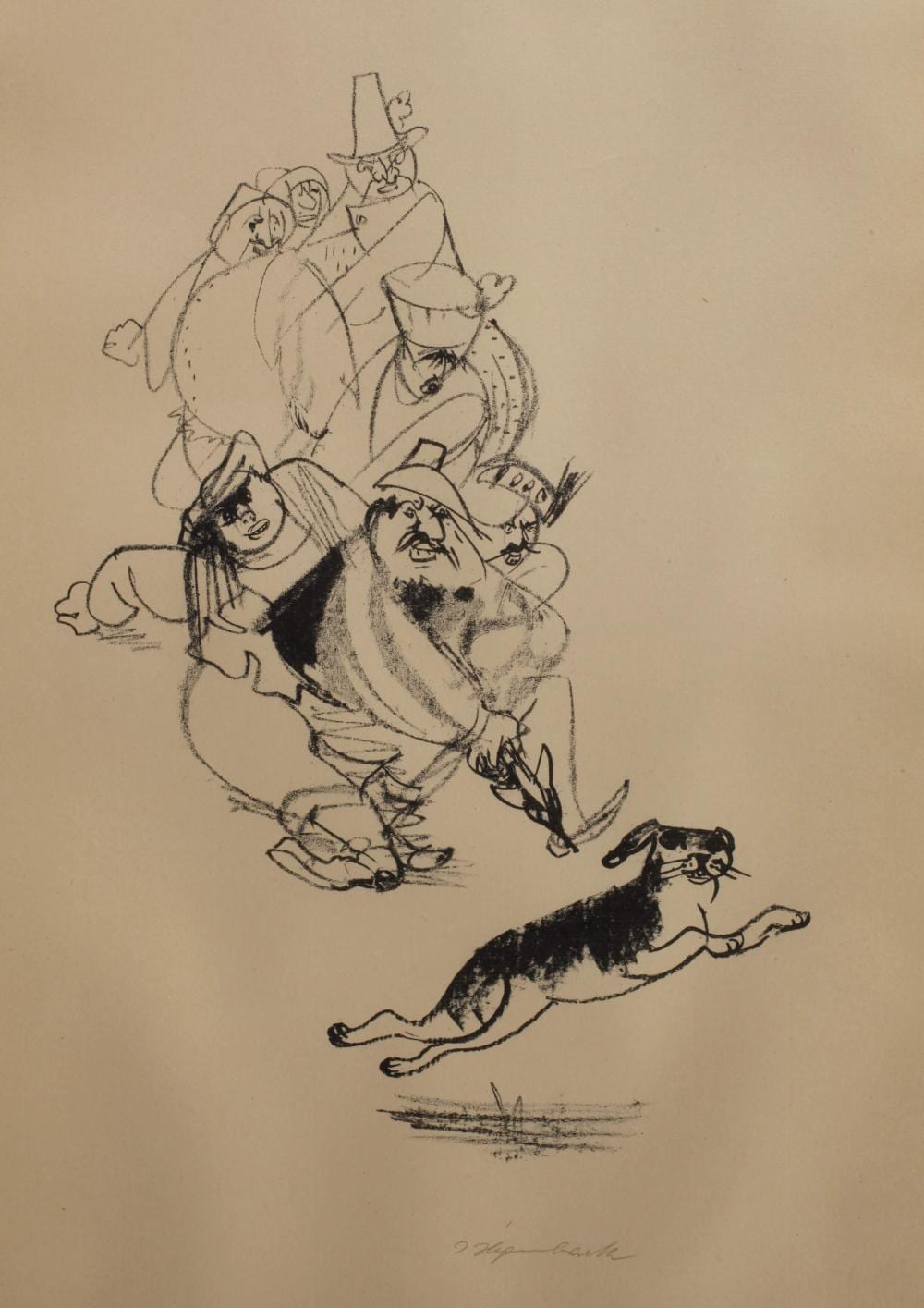
Josef Hegenbarth, "Die sieben Schwaben" sieben mit einer Lanze bewaffnete Männer, einen Hasen verfolgend, Kreidelithographie, Mitte 20. Jh., unter der Darstellung in Blei signiert "Josef Hegenbarth", geringe Erhaltungsmängel, hinter Glas gerahmt, Darstellungsmaße ca. 30 x 20 cm, Blattmaße ca. 46,5 x 30,5 cm. Künstlerinfo: eigentlich Joseph Franz Hegenbarth, dt. Maler, Graphiker und Illustrator (1884 Böhmisch Kamnitz bis 1962 Dresden), erste Förderung durch Emanuel Hegenbarth, studierte 1908–15 an der Akademie Dresden bei Carl Bantzer und Oskar Zwintscher, bis 1915 Meisterschüler bei Gotthardt Kuehl, 1916–17 Aufenthalt in Prag, später bei Halm und Goldmann in Wien, ab 1925 Mitarbeiter der Münchner "Jugend" und des "Simplizissimus", Mitglied der Dresdner Künstlervereinigung (Sezession), 1926 Mitglied der Wiener Secession und 1929 der Prager Secession, Mitglied im Deutschen Künstlerbund Weimar, 1933 als „entartet“ diffamiert, ab 1947 Professor an der Dresdner Akademie, erhielt zahlreiche Ehrungen, unter anderem den Nationalpreis, tätig in Dresden-Loschwitz, zeitweise Atelier im Künstlerhaus, Quelle: Thieme-Becker, Vollmer, Dressler, Eisold „Künstler in der DDR“ und Internet. Josef Hegenbarth, "Die sieben Schwaben" seven men armed with a lance, chasing a hare, chalk lithograph, mid 20th century, signed "Josef Hegenbarth" in pencil below the image, minor conservation defects, framed behind glass, image dimensions approx. 30 x 20 cm, sheet dimensions approx. 46.5 x 30.5 cm. Artist information: actually Joseph Franz Hegenbarth, German painter, graphic artist and illustrator. German painter, graphic artist and illustrator (1884 Böhmisch Kamnitz - 1962 Dresden), first supported by Emanuel Hegenbarth, studied 1908-15 at the Dresden Academy under Carl Bantzer and Oskar Zwintscher, until 1915 master student of Gotthardt Kuehl, 1916-17 stay in Prague, later with Halm and Goldmann in Vienna, from 1925 employee of the Munich "Jugend" and the "Simplizissimus", Member of the Dresden Artists' Association (Secession), member of the Vienna Secession in 1926 and the Prague Secession in 1929, member of the Deutscher Künstlerbund Weimar, defamed as "degenerate" in 1933, professor at the Dresden Academy from 1947, received numerous honours, including the National Prize, worked in Dresden-Loschwitz, at times had a studio in the Künstlerhaus, source: Thieme-Becker, Vollmer, Dressler, Eisold "Artists in the GDR" and Internet.