Have one like this? Check yours freeOr have an appraiser value it
Lot description
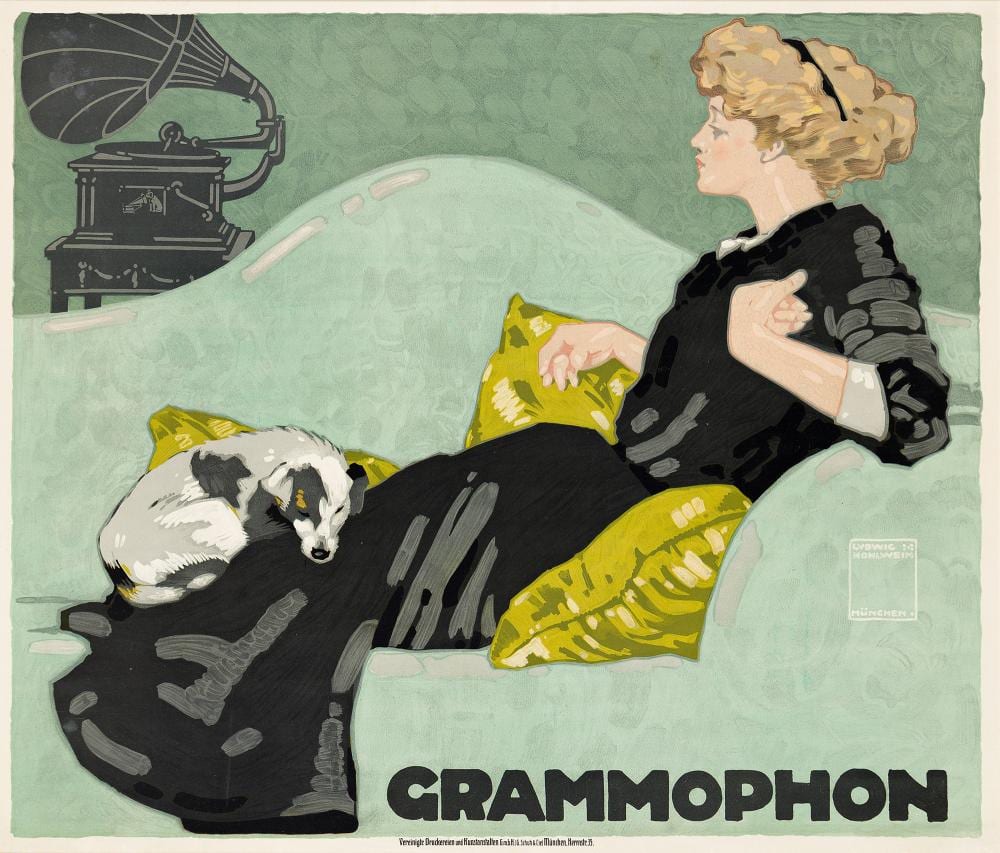
Ludwig Hohlwein 1874-1949 Grammophon. 1910. Condition B+: repaired tears and creases in margins; replaced punch holes at top margin, possibly for hanging. Matted and framed. The relaxed pose of this woman on a couch evokes a popular graphic meme that appears in earlier artwork and several earlier posters; most prominently it derives from Ramon Casas' 1899 painting Decadent Young Woman, which, in the same color scheme, depicts a young woman reclining with her magazine. Casas used this imagery again in a poster that same year for Pel & Ploma (1899). This tableaux of women languidly reading or resting with their literature was so popular it also appeared in a poster by Kolomon Moser, Lesen Sie (1900) and Thomas Heine's Weite Welte (1901). With direct visual cues to these earlier words, Hohlwein's poster replaces the book with a much newer technology, a Gramophone, diverting the woman's attention to her music player. In the 1890s, Emile Berliner initiated the transition from Edison's phonograph cylinders to flat discs, coining the term "gramophone" for disc record players. Upon close inspection of the player, one can see the small carving of Nipper the Dog - the logo of "His Master's Voice" Gramophone Company beginning in 1909. Undoubtedly, the sleeping terrier in the poster represents the mascot's real-life counterpart. During this era, the transition of musical entertainment to something that could be enjoyed at home was inextricably tied to women's realm in the household, giving them an education that wasn't accessible to most before. In turn, they also became the primary target of advertising, since they were now the designated buyers of this product as well. Rare. We have only been able to locate 4 other copies at auction in the last 20 years. DFP-III 1376, Hohlwein 1376, Hohlwein / Stuttgart 37.