Have one like this?
Upload a photo for a free check of what yours may be worth.
Lot description
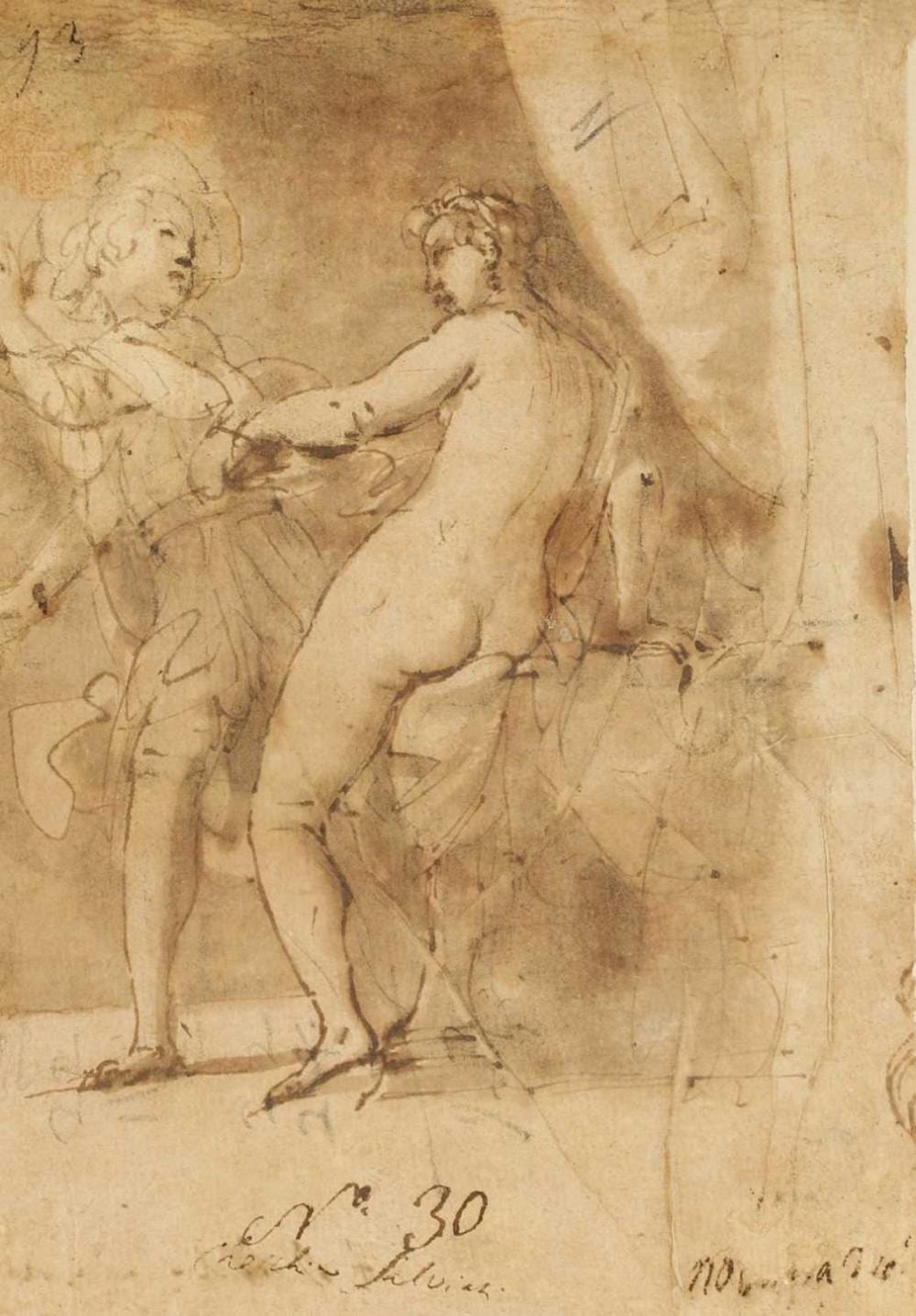
Giovanni Baglione (Italian, 1566-1643) Joseph and Potiphar’s Wife pen and brown ink and wash, inscribed by the so-called ‘double-numbering collector’, '93' u.l., 'No 30/Cechino Salviati' l.c., and 'Novanta tré' l.r., also inscribed 'AJ'(?) verso (18.5 x 13.5cm; unframed) Provenance: Double-numbering collector (fl. Rome, circa 1680-1720; his number: '93; Novanta tré'; presumably Alcide Donnadieu (circa 1791-1861), London (L. 97 [? missing part of the paraph] on verso of the old backing); with Thomas Agnew & Sons Ltd., London. Footnote: Literature: Maryvelma Smith O’Neil, ‘Giovanni Baglione: Seventeenth-century Artist, Draughtsman and Artist’, 2 vols., PhD, Oxford University, 1992, i, p. 283, no. 80, ii, fig. 254; Maryvelma Smith O’Neil, 'Giovanni Baglione: Artistic Reputation in Baroque Rome', Cambridge, 2002, pp. 139 (pl. 85) and 267 (no. 94). As Smith O’Neil first pointed out, this is a study, with numerous differences, for Baglione’s painting in the Alte Pinakothek, Munich (inv. no. 3637; Smith O’Neil 2002, no. 68), which is datable to circa 1622. She commented on the drawing as follows: 'The position of the figures is a reversal of the arrangement in the painting, but the soft, luminous handling of the female form is analogous and the fleeing Joseph, with a long streak of shadow beneath him, is reflected in the Munich drawing [Staatliche Graphische Sammlung, inv. no. 2614; only for the figure of Joseph: her no. 95]. This idea was abandoned because the pose of Potiphar’s wife was too passive'. Other studies for the painting are in the Museo Nazionale di Capodimonte, Naples (inv. no. 1046 recto; Smith O’Neil, no. 92), and the Uffizi, Florence (inv. no. 4328 S; Smith O’Neil, no. 93). Despite its rapid execution, the drawing suggests successfully the figures’ setting and their ambient lighting. The emphasis on strong chiaroscuro and Joseph’s everyday dress as a young 'bravo' reflect the influence of Baglione’s great rival Caravaggio (1571-1610). Condition Report: Executed on laid paper. There are numerous creases which are a result of the work having been stuck down to another sheet of paper. Discolouration and staining, please refer to illustration. Edges have been trimmed unevenly.