Have one like this? Check yours freeOr have an appraiser value it
Lot description
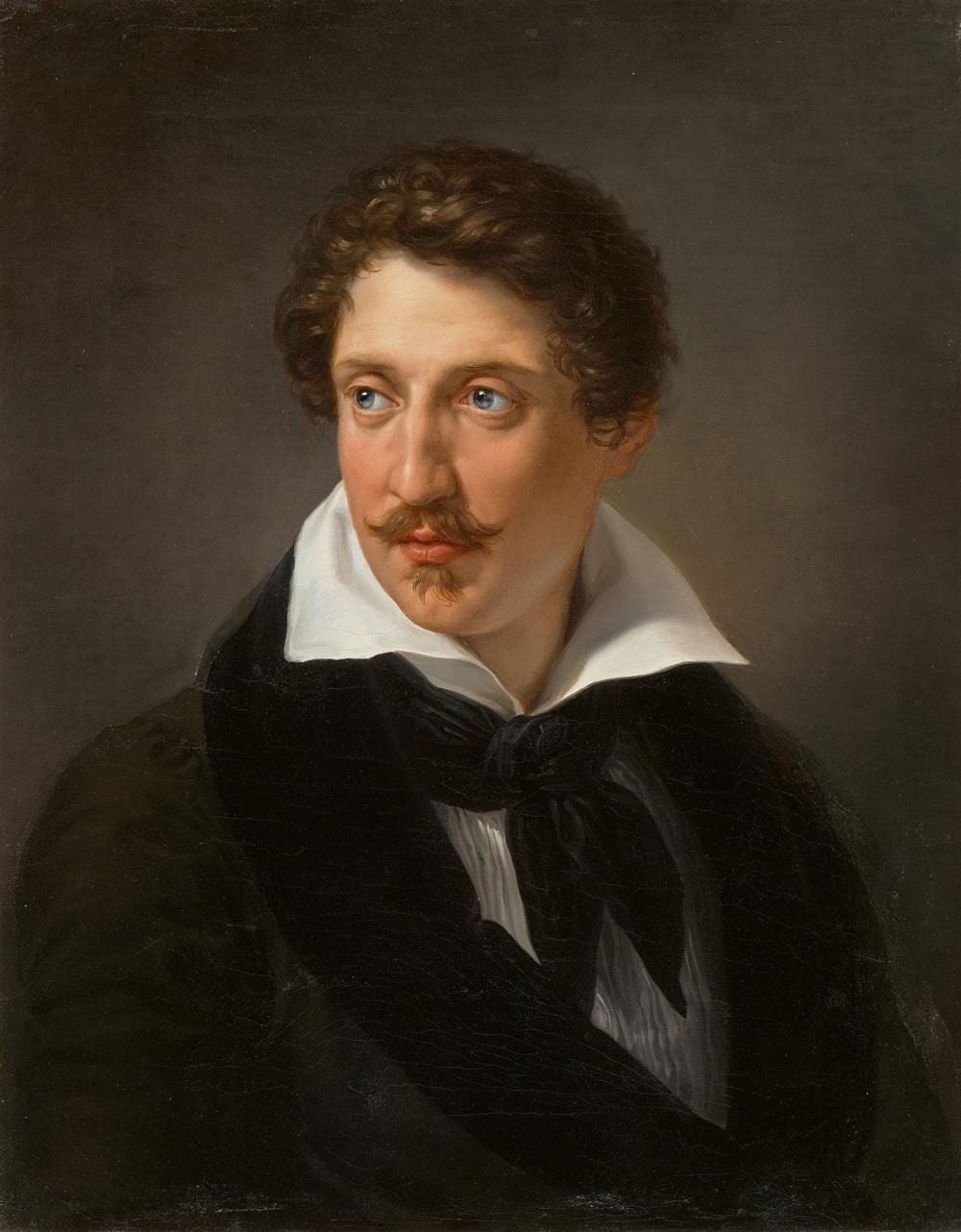
In his "Promenades dans Rome", Stendhal (fig. 2) recounts with his irresistible enthusiasm one of those social gatherings for the sake of which he so loved his stays in Italy. For 29 August 1827 he records a soirée in the salon of the "duchesse de D***" (most likely the widowed Duchess of Devonshire, who lived in Rome). On the piano lies a painting that the duchess intends to acquire: a portrait of Cesare Borgia by the hand of Giorgione (fig. 1). The company converses about the arts in general and about the portrait in particular, when a man rises and delivers an impromptu lecture on the painting — a lecture that impresses Stendhal: "Un homme remarquable par le feu de son esprit." This man of esprit is Conte Francesco Borgia, a descendant of the Renaissance prince portrayed by Giorgione, from the Velletri branch of the Spanish family. Stendhal writes of him: "Count Borgia, from Milan, who fought in the wars of the Napoleonic era with a courage worthy of his ancestors, now protects the arts in times of peace (M. le comte Borgia, de Milan, après avoir fait la guerre du temps de Napoléon avec une bravoure digne des aïeux, protège les arts pendant la paix…; Stendhal, Voyages en Italie, Paris 1973, p. 634)." The portrait by Giorgione is a painting today attributed to Altobello Melone, now held in the Accademia Carrara in Bergamo. As Stendhal also reports, Francesco Borgia had a copy made of it by Pelagio Palagi. The count commissioned his own portrait from Francesco Hayez, whom Stendhal called the premier peintre vivant. Hayez was indeed one of the most important Italian painters of the Romantic era; his monumental history paintings, inspired by classical art, as well as his portraits established his fame already during his lifetime. In the present likeness, Francesco Borgia is depicted in a bust-length portrait; the count gazes at the viewer with his piercing blue eyes. The brushwork alternates between the fine glazes of the flesh tones and the more vigorous impasto with which the hair and clothing are rendered. With this virtuosity, Francesco Hayez brings the homme remarquable to life in the portrait. According to a handwritten note by his daughter Alcmena on the reverse of the painting, this portrait was a gift from Francesco Borgia to his wife Luigia Borgia Ferrari on the occasion of the birth of their child on 30 September 1825. This detail allows for an exact dating and refines the dating proposed by Fernando Mazzocca, who had placed it around 1828 and described it as follows: "A fine, pared-down portrait that recalls the contemporary works of Palagi; it must have been painted towards the end of the third decade [of the nineteenth century]" ("bel ritratto essenziale che richiama quelli contemporanei del Palagi, dovrebbe collocarsi verso la fine del terzo decennio"; Mazzocca, op. cit., p. 198, no. 124). Fig. 1: Altobello Melone, Portrait of Cesare Borgia, Fig. 2: Olaf Johan Södermark, Portrait of Stendhal, Versailles, Châteaux de Versailles et de Trianon © bpk / GrandPalaisRmn / Gérard Le Gall.